

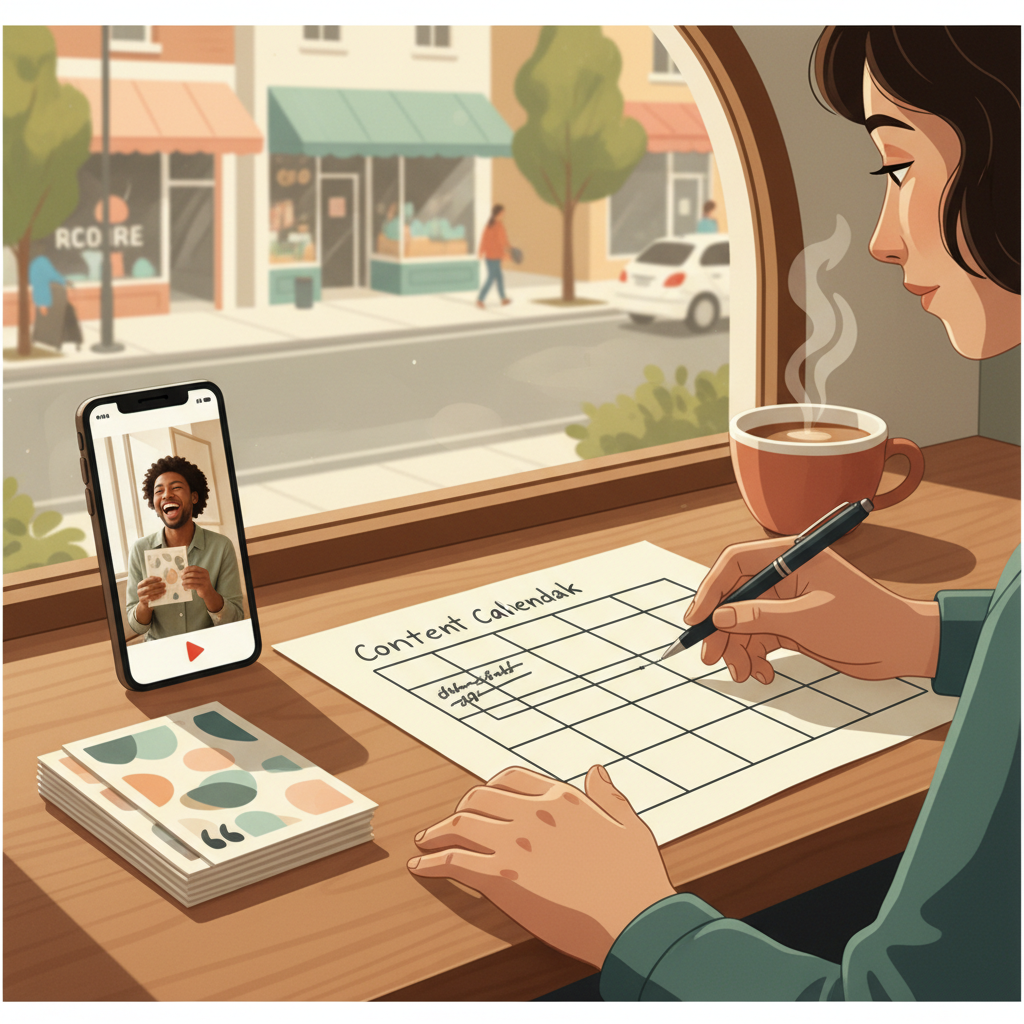
Content Marketing

Turn One Customer Story into 12 Local Posts: A Monthly Blueprint

Most small businesses have more good stories than they publish. This guide shows, step-by-step, how to turn a single customer story into 12 local posts—with exact captions, a 2-hour workflow, and a posting calendar that gets attention.

6 min read
BrandZillaBrandZilla EditorialReviewed by marketing operators
Turn One Customer Story into 12 Local Posts: A Monthly Blueprint

You have one great customer story: somebody who came in with a problem, got results, and told you it mattered. But you post that story once and then disappear. That’s the real problem — great social content dies because it’s treated like a one-off.

This guide turns that single story into 12 distinct local posts you can publish over a month. No fluff, no brand manifesto. Exact captions, short video scripts, a two-hour production workflow, and a posting schedule that fits a small team.

The simple logic: expand one story into specific asset types

Think of the customer story as the anchor. From the anchor you can produce 12 items by splitting the story into different purposes: proof, how-to, behind-the-scenes, local tie, short testimonial, and direct invite. Here’s an easy split that works for local businesses:

  1. Anchor long-form (video or 300–400 word post) – the full customer story.
  2. Two x short clips (30–45s) – use for reels or short posts.
  3. Three x quote cards – pull distinct lines the customer said.
  4. Two x how-to posts – teach something related to the problem solved.
  5. Two x behind-the-scenes or team posts – humanize the work.
  6. One x local tie / community post – connect the story to your neighborhood.
  7. One x direct CTA – clear next step (book, call, visit).

That’s 12 pieces from one recorded conversation or written review.

Reality check: Most small businesses post 3x then quit. Consistency beats creativity 9 times out of 10.

The 2-hour production workflow (exact steps)

You don’t need a video crew. Do this in one morning.

  1. Prep (10 minutes): pick the story, write a 150–200 word anchor summary, and list 3 soundbites.

  2. Record (25–35 minutes): film the customer telling the story (3–4 minutes), then capture 2–3 short testimonials (20–30s each). If the customer can’t be filmed, record the owner or staff telling the story on camera.

  3. Capture B-roll (15 minutes): 6–8 short clips of the shop, the product, staff at work, signage, the neighborhood.

  4. Write (30 minutes): craft the anchor post, 3 quote cards, 2 how-to posts, 2 behind-the-scenes captions, and 1 CTA caption. Use the templates below.

  5. Assemble (20–30 minutes): edit two short clips, design quote cards (use a phone template), and schedule posts in your publishing tool or notes app.

Total: about 2 hours. If you batch two stories in a week, you can fill an entire month in a morning.

Quick win: Repurpose one customer review into a 3-post mini series this week.

Exact captions and short scripts (copy-paste ready)

Anchor long-form (post or 60–90s video caption)

"When Maria called two days before her son’s party she was sure she’d have to drive 40 minutes to find a cake. We said yes. She walked out with a custom cake that arrived on time and everyone at the party asked where it was from. We fix last-minute problems like this — here’s how we did it for Maria.

Step 1: We checked inventory. Step 2: We prioritized the order with our morning baker. Step 3: We handled delivery so she didn’t worry.

If you ever need a last-minute cake in [Neighborhood], call or DM us. We’ll do our best to help."

Short clip script (30–45s) — use with B-roll and text overlay

Camera: 30s of the cake in the oven / being boxed.

Voiceover: "Maria called two days before the party—no panic, just steps. We confirmed design, prioritized the order, and delivered. That’s how we handle last-minute cake requests in [Neighborhood]."

Quote card examples (pull direct lines from the customer)

  • "They saved my son’s birthday." — Maria, Parkside
  • "I thought I’d have to cancel the party." — Maria
  • "Best customer service I’ve seen from a bakery." — Maria

How-to post (teach, 2 short tips)

"How to order a last-minute cake without stress: 1) Call first thing in the morning, 2) Be flexible on decoration, 3) Ask about delivery. We can usually make it work if you give us a window.

PS: We keep a short-notice list — DM to join."

Behind-the-scenes caption

"Our morning baker uses a simple checklist to prioritize same-day orders. When Maria called, the checklist keeps us from missing steps. Want to see it? Swipe to the checklist."

Direct CTA caption

"Have a party this weekend? We have 3 same-day slots left. Book online or call [phone]."

Common mistake: Treating Instagram captions like tweets — context outperforms one-liners for local businesses.

Scheduling: a simple 30-day calendar from one story

Use this pattern to spread the 12 pieces across 30 days so followers see variety and repetition without feeling spammed.

  • Week 1: Anchor long-form (day 1), quote card (day 3), short clip (day 6)
  • Week 2: How-to (day 9), behind-the-scenes (day 12), quote card (day 15)
  • Week 3: Short clip (day 18), local tie (day 21), how-to (day 24)
  • Week 4: Quote card (day 26), behind-the-scenes (day 28), CTA (day 30)

Why this works: people need multiple exposures before acting. This schedule mixes formats and placements so the same story shows up in different moods (proof, teach, human, local).

One mini-example: practical numbers that prove the approach

Cornerstone Auto in Portland used a single 'tow-to-repair' story. They filmed an owner interview and one customer testimonial, made 12 posts in 10 days, and followed the schedule above. Results in 6 weeks:

  • 8 calls mentioning the post and asking about similar repairs.
  • 5 new booked repairs worth an average of $420.
  • A 12% lift in local search clicks to their 'book now' page.

They spent one morning shooting and two hours editing across two days. No paid ads.

Local business example: A neighborhood locksmith filmed a single 'saved a locked-out mom' clip and used it for 10 posts; they booked 9 emergency calls in the following month.

Post-production checklist (one-page)

  • Anchor post written and saved (300–400 words).
  • Two short clips trimmed to 30–45s.
  • Three quote cards designed and exported.
  • Two how-to captions written and scheduled.
  • Two behind-the-scenes images or short videos captured.
  • Local tie post written with neighborhood tags and local hashtags.
  • CTA post scheduled with clear booking link and hours.
  • All posts scheduled across the 30-day calendar.

What actually works: A 5-post weekly rhythm built from one anchor piece — not daily improvisation.

Quick notes on captions, hashtags and tagging

  • Always include one clear location mention in caption (e.g., "in [Neighborhood]"). That local word helps both human readers and some local discovery.
  • Use 6–10 focused hashtags (mix of neighborhood + service + occasion). Example: #ParksideBakery #LastMinuteCake #BirthdayCake [city tag].
  • Tag the customer when allowed. If they’re shy, get written permission and tag a nearby landmark instead.
  • For stories/reels, add 3–5 text cards that summarize the story for people watching without sound.

Practical shortcut: You can build this system manually — or use BrandZilla to stay consistent without hiring a social media manager.

How to scale beyond one story

  • Repeat the system: 4 months = 16 anchor stories → fills half a year of content using the same repurposing method.
  • Keep an index: track customer name, outcome, 3 soundbites, and date recorded. That index becomes your month-to-month content queue.
  • Assign one person (owner, manager, or trusted staff) to be the 'story collector' — their job is to ask for quick customer stories each week.

Final Thoughts

This isn’t about being clever on social media; it’s about squeezing more mileage from what you already have — your customers. One recorded story makes your marketing look consistent, human, and local. Take two hours, follow the checklist, and post across 30 days.

If you want a system to keep this cadence without a new hire, BrandZilla was built for small teams who need to stay visible and trusted.

#content-marketing#local-marketing#social-media#repurposing#small-business#content-repurposing

Questions business owners actually ask

The real objections — answered straight, no fluff.

BrandZilla

BrandZilla Editorial Team

SMB MarketingContent Strategy

Practical playbooks written and reviewed by people who actually run content programs for small and local businesses — not generic AI output. Every guide is pressure-tested against what real operators do on Instagram, Facebook, LinkedIn and Google.

Used by 1,000+ businessesLast updated Aug 25, 20266 min read

Get weekly content ideas for your business

Join business owners getting practical, ready-to-post BrandZilla content prompts every week. No spam.

No spam. Unsubscribe anytime.

Related articles