The 4-Pillar Content System Small Businesses Can Stick To
If you run a local business and keep disappearing from social, this 4-pillar system is a no-fluff way to stay visible, build trust, and get more enquiries — with one hour of weekly work.
7 min read
BrandZilla EditorialReviewed by marketing operators· Updated Oct 7, 2026· 7 min read
If posting feels like throwing spaghetti at the wall and hoping something sticks, you are not alone. Small business owners try random posts, then run out of steam. The result: no new enquiries, inconsistent foot traffic, a social feed that looks abandoned.
You need a system that fits a 3–5 person operation: predictable, repeatable, and low-effort. Not a content experiment or a complicated SaaS workflow — something you can run between appointments.
This article gives a compact 4-pillar framework, exact caption templates, a weekly schedule, and a 6-week example you can copy. No buzzwords. Just a practical system that keeps you visible and trusted.
The problem in plain terms
Local customers make quick trust decisions. They scan a feed, check a review, then move on. If your posts aren’t showing regular proof or useful info, you lose. Worse: posting random promotions or cryptic jokes confuses people who might otherwise book.
The fix isn’t more creative brainstorming — it’s focused repetition. Pick a small set of content types that answer customers’ real questions, prove you can deliver, and make it easy to act.
Reality check: Most small businesses post 3x then quit. Consistency beats creativity 9 times out of 10.
The 4 pillars (and why four works)
Keep it to four dependable topics. Any more and it becomes impossible to sustain. Each pillar has a clear purpose and a predictable output.
How we help (explain what you do in plain language)
Proof (before/after, reviews, quick case snippets)
Behind the counter (humanize the business with process or short how-tos)
Offers & local events (clear next steps: book, visit, call)
Why four? It covers the decision path: understand → trust → relate → act. Use a single anchor piece each week (a short video, a case photo, or a customer quote) and spin four posts from it.
Common mistake: Treating Instagram captions like tweets — context outperforms one-liners for local businesses.
Weekly schedule you can actually keep
Time commitment: 60–90 minutes once per week.
Monday (30–40 min): Capture or pick the anchor piece (one video clip, one customer photo, or one how-to photo).
Tuesday (20 min): Write four captions from templates and schedule them for the week.
Thursday (10–20 min): Engage (reply to comments, reshare a customer story).
Repeat. Use the same pillars in the same order so customers learn the rhythm.
Quick win: Repurpose one customer review into a 3-post mini series this week.
How to turn one anchor into 4 posts (exact templates)
Anchor: short 20–40 second video of a service being performed, or a clear before/after photo.
Post A — How we help (Monday)
Caption template: "We help [audience] with [specific service] so they can [outcome]. Today we fixed [brief problem] in [time]."
Example: "We help homeowners stop kitchen leaks before they damage cabinets. Today we fixed a hidden pipe leak in 45 minutes. Here's how we found it."
CTA line: "Need a quick check? Call us at [phone] or book a slot online."
Tip: "Tip from [name]: [one-line how-to]. Do this [frequency]."
Offer: "Local special: [discount or bonus]. Valid for [neighbourhood]. Book by [date]."
Use these exact lines and swap the bracketed parts.
Steal this template: "We help [audience] [outcome] without [pain]. Here's how →"
How to make this low-effort for a tiny team
Batch capture: use one appointment a week to film or photograph. 60 seconds of footage is enough.
Reuse captions: rotate the templates and change the specifics (name, time, result).
Delegate micro-tasks: one person captures, one schedules, one replies to comments.
Practical shortcut: You can build this system manually — or use BrandZilla to stay consistent without hiring a social media manager.
When to promote and when to educate
Promote (offers & events) once per week. Too many promotions lower trust.
Educate (tips and behind-the-scenes) twice per week. These build credibility.
Proof (before/after and reviews) once per week. Social proof converts skeptics.
Balance the ratio: 2 educational, 1 proof, 1 promotional post each week.
Metrics that actually matter for local businesses
Calls booked and online bookings tied to a post (measure with a simple question: "How did you hear about us?").
Direct messages that lead to a booking.
New customer first-purchase or appointment.
Ignore vanity metrics. Track two numbers weekly: enquiries from social and bookings from social.
Common objections and quick answers
Q: "I don’t have time." — Batch one hour weekly, use templates. Next step: pick a single anchor for this week.
Q: "We don't have customers who want videos." — Use photos, before/afters, or text-based testimonials. One good photo + caption is enough.
Q: "What if I run out of ideas?" — Rotate the four pillars and reuse templates. Also keep a running list of customer questions you answer in captions.
FAQ
Q: What if I don't have time to post every day?
A: You don't need daily posts. This system runs on 4 posts per week and one hour of batching. Next step: schedule one batch session this week.
Q: Can I reuse old content without looking repetitive?
A: Yes — update the caption with a new angle (seasonal note, fresh tip, or recent metric). Repost after 6–8 weeks with a new hook. Next step: pick one evergreen post to refresh this month.
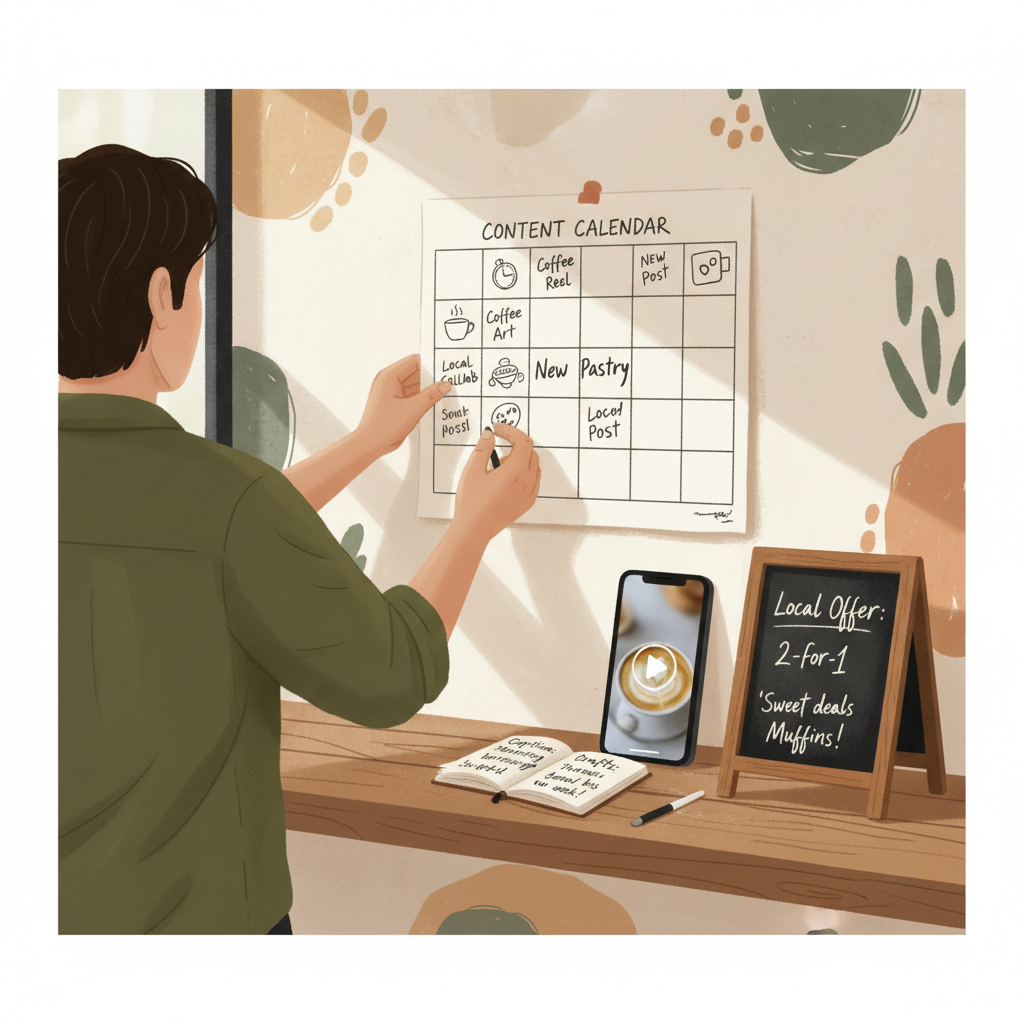
Q: Do small businesses actually need a content calendar?
A: Yes. A simple 4-column calendar (week, anchor, captions, CTA) prevents the random-post trap. Next step: create one row for the upcoming week.
Q: How long before posting consistently actually brings in customers?
A: Expect measurable enquiries within 3–6 weeks if you post consistently and cue a local offer. Next step: track calls and ask new callers how they found you.
Q: Can one person realistically run this?
A: Yes. With batching and templates one person can handle capture, captioning, and scheduling in about 60–90 minutes per week. Next step: block an hour on your calendar for next Monday.
A useful final note: consistency wins. Pick these four pillars, stick to the weekly rhythm, and measure only the actions that matter — calls and bookings. If you want a practical shortcut to keep it running without hiring a social manager, there are content systems that help small teams stay visible and consistent.
— A straightforward system beats a creative stunt you can’t maintain.
#content marketing#local business#content systems#small business#content calendar#social media
Questions business owners actually ask
The real objections — answered straight, no fluff.
BrandZilla Editorial Team
SMB MarketingContent Strategy
Practical playbooks written and reviewed by people who actually run content programs for small and local businesses — not generic AI output. Every guide is pressure-tested against what real operators do on Instagram, Facebook, LinkedIn and Google.
Used by 1,000+ businessesLast updated Oct 7, 20267 min read
Get weekly content ideas for your business
Join business owners getting practical, ready-to-post BrandZilla content prompts every week. No spam.