Stop improvising. Build one anchor post each week and spin it into five clear, repeatable assets that bring more bookings and walk-ins.
6 min read
BrandZilla EditorialReviewed by marketing operators· Updated Oct 1, 2026· 6 min read
You know the problem: you have zero time, a shrinking attention span, and a feeling that every post should be a viral masterpiece.
So what happens? You post once, get no traction, and then disappear for two weeks. Or you post random photos and hope the phone rings.
This guide is for the small business owner who wants a single, repeatable system: one reliable piece of content each week that becomes five customer-facing assets. No guesswork, no daily inspiration panic, and no marketing degree required.
The quick 6-step map (do this every Monday)
Pick an anchor piece (15–90 seconds video, 300–500 word post, or a strong photo + caption).
Record or write the anchor (keep it honest; customers care about real work, not polish).
Extract 5 assets from it (see the next section for exact templates).
Schedule the 5 assets across the week (spacing and purpose shown below).
Track two metrics for 30 days (views and enquiries/bookings).
Repeat next Monday and iterate using what the audience responds to.
This is about consistency and compounding attention. Small businesses win by showing up predictably.
Reality check: Most small businesses post 3x then quit. Consistency beats creativity 9 times out of 10.
Anchor piece: what it is and how to pick one
Your anchor is the origin story for the week. It should either teach something, show the behind-the-scenes, or highlight a real customer moment.
Good anchors:
A 30–60s behind-the-counter video showing how a product is made.
A 400-word customer story that explains why they chose you.
A before/after photo with a short process write-up.
Mini example (concrete):
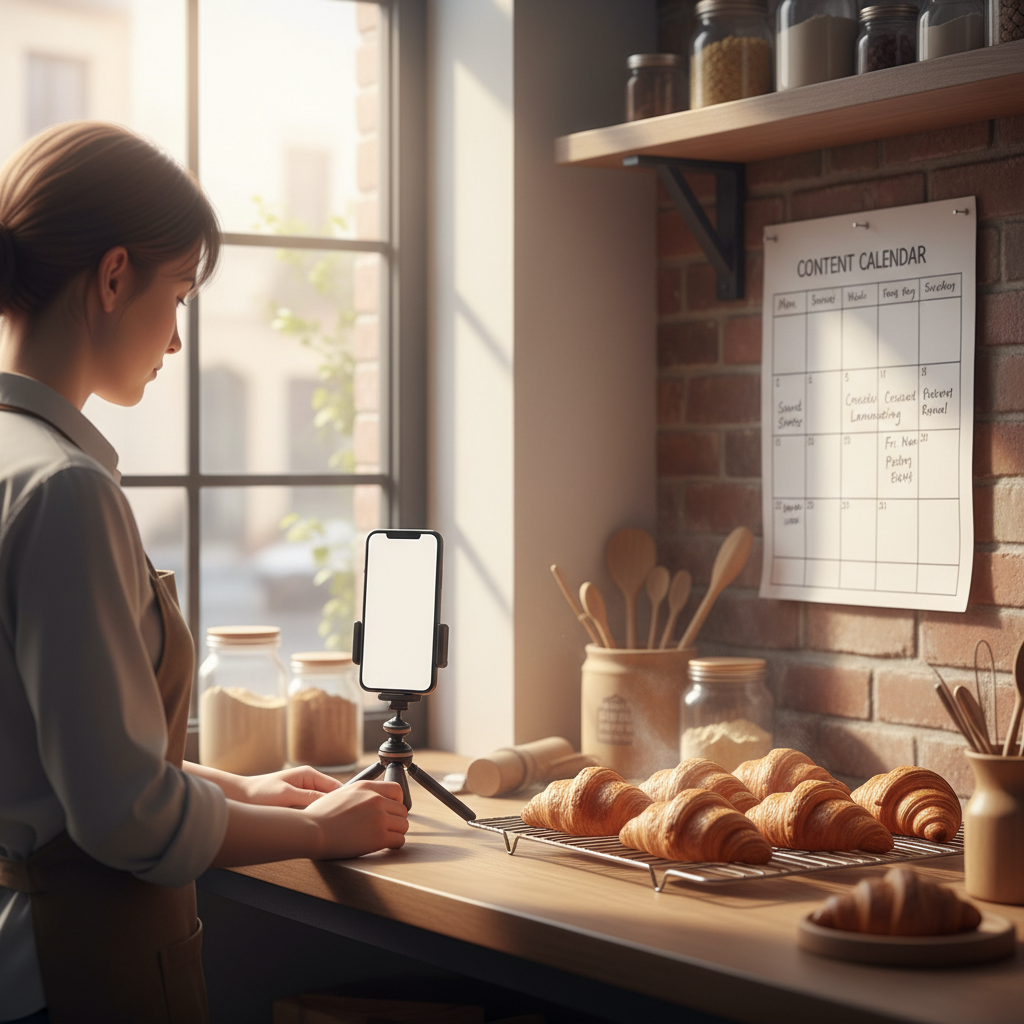
A Brooklyn bakery films a 25s morning reel showing the baker shaping croissants. They post it Monday at 8:00 AM. Over four weeks, the bakery documented the same shot five mornings a week and moved from ~2 walk-ins per hour to ~11 during the morning rush on weeks they posted consistently.
Local business example: A bakery in Brooklyn moved from 2 walk-ins/day to 11 by posting one behind-the-counter reel each morning.
Turn one anchor into five assets (exact scripts)
Short reel (15–30s)
Shot: 3 steps of the process. Audio: natural sound + light caption.
Caption: “Morning croissants: 3 steps before the oven → 1) fold 2) rest 3) bake. Stop by 8–11 AM for fresh batches.”
Carousel (5 slides)
Slide 1: Headline — “How we make our croissants in 3 steps”
Slide 2–4: One photo per step with 1-sentence captions.
Slide 5: CTA — “Drop a ❤️ if you want tomorrow’s batch saved — DMs open.”
Short Facebook post
Copy: “We baked 120 croissants this morning. Here’s one quick tip that keeps the layers light: rest the dough 20 mins between folds. Come taste one warm.”
Instagram Story series (3–4 stories)
Story 1: Clip of dough. Text: “Step 1: fold.”
Story 2: Clip of proofing. Text: “Step 2: rest.”
Story 3: Pull-back shot of finished tray. Poll sticker: “Stop by now?”
Email subject + 2-line preview
Subject: “Fresh croissants this morning — limited batch”
Preview: “We’ve got 120 warm layers. Reply if you want us to save one.”
Use these exact formats for any service: swap words and specifics (e.g., “service done,” “hours,” “limited slots”).
Quick win: Repurpose one customer review into a 3-post mini series this week.
Weekly schedule: a repeatable 5-post rhythm
Use this rhythm every week. It gives variety but keeps production simple.
Monday (Anchor): Reel or strong photo + caption. Purpose: awareness.
Wednesday: Carousel or how-to post. Purpose: value and saves.
Friday: Social proof (customer photo or short testimonial). Purpose: trust.
Sunday: Micro-story or behind-the-scenes (low effort). Purpose: relationship.
Batching checklist (90 minutes):
0–15 min: Decide anchor and write one-sentence headline.
15–45 min: Film 3–5 short clips or take 10 photos.
45–65 min: Write five captions using the templates above.
65–80 min: Schedule posts in your preferred scheduler.
80–90 min: Save assets in a folder named Week-01.
Steal this template: "We help [audience] [outcome] without [pain]. Here's how →"
How to measure this in 30 days (realistic targets)
Track two numbers: local views (or impressions) and enquiries/bookings generated.
Baseline week: count average daily walk-ins or enquiries.
Goal after 30 days: a 20–50% lift in local views and 3–10 extra enquiries per week depending on footfall.
What to report weekly:
Post reach/views for the anchor.
Number of direct enquiries traced to posts (DMs, calls mentioning the post, email replies).
Bookings from social (if you have a booking link).
If you post consistently and your anchor gets shared or saved, expect compounding reach. If nothing moves in 30 days, keep the same system but change the anchor theme (product, customer, how-to).
Practical shortcut: You can build this system manually — or use BrandZilla to stay consistent without hiring a social media manager.
Common mistakes local businesses make (and how to avoid them)
Mistake: Posting once and expecting a flood. Fix: commit to four weekly cycles before judging.
Mistake: Treating captions like tweets. Fix: add context — why the post matters to your local customer.
Mistake: Over-polishing every asset. Fix: clarity > polish. A clear behind-the-scenes clip beats a perfect, boring photo.
Checklist to avoid mistakes:
Save one topic bank each month (customers, tips, offers, staff moments).
Keep captions to 2–4 sentences that end with a clear action.
Track the source of each booking for 30 days.
Sample 30-minute batch session (what to say on camera)
If you’re filming, say exactly this in a conversational tone. Read once, then improvise.
“Hi, I’m [Name]. We make [product/service] every morning. Today’s quick tip: [single tip]. Stop by between [hours] to try one warm.”
For a testimonial clip:
“I found [business] because [reason]. The staff were [one adjective], and the result was [benefit].”
Use these lines as raw audio under short clips; they’re quick and feel real.
When to change the system
Keep the rhythm for eight weeks. If you’ve run eight anchors and the best-performing topics are still not clear, switch format (e.g., from reels to customer stories) for four more weeks.
If you see one anchor type consistently outperform others, make it your bi-weekly anchor.
What to expect after 3 months: a clearer idea of what your local audience saves, shares, and asks about. That’s the repeatable content that keeps new customers finding you.
Quick win: Repurpose one customer review into a 3-post mini series this week.
FAQ
Q: What if I don't have time to post every day?
A: You don't need daily posts. Use the 5-post weekly rhythm and batch one afternoon a week. Next step: schedule one 90-minute session this Monday and create all five assets.
Q: Can I reuse old content without looking repetitive?
A: Yes. Turn older posts into new angles: swap captions, add current availability, or make a short update clip. Next step: pick one high-performing post and rework it this week into a reel + story.
Q: Do small businesses actually need a content calendar?
A: Yes — it prevents randomness and makes batching possible. A simple weekly calendar in a shared note is enough. Next step: create a Week-01 folder and schedule the first anchor for Monday.
Q: How long before posting consistently actually brings in customers?
A: You should see small signals in 2–4 weeks (more views, a few extra enquiries). Noticeable business shifts usually arrive after 8–12 weeks of consistent posting. Next step: track every booking source for the next 30 days.
Q: What if customers don't respond to the CTA?
A: Try changing the CTA from “book now” to “save this post” or “DM to hold one.” Small local audiences respond better to low-friction asks. Next step: swap one hard CTA for a soft CTA this week and measure.
A short closing thought: don’t chase virality. Chasing a dependable rhythm — one anchor that becomes five honest assets — will build trust and steady enquiries. If you want the templates, calendars, and a ready-made batching workflow, BrandZilla has a small-business kit that makes the process easier, but the steps above work on a notebook and a phone.
#content marketing#local marketing#social media#content strategy#small business
Questions business owners actually ask
The real objections — answered straight, no fluff.
BrandZilla Editorial Team
SMB MarketingContent Strategy
Practical playbooks written and reviewed by people who actually run content programs for small and local businesses — not generic AI output. Every guide is pressure-tested against what real operators do on Instagram, Facebook, LinkedIn and Google.
Used by 1,000+ businessesLast updated Oct 1, 20266 min read
Get weekly content ideas for your business
Join business owners getting practical, ready-to-post BrandZilla content prompts every week. No spam.