How to Write a Local Brand Promise That Actually Brings Customers
Most local businesses have a fuzzy brand line that doesn’t help customers decide. This guide shows how to write a clear, testable one-line brand promise, with templates, scripts and a 14-day test plan.
7 min read
BrandZilla EditorialReviewed by marketing operators· Updated Oct 4, 2026· 7 min read
Customers tell me they want a short line that makes people call or walk in — not a vague mission statement. "We're reliable and affordable" doesn't move anyone because everyone says it. Local businesses need a brand promise that signals a specific benefit, a clear audience and a believable reason to trust you.
This short guide shows a practical 3-step framework to write that line, exact templates you can copy, quick tests to run in two weeks, and the precise words to use in ads, Google Business Profile and your front window.
1) Why a single short brand promise matters for local businesses
You have roughly 3 seconds to communicate why a customer should choose you over the guy down the street. A one-line brand promise is the single most repeatable message your team, signage and posts should use.
It needs to do three things:
State who you help (audience).
Promise a specific outcome.
Remove a common objection or give a differentiator.
Too many small businesses try to be clever. Clever confuses. Clear converts.
Reality check: Most small businesses post 3x then quit. Consistency beats creativity 9 times out of 10.
2) The 3-word framework (plus a 1-line formula)
Start with a compact mental tool you can actually use when writing copy.
3-word framework (use one word per idea):
Audience — who you help (e.g., "busy parents", "renters", "office managers").
Outcome — the direct benefit (e.g., "fixed same day", "fresh bread daily", "quiet AC").
Proof/edge — why you're believable (e.g., "local for 20 years", "licensed & insured", "on your block").
From those three words you build a 1-line formula:
"We help [audience] get [outcome] — [proof/edge]."
Examples:
"We help busy parents get quick oil changes — same-day service from a local shop."
"We help Airbnb hosts keep properties rental-ready — we clean in under 90 minutes."
Quick win: Repurpose one customer review into a 3-post mini series this week.
3) Exact templates you can copy and where to use them
Use these templates verbatim, then tweak after testing.
Templates (short version for shopfront, Google, ads):
Shop window / Google Business Profile headline: "[Outcome] for [Audience] — [Proof]". Example: "Same-day keys for renters — local locksmith on your block."
Instagram bio / Facebook About: "We help [audience] [outcome]. Open [hours]. Call [phone]." Example: "We help busy parents get kids' haircuts fast. Open 9–6 weekdays. Call 555-0123."
Ad headline: "[Audience]: [Outcome] in [timeframe]". Example: "Renters: New locks installed in 1 hour."
Short script for phone greeting: "Thanks for calling [Business]. We help [audience] with [outcome]. How can I help you today?"
Copy these into your properties and keep the wording the same for 14 days.
4) A 14-day local test plan (do this, not that)
Testing your promise is simple. Don’t try to measure brand awareness — measure actions: calls, bookings, walk-ins.
Day 0: Pick one promise line and use the short templates across your business listing, voicemail and a boosted local post. Keep pricing and services the same.
Days 1–7: Track daily calls/bookings attributable to the wording. Note: use a unique phrase in the post like "mention FASTPROMISE for priority service" to identify responses.
Days 8–14: Swap to a control line (your old wording or a generic line) and run the same tracking.
Compare totals. If the promise line generates 10-30% more actions, keep it and repeat the test in a different channel.
Mini example: A neighborhood locksmith in Portland tested "Locks rekeyed while you wait — local, fast service" for 14 days. Calls rose from 20 to 26 (30% increase) and same-week jobs booked rose 25%. The owner kept the line and used it on a small door-hanger campaign.
Local business example: A bakery in Brooklyn moved from 2 walk-ins/day to 11 by posting one behind-the-counter reel each morning.
5) Words that work (and words that kill trust)
Use these power words sparingly: "same-day", "guaranteed", "licensed", "on your block". They reduce friction because they answer common doubts.
Over-promising timelines without proof: "overnight miracle".
Jargon that confuses: "efficacy", "synergy".
Swap vague lines for specific ones. "Fast and friendly" becomes "Same-day service, friendly local team".
Common mistake: Treating Instagram captions like tweets — context outperforms one-liners for local businesses.
6) A simple checklist to deploy the promise across touchpoints
Use this deployment checklist (takes about 90 minutes total):
Update Google Business Profile description and headline.
Change voicemail greeting to include the line.
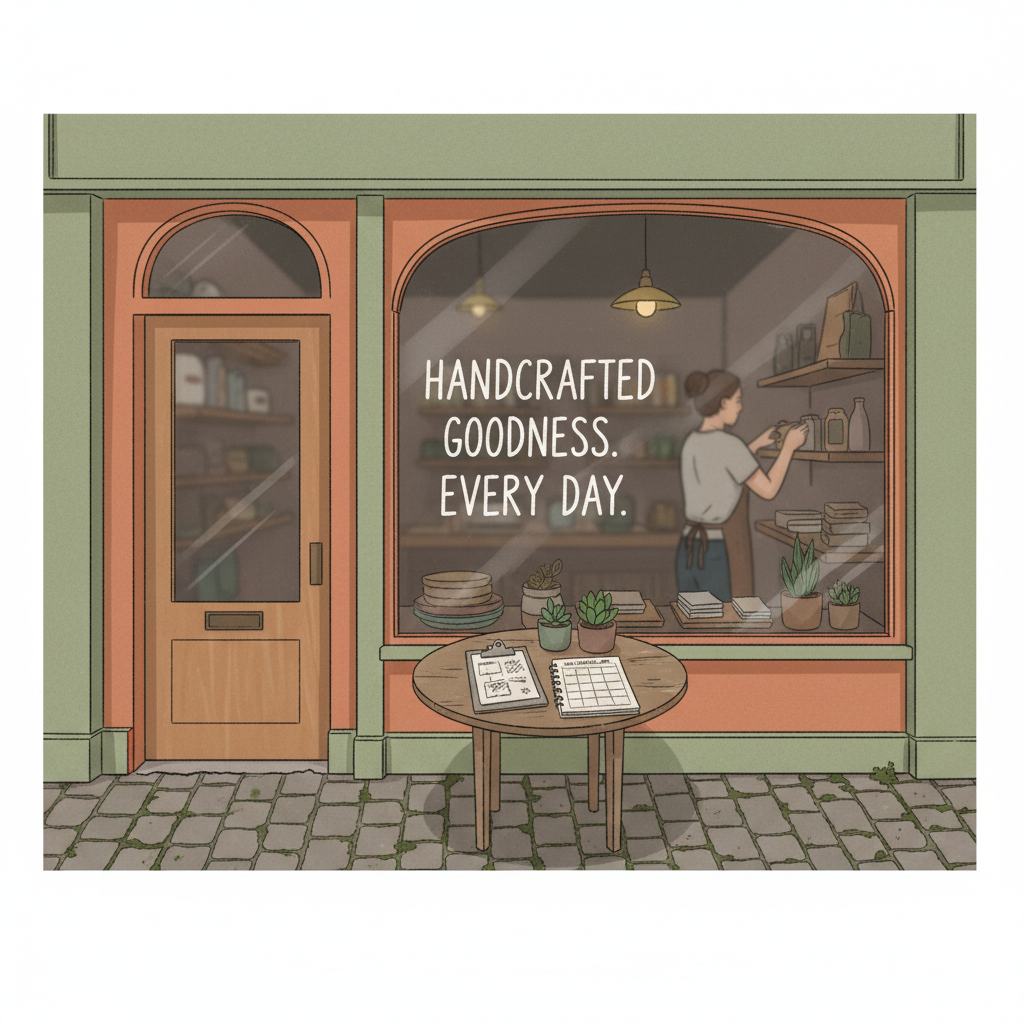
Add the line to your shop window or a printed A-frame.
Put a line in your email signature for two weeks.
Create one boosted local post (single image + line) and run for 7 days.
Train staff: two practice reads of the phone script.
Keep the line consistent for at least 28 days unless it clearly backfires.
7) How to use the line in social posts without sounding stale
Turn the one-line promise into a content anchor. Examples:
Post format A: Proof post. Photo + line + 2-sentence customer story.
Post format B: Behind-the-scenes. 15–30s reel showing the promise in action.
Post format C: FAQ. One line as the headline, then answer the top objection in the caption.
Exact caption you can copy for a post showing a job done:
"We help apartment renters get locks changed fast — local locksmith on your block. Today we rekeyed 3 units in under 60 minutes. Call 555-0123 to book same-day."
Steal this template: "We help [audience] [outcome] without [pain]. Here's how →"
Practical shortcut: You can build this system manually — or use BrandZilla to stay consistent without hiring a social media manager.
8) Handling objections and tricky promises
If your promise could invite risky expectations (e.g., same-day for all jobs), add a short qualifier. Example: "Same-day for most jobs — call to confirm availability." That reduces angry customers while keeping the benefit front and center.
If customers challenge proof, use micro-evidence: a one-line badge "Licensed & insured since 2006" on your listings, or a small counter on the booking page: "3,400 local jobs completed." Micro-evidence compounds trust.
9) When to rewrite the promise
Rewrite only if a promise consistently underperforms after two tests or your business changes (new owner, new services, new service area). If you’re expanding, make the audience broader: "for [neighborhoods] and surrounding areas." Use the same testing process.
10) Quick scripts and signs you can copy today
Window sign (large text): "Fast, local carpet cleaning — dry in 2 hours."
Phone greeting: "Hi, you’ve reached [Business]. We help [audience] get [outcome]. Press 1 for bookings."
FB/IG pinned post: "We help [audience] [outcome]. Book now — [link]."
These scripts remove hesitation. Use the phone script every time for one month and you’ll hear how it changes conversations.
What to measure during tests:
Calls attributed to the phrasing (use a campaign phrase).
Bookings or completed jobs.
Walk-ins if you can tag them with a question at the cash register.
FAQ
Q: What if I don't have time to post every day?
A: You don't need daily posts to test a promise. Update your listings, voicemail and one boosted post for 14 days. Measure calls and bookings. Next step: create one proof post per week.
Q: Can I reuse old content without looking repetitive?
A: Yes — reuse the same promise but vary the proof. Swap photos, customer quotes, or short clips. Next step: turn one review into three different posts this week.
Q: Do small businesses actually need a content calendar?
A: Yes, but it can be very small. Start with a 4-post monthly calendar: Proof, Behind-the-scenes, FAQ, Offer. Next step: plan one month in an hour.
Q: How long before posting consistently actually brings in customers?
A: You can see changes in calls or bookings within 7–14 days if your promise addresses a clear need. Next step: run the 14-day test above.
Q: Can I use superlatives like “best” if I have the awards to prove it?
A: Only with proof. If you have a local award, say "Voted Best Pizza 2025 — [publication]". Next step: add the award to your listings with the year.
Short final thought
A single clear brand promise gives your small business a repeatable edge — and it's cheap to test. Start with the three-word framework, use the templates above, run the 14-day test, and keep the one that moves calls and bookings.
If you want a practical way to keep this consistent across listings and posts, tools like BrandZilla make it simple to store and reuse the line across channels.
The real objections — answered straight, no fluff.
BrandZilla Editorial Team
SMB MarketingContent Strategy
Practical playbooks written and reviewed by people who actually run content programs for small and local businesses — not generic AI output. Every guide is pressure-tested against what real operators do on Instagram, Facebook, LinkedIn and Google.
Used by 1,000+ businessesLast updated Oct 4, 20267 min read
Get weekly content ideas for your business
Join business owners getting practical, ready-to-post BrandZilla content prompts every week. No spam.