SMS vs Email for Local Businesses: A Practical Comparison
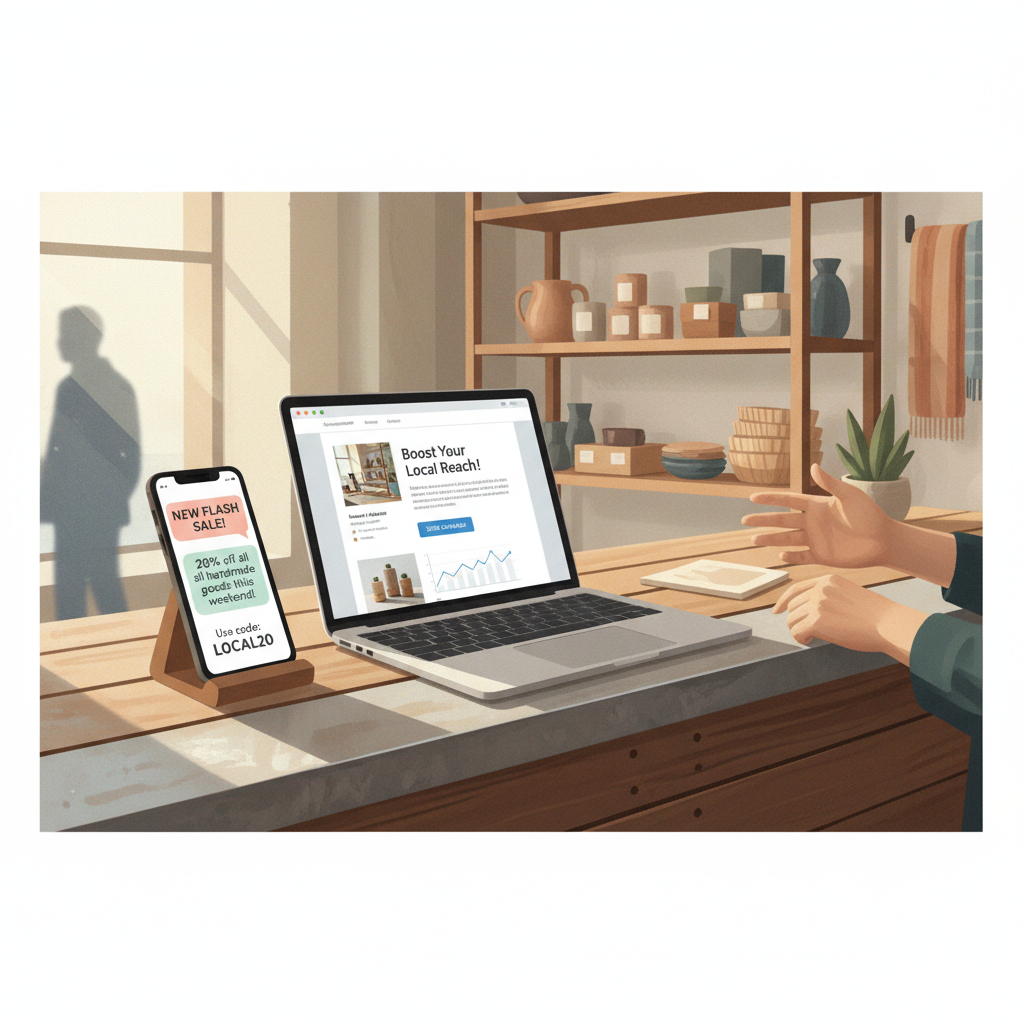
Local business owners ask: should I be sending texts or emails to get more bookings and repeat customers? This article gives a simple decision framework, real templates, expected metrics, and a step-by-step plan you can run this week.
7 min read
BrandZilla EditorialReviewed by marketing operators· Updated Sep 9, 2026· 7 min read
Local business owners usually put this problem in plain language: “I keep sending emails and nobody books. Should I try texting?” or “My customers ignore my promos — is SMS worth the risk?”
You don’t need a fancy tool or a marketing degree. You need a clear way to choose the channel that fits your customers, your offers, and the type of action you want (bookings, confirmations, or rebookings).
Below is a practical, no-nonsense comparison plus exact scripts, timing, and a 5-step test you can run in 30 days. No theory — just what to say and when to send it.
Quick decision framework: when to pick SMS, when to pick email
Use this 3-question score. Give each item 0–2 points, total out of 6.
Urgency (do you need an immediate response?): 0=no, 1=within a few days, 2=today/next 48 hours.
Offer simplicity (single call to action like "book now" vs long explanation): 0=requires long copy, 1=short explanation, 2=single CTA.
Customer tolerance (do customers expect texts? older customers may prefer email): 0=prefer email, 1=neutral, 2=open to SMS.
Reality check: Most small businesses post 3x then quit. Consistency beats creativity 9 times out of 10.
What each channel actually does well (and where they fail)
SMS
Strengths: near-instant visibility, high open rates (see metrics below), excellent for reminders, urgent promotions, and short CTAs.
Weaknesses: short space, higher irritation risk if overused, legal opt-in requirements.
Email
Strengths: better for longer content, storytelling, coupons that need explanation, newsletters and broad nurturing.
Weaknesses: lower open rates, slower to drive immediate action.
Real metrics to expect (benchmarks you can use)
Average SMS open rate: 90% within 3 minutes. Typical reply/engagement rates for local offers: 5–20% depending on offer quality.
Average email open rate (local small business lists): 20–35%. Click-through to booking page: 2–8%.
Conversion to booking depends on offer and follow-up: a good SMS reminder + link can convert 10–25% of recipients to a same-week booking; email promos commonly convert 1–5%.
These are working benchmarks — run a small test and compare your own results.
30-day test plan (run this on a subset of customers)
Pick 1,000 contacts or fewer. If you don’t have 1,000, use everyone you have.
Split 60/40 into email-first and SMS-first groups (randomly).
Use the same offer: a 20% rebooking discount valid 10 days.
Send timing:
Email-first: Day 0: email; Day 3: email reminder; Day 6: SMS reminder.
SMS-first: Day 0: SMS; Day 3: SMS reminder; Day 6: email follow-up.
Track opens, replies, clicks, and bookings. Measure cost-per-booking.
Decide winner after 30 days. If results are close, look at lifetime value (repeat rate) before switching full-time.
Quick win: Repurpose one customer review into a 3-post mini series this week.
Exact scripts and subject lines you can copy-paste
Use these as-is or tweak a word.
Appointment reminder (SMS)
"Hi [First], it’s Mia at Willow Salon — just a reminder of your haircut tomorrow at 3pm. Reply 'C' to confirm or call us at 555-0123. See you!"
No-show follow-up (SMS)
"Hi [First], you missed your appointment today. If you still want the 20% reschedule offer, reply 'RES' and we’ll find a time. Offer expires in 48 hours."
New-customer email welcome
Subject lines (pick one):
"Welcome — here's 15% off your first visit"
"Thanks for booking with [Business]. A quick hello."
Body (short):
"Hi [First], thanks for choosing [Business]. Bring this email for 15% off your first visit. Book online here: [link]. Need help? Reply to this email or call 555-0123. — [Owner name]"
Flash offer (SMS)
"2-hour quick sale: 2-for-1 manicure today 2–4pm. Reply 'BOOK' and we’ll hold a spot. [Name], 555-0123"
Rebooking sequence for service businesses (3-touch)
Day 0 (SMS): "Hi [First], thank you for visiting! Ready to book your next [service]? Reply 'BOOK' and pick a time."
Day 3 (email): "Loved having you — here’s how to keep results longer (and a 10% rebook code)." + link.
Day 7 (SMS): "Quick reminder: your 10% rebook code expires tomorrow. Reply 'BOOK' to use it."
Common mistake: Treating Instagram captions like tweets — context outperforms one-liners for local businesses.
Compliance and opt-in language (do this right)
Always get clear opt-in for SMS. Simple script at checkout or on a form: "Yes, I agree to receive text messages about appointments and offers from [Business Name]. Message & data rates may apply. Reply STOP to opt out."
Keep message frequency reasonable (1–4 texts/month for promos; more for active reminders).
Store opt-ins and time stamps. Use a simple column in your customer spreadsheet if you don’t have software.
Choosing frequency and cadence
Reminders (appointments): 48 hours before + 2 hours before (SMS). Email can be 7 days before + 24 hours before for longer-prep services.
Promotions: email once-weekly or biweekly; reserve SMS for 1–2 timely promotions per month.
Use email for storytelling and building trust: staff spotlights, longer explanations of services, and monthly newsletters.
Use SMS for action: confirm, remind, flash deals, and rebook nudges.
Trigger-based SMS: automated appointment confirmation and a post-visit thank-you with a rebook link.
Mini-example: Miller's Barber Shop (Portland)
Baseline: 12 repeat bookings/week from previous customers.
Test: Miller’s ran the 30-day test above on 400 customers (240 email-first, 160 SMS-first) with a $15 rebook credit valid 10 days.
Result after 30 days: Email-first group produced 18 bookings (7.5% conversion on opens), SMS-first produced 36 bookings (22.5% conversion). Cost per booking was similar. Miller’s kept SMS-first for urgent rebook nudges and continued email for monthly newsletters. Within 8 weeks repeat bookings rose from 12 to 28 per week.
Local business example: A bakery in Brooklyn moved from 2 walk-ins/day to 11 by posting one behind-the-counter reel each morning.
How to measure success (exact numbers to track)
Delivery rate (SMS and email). If emails bounce >5% clean your list.
Open rate (email) and read/response for SMS.
Click-through-rate (CTR) to booking page or phone number taps.
Conversion rate to booking (bookings divided by messages delivered).
Cost-per-booking (ad spend + tool cost / bookings from the campaign).
Aim to improve one metric per month (e.g., increase CTR from 3% to 6%).
When email is still the right move
High-value offers that need explanation (packages, membership tiers).
When you need to include a lot of links, photos, or long-form trust content.
If your audience skews older and prefers email.
When SMS is the right move
Short window offers, same-week bookings, reminders, and immediate confirmations.
If you have strong opt-in data and a personal customer relationship.
For short, clear CTAs like "reply BOOK" or a single link.
Implementation checklist (start this week)
Step 0: Export your customer list with opt-in flags.
Step 1: Pick your 30-day test group.
Step 2: Load templates above into your tool (or use your phone for SMS to 50 customers first).
Step 3: Run the cadence and record every booking source.
Step 4: Review after 30 days, pick the winner, and document the cadence.
Steal this template: "We help [audience] [outcome] without [pain]. Here's how →"
FAQ
Q: What if I don't have time to write both SMS and email?
A: Start with one sequence (pick the highest-scoring channel from the decision framework) and run the 30-day test. Outsource writing one template set to a local freelancer for $50–150 if needed. Next step: schedule the wins into your calendar.
Q: Can I reuse old email content for SMS without sounding repetitive?
A: Yes — shorten the core offer and remove filler. Turn a long promo email into a 1–2 line SMS with a link. Test on a small group first. Next step: pick one past email and compress it into an SMS today.
Q: Do small businesses actually need a list for SMS?
A: Yes. SMS requires opt-in and a list you own (not just followers). Start collecting opt-ins at checkout, on receipts, and with a simple sign-up form. Next step: add an opt-in checkbox to your booking page this week.
Q: How long before texting or emailing brings in customers?
A: You can get measurable results in 7–30 days if you run a targeted offer and track bookings properly. Next step: run the 30-day test above and compare bookings.
A short finishing thought: pick one clear goal (bookings or rebooks), pick the right channel with the 3-question score, and test for 30 days with the templates above. Most businesses overcomplicate both channels — simplicity wins.
Practical shortcut: You can build this system manually — or use BrandZilla to stay consistent without hiring a social media manager.
If you want a plug-and-play weekly plan that uses these scripts and keeps you visible without spending hours, a small content system can save you time and keep customers coming back.
The real objections — answered straight, no fluff.
BrandZilla Editorial Team
SMB MarketingContent Strategy
Practical playbooks written and reviewed by people who actually run content programs for small and local businesses — not generic AI output. Every guide is pressure-tested against what real operators do on Instagram, Facebook, LinkedIn and Google.
Used by 1,000+ businessesLast updated Sep 9, 20267 min read
Get weekly content ideas for your business
Join business owners getting practical, ready-to-post BrandZilla content prompts every week. No spam.