How to Refresh Your Small Business Brand in 30 Days (No Agency Needed)
You don’t need an agency or a big budget to make your brand feel current and believable to local customers. This 30-day playbook gives step-by-step tasks, scripts, and a checklist you can finish in a month.
7 min read
BrandZilla EditorialReviewed by marketing operators· Updated Jul 28, 2026· 7 min read
You know the problem: your logo looks fine, but customers don’t recognize you in the neighborhood. Your messaging is vague, staff use different words, and online profiles say three different opening hours.
That’s why people walk past your store, or call to ask a question you already answered on your website. Rebranding isn’t the answer — a focused refresh is. Small businesses need clarity, not creative experiments.
This guide gives a practical 30-day brand refresh you can complete yourself. No agency, no expensive redesigns — just clear steps, exact phrasing you can copy, and a checklist to keep everyone on the same page.
The 30-day framework (what to expect)
Work in weekly sprints. Each week has one main outcome plus daily 30–90 minute tasks. Expect to spend 4–6 hours in week 1 (discovery), 3–5 hours in week 2 (visuals + copy), and 2–4 hours in weeks 3–4 (rollout and consistency).
Week 1: Decide your brand promise and core messages.
Week 2: Update visual assets and customer-facing copy.
Week 3: Align online profiles, local listings, and in-store touchpoints.
Week 4: Create a 5-post weekly rhythm and hand the plan to staff.
Reality check: Most small businesses post 3x then quit. Consistency beats creativity 9 times out of 10.
Week 1 — Nail the one-sentence brand promise
Objective: A single line that explains who you serve, what you do, and why it matters.
Why this matters: Employees, partners, and customers should be able to say it in their own words. If your promise is fuzzy, everything else will be too.
How to write it (10–20 minutes):
Use this formula: "We help [audience] [primary outcome] without [big pain point]."
Choose only one audience and one outcome. Keep it under 12 words.
Steal this template and adapt:
"We help busy parents find fresh, grab-and-go breakfasts without long lines."
Write three variations, then test with someone who doesn’t work with you. Pick the clearest.
Quick win: Repurpose one customer review into a 3-post mini series this week.
Week 1 tasks (copy + positioning checklist)
Draft three one-sentence brand promises.
Write the 3-word shorthand staff will use to describe your business (example: "Fast Fresh Breakfast").
List the top 3 problems customers want solved.
Pick brand tone in one sentence (e.g., "Helpful, no-nonsense, friendly").
Spend a coffee break on this — the rest of the month follows these choices.
Week 2 — Visuals and customer-facing copy
Objective: Update the simplest, highest-impact items: front-door sign, website headline, and main sales flyer.
Why these first: Customers notice visuals and headlines before anything else. Changing them moves perception quickly.
Visual quick rules (no designer required):
Use one primary color + one accent color. Pick from your logo or the storefront.
Choose one readable sans-serif for headlines and one simple serif or sans for body text.
Logo stays the same unless it’s clearly dated (pixelated or illegible).
Copy quick rules:
Headline = brand promise. Make it the first thing on the homepage and the front of your menu/flyer.
Subhead = 12–20 words about how you deliver that promise.
CTA = 3 words max (Book Now / Call In / Walk In Today).
Mini example (coffee shop):
Brand promise: "We help busy parents find fresh, grab-and-go breakfasts without long lines."
Homepage headline: "Fresh breakfasts in under 5 minutes."
Subhead: "Family-friendly sandwiches, fast coffee, and easy pickup at the corner of Maple & 3rd."
CTA: "Order for pickup"
Common mistake: Treating Instagram captions like tweets — context outperforms one-liners for local businesses.
Week 2 tasks (assets to update)
Change the homepage headline and subhead.
Update Google Business Profile short description with the new brand promise.
Edit your menu PDF and any in-store flyers.
Replace one social profile image (cover or profile) with the updated visual.
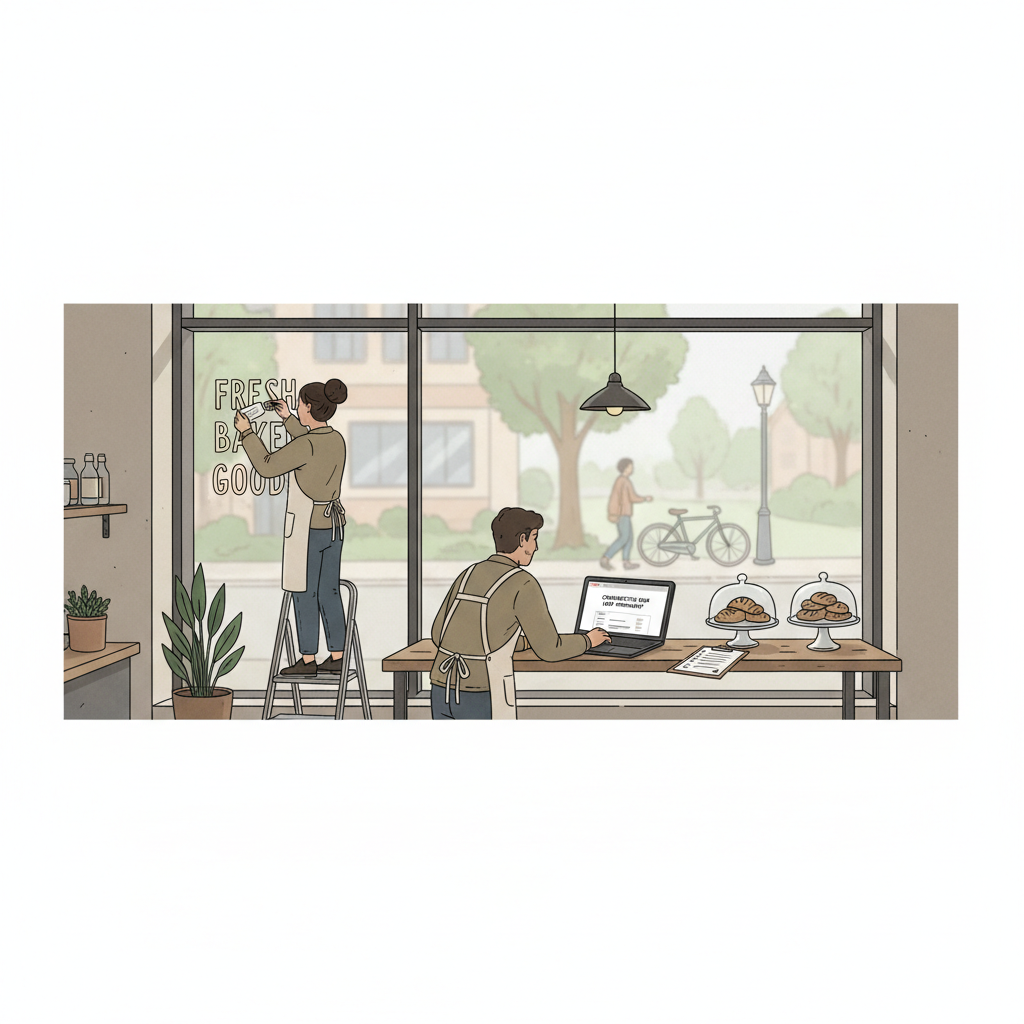
If you have a printer, invest $80–150 in a small vinyl sign or window cling with the new headline — it pays for itself.
Week 3 — Roll out to local listings and in-store
Objective: Make sure the same message appears everywhere customers find you.
Tasks (3–4 hours):
Audit and update: Google Business Profile, Facebook Page, Yelp, Nextdoor, and any directory listings.
Check opening hours and contact info for consistency.
Print a short script for staff to use on phone and at counter (see template below).
Phone script (copy-paste):
"Thanks for calling [Business Name]. We offer [one-sentence promise]. Can I help you with pickup, order, or hours?"
In-store script for staff (two lines):
"Hi — we make fresh breakfasts ready in under 5 minutes. Would you like to look at today's specials?"
Steal this template: "We help [audience] [outcome] without [pain]. Here's how →"
Week 4 — Lock a 5-post weekly rhythm and handoff
Objective: Stop improvising. Build a simple weekly content rhythm built from one anchor piece.
What actually works: A 5-post weekly rhythm built from one anchor piece — not daily improvisation.
Weekly rhythm (repeat each week):
Anchor post (longer explanation or customer story) — 1 per week.
Behind-the-scenes (short clip or photo) — 1 per week.
Customer review highlight — 1 per week.
Offer or CTA (special, booking link) — 1 per week.
Community or local shout-out — 1 per week.
Example week for a locksmith:
Monday (Anchor): 200‑word post explaining 3 scenarios when customers should call a locksmith now.
Wednesday (BTS): Photo of technician with a 10‑word caption and safety tip.
Friday (Review): Screenshot of a 5‑star review + thank-you note.
Saturday (Offer): "Weekend discount: 10% off lock rekeys — call to book."
Sunday (Local): Repost a neighbor hardware store's post and add a supportive line.
Local business example: A bakery in Brooklyn moved from 2 walk-ins/day to 11 by posting one behind-the-counter reel each morning.
30-minute weekly checklist (use this every Monday)
Post the anchor piece.
Schedule two smaller posts and one story.
Check business listing hours and phone number.
Reply to any direct messages or reviews.
Practical shortcut: You can build this system manually — or use BrandZilla to stay consistent without hiring a social media manager.
Example: 30-day timeline for a small plumbing company
Week 1: Decide brand promise — "We help homeowners fix leaks fast without paying for emergency rates." (3 hours)
Week 2: Update homepage headline, Google listing, and print a one-sheet for vans. (4 hours)
Week 3: Train technicians on a 15‑second customer script and update local directory listings. (3 hours)
Week 4: Start posting one anchor article weekly and 4 supporting posts. Track calls tagged with the new campaign. (2–3 hours)
Result (realistic): Within 30 days they saw a 15% increase in calls mentioning the website and a 10% uptick in booked jobs from the local pages.
Measurement — simple metrics that matter
Track these weekly:
Calls mentioning your website or a social post.
Local listing views and profile actions (Google Business Profile shows these).
Number of consistent posts published.
One soft metric: staff can state the brand promise from memory.
Aim for a 10–20% increase in profile actions or direct calls within 30–60 days. If nothing changes, revisit your promise — it’s probably still too vague.
Common objections and quick replies
"I don’t have time to do this." Split tasks: do Week 1 on a slow shift, and spread weeks 2–4 in 30–60 minute chunks. Delegate posting to one trusted employee.
"We can’t afford a new logo." You probably don’t need one. Focus on headlines and a single color update first.
FAQs
Q: What if I don't have time to post every day?
A: You don't need daily posting. Start with one anchor post per week and two smaller posts. Schedule them on one afternoon and reuse the content in-store. Next step: set aside 60 minutes on Monday to schedule the week.
Q: Can I reuse old content without looking repetitive?
A: Yes, if you edit the angle. Turn a customer review into a short video, a quote card, and a staff reaction post across two weeks. Next step: pick one good review and plan three formats for it.
Q: Do small businesses actually need a content calendar?
A: Yes, a simple calendar keeps you consistent and prevents last-minute decisions. Use a one-page weekly calendar — it’s enough. Next step: sketch one month’s themes on a single sheet.
Q: How long before posting consistently actually brings in customers?
A: Expect to see local awareness lift in 30–60 days and measurable calls or bookings in 60–90 days. Next step: track calls and ask "How did you find us?" for every booking.
Q: What if my staff won't use the scripts?
A: Keep scripts to one sentence. Role-play once on a slow day and reward the team when they nail it. Next step: print the script on the counter and run a quick practice session.
Small brand changes stack quickly. Pick clear language, update the few things customers see first, and lock a simple weekly rhythm. That’s what actually moves the needle for local businesses — not a full redesign.
If you want a short checklist you can print and hand to your team, you can use BrandZilla as a simple way to keep the plan running without hiring outside help.
Thanks for doing the practical work — your brand will start meaning something to local customers long before you consider a full rebrand.
The real objections — answered straight, no fluff.
BrandZilla Editorial Team
SMB MarketingContent Strategy
Practical playbooks written and reviewed by people who actually run content programs for small and local businesses — not generic AI output. Every guide is pressure-tested against what real operators do on Instagram, Facebook, LinkedIn and Google.
Used by 1,000+ businessesLast updated Jul 28, 20267 min read
Get weekly content ideas for your business
Join business owners getting practical, ready-to-post BrandZilla content prompts every week. No spam.