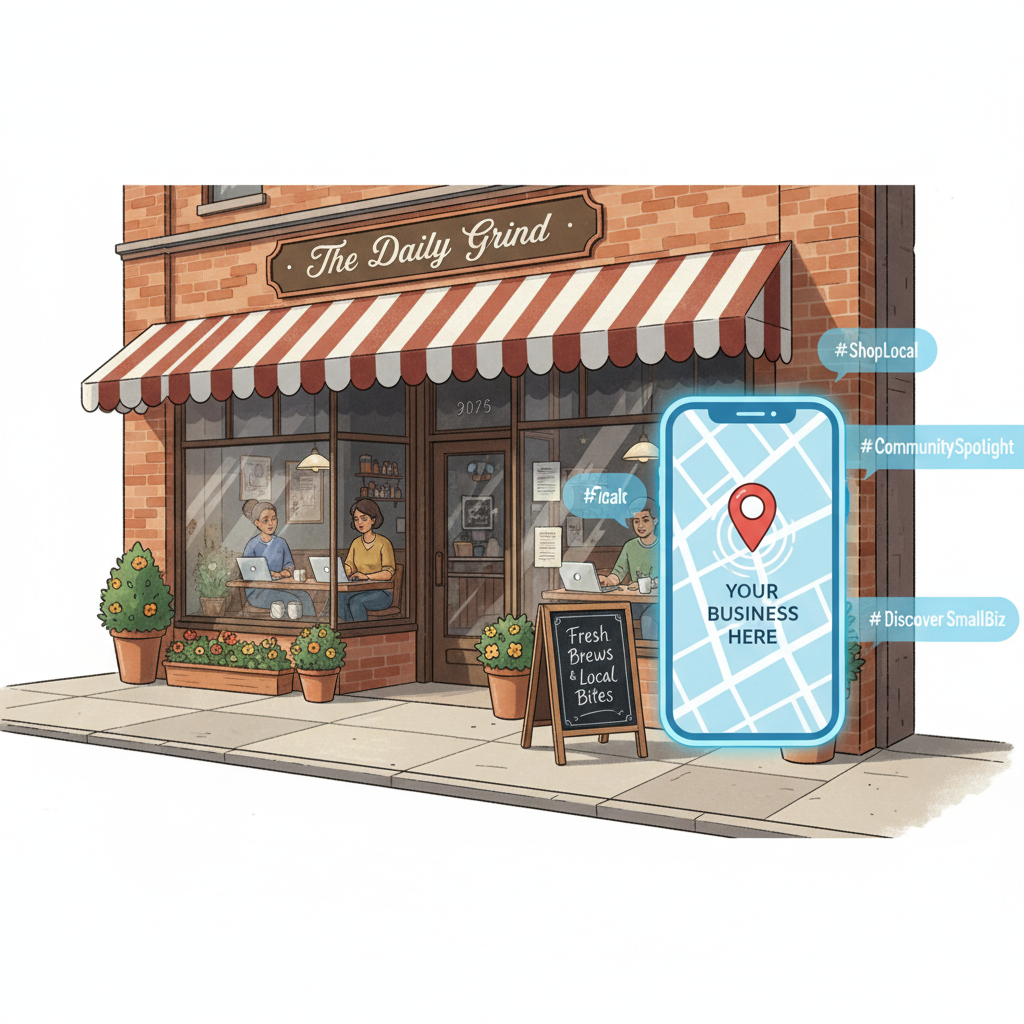
Local Hashtags & Location Tags That Actually Bring Customers
If your posts get likes but no customers, you’re misusing location signals. This guide shows which hashtags and location tags local businesses should use, when, and why.
6 min read
BrandZilla EditorialReviewed by marketing operators· Updated Jul 6, 2026· 6 min read
If your Instagram or TikTok posts get likes but not bookings, you’re doing something right — just not the right thing for local customers.
Most small-business owners think hashtags are for reach and location tags are for vanity. The reality: local tags are a search signal. Neighbors, tourists, and referral pages use them to find places to buy from this week.
This guide gives a clear, repeatable system: which tags to pick, how many to use, where to place them, and exact caption templates to convert views into walk-ins and calls.
Why local tags matter (but usually fail)
Short answer: people search locally. Long answer: discovery on social platforms has a strong local signal — location tags, neighborhood hashtags, and community pages all connect people who are physically nearby and ready to buy.
But most businesses fail because they treat tags like tossing breadcrumbs: random, inconsistent, and untargeted. That gets you vanity views, not customers.
Reality check: Most small businesses post 3x then quit. Consistency beats creativity 9 times out of 10.
The 3-tier tag system (use this every time)
Think of local tagging as three layers. Always include one from each tier.
Anchor location (mandatory)
The exact venue tag: your store, cafe, salon — the official location sticker.
Use this for every post. It tells the platform exactly where you are.
Neighborhood tags (3–5 tags)
City neighborhood names (e.g., #CapitolHill, #ChelseaNYC) and common local shorthands.
Choose 1-2 high-traffic neighborhood tags and 2-3 very specific micro-neighborhood or block tags.
Intent or moment tags (2–4 tags)
Tags that match what people are searching for now: #brunchnearme, #same-day-hair, #weekendbites.
Rotate these based on the post (events, menu items, services).
Always cap the total to platform norms: Instagram — ~10 well-chosen tags in caption + a location sticker; TikTok — 3–6 tags, prioritize intent tags plus neighborhood.
Quick win: Repurpose one customer review into a 3-post mini series this week.
How to pick the exact tags (15-minute audit)
Do this once and update quarterly.
Search your city + neighborhood on Instagram and TikTok. Note 6-8 tags with recent activity (posts within 7–14 days).
Open the top 3 accounts that feature businesses (local food accounts, neighborhood pages). Copy 2 tags they use frequently.
Check competitors: what location tag and neighborhood tags do they use? Mirror the good ones, but keep your anchor unique.
List 10 tags in a note: 1 anchor, 4 neighborhood, 5 intent. That becomes your weekly pool.
Platform-specific rules
Instagram
Use the location sticker (map pin) on Reels and Stories always.
Put primary tags in the caption (3–6) and any extras in the first comment if you must. Keep the visible caption readable; don’t clutter.
Use one emoji or short CTA in the caption: “Open until 8pm tonight — walk-ins welcome 🔥”
TikTok
Use fewer tags. Pick 2 neighborhood + 1–2 intent tags.
Pair tags with a short overlay text that says your neighborhood and call-to-action: e.g., “Free espresso shot today — East Village”.
TikTok rewards watch-time; your first 2 seconds should signal “local” (a street sign, shopfront, or quick voiceover with neighborhood name).
Facebook & X (formerly Twitter)
Use the standard location check-in; use 1–2 hashtags in posts if they add clarity.
Cross-post neighborhood-focused posts to local groups and pages (follow group rules — no hard selling).
Common mistake: Treating Instagram captions like tweets — context outperforms one-liners for local businesses.
Exact posting workflow (30–60 minutes weekly)
Do this once per week and reuse bits across posts.
Pick your anchor post of the week (30–40 mins). A photo, a short reel, or a customer story that highlights a product or service.
Write the caption with 3 parts: Hook (1 line), Value (2–3 lines), Local CTA (1 line with neighborhood). Example: “Late plans? We’re making fresh loaves until 7pm. 10% off if you mention ‘walk-in’ — East Williamsburg.”
Make 2 variants: a short Reel and a static post. For each variant, change one tag to test performance (swap one neighborhood tag).
Schedule or post: maps and tags are immediate signals; post during early evening for restaurants and before work hours for services.
What actually works: A 5-post weekly rhythm built from one anchor piece — not daily improvisation.
Copy-paste caption and tag templates
Use these verbatim and adjust a word or two.
Template A — Shop promotion
"Hot take: Our [product] sells out every weekend. Last batch at 5pm today — mention ‘walk-in’ for a free sample. Located in [Neighborhood]."
Tags (Instagram): [Your Location Sticker], #NeighborhoodMain, #NeighborhoodShort, #ThisWeekSpecial, #NearMe
Template B — Service availability
"Need a same-day [service]? We saved one slot at 4pm. Text us to claim — [Phone]. Serving [Neighborhood] and nearby.">
Tags (TikTok): [Your Location Tag], #SameDay[Service], #NeighborhoodName
Template C — Community tie-in
"Pop-up tonight with @[localmaker] — starts 6pm. Bring a friend and get 10% off food. Find us on [Street Name], [Neighborhood]."
Tags: location sticker, #PopUp[City], #NeighborhoodEvent, #WeekendPlans
Steal this template: "We help [audience] [outcome] without [pain]. Here's how →"
Mini-example: How a barber doubled bookings in 8 weeks
Joe’s Barber — a three-chair shop in Portland — started tagging his exact shop location, three neighborhood tags (#NortheastPortland, #AlbertaArts, #PortlandBarber), and two intent tags (#SameDayHair, #MenHaircut). He posted 2 Reels/week using the same template (shop exterior + quick clip of haircut + pinned location).
Result: Within 8 weeks Joe’s online appointment requests rose from 6/week to 14/week and walk-ins jumped from 4/day to 9/day. He spent one hour weekly on content.
Local business example: A bakery in Brooklyn moved from 2 walk-ins/day to 11 by posting one behind-the-counter reel each morning.
Quick experiments to run (7–14 days)
Swap one neighborhood tag each week and track which tag brings profile visits.
Run the same Reel with two different location stickers (your store vs. neighborhood park) and compare saves and directions taps.
Use a short local CTA like “walk-ins welcome” and measure calls or visits for a week.
Practical shortcut: You can build this system manually — or use BrandZilla to stay consistent without hiring a social media manager.
Pre-post checklist (do this every post)
Location sticker set to exact venue.
1 anchor neighborhood tag + 2–4 neighborhood/micro tags.
1–2 intent tags relevant to the offer.
Caption includes neighborhood name and a one-line CTA.
If a Reel, first 2 seconds show a clear local cue (street sign, shopfront, or voiceover).
Booking/appointment requests attributed to social.
Likes and followers help credibility, but if directions and calls don't change, change your tags and CTA.
Wrapping note
Local visibility is not guessing. Use the 3-tier system, pick tags intentionally, and run small experiments. Consistency wins: use one anchor post a week, tag it properly, and tweak one variable each week.
If you want a system that keeps the routine going, tools exist to help small teams stay consistent without hiring a full-time manager.
The real objections — answered straight, no fluff.
BrandZilla Editorial Team
SMB MarketingContent Strategy
Practical playbooks written and reviewed by people who actually run content programs for small and local businesses — not generic AI output. Every guide is pressure-tested against what real operators do on Instagram, Facebook, LinkedIn and Google.
Used by 1,000+ businessesLast updated Jul 6, 20266 min read
Get weekly content ideas for your business
Join business owners getting practical, ready-to-post BrandZilla content prompts every week. No spam.