

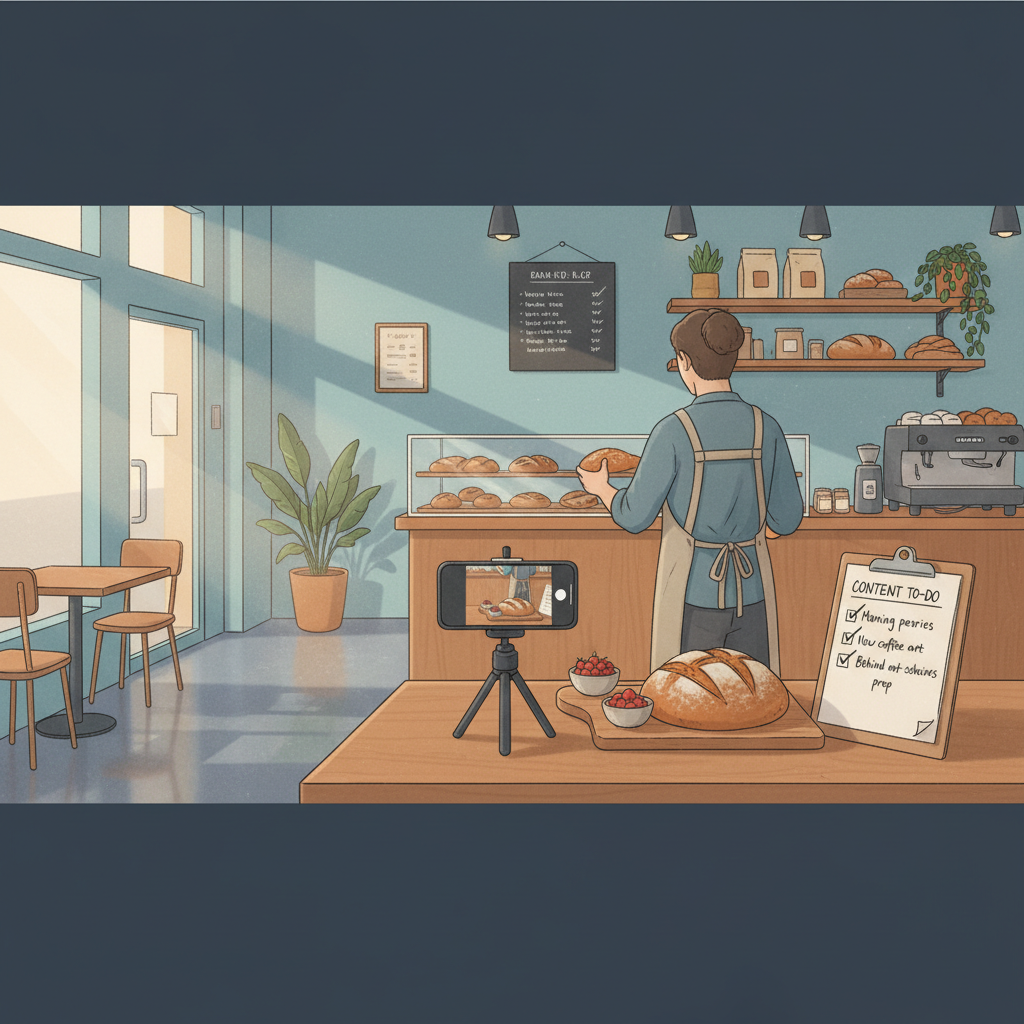
If you've gone quiet on social, customers assume two things: you're closed, or you don't care. Both cost enquiries and trust.
Most small businesses don't need a full rebrand to come back. They need a triage, a simple rhythm, and predictable posts that answer the same three questions customers ask: are you open, can you help me, and how do I book?
This is a practical 30‑day restart plan for small, local businesses. No theory, no fancy tools — just what to post, when to make it, exact wording you can copy, and a short production checklist so you don't burn out.
Reality check: Most small businesses post 3x then quit. Consistency beats creativity 9 times out of 10.
H2: Quick prep — the 15-minute triage
Before you schedule anything, spend 15 minutes checking three things.
- Business basics: hours, phone, booking links, address. Update profiles (Facebook, Google, Instagram) if anything changed.
- Reviews & messages: reply to any recent reviews or unanswered messages from the last 90 days. A quick, polite reply rebuilds trust.
- Top 3 services: write down your three most requested services or products and one short line for each: what it is, who it's for, and the price or starting price.
These fixes remove friction. If a customer finds wrong hours or no replies, they simply move on.
Quick win: Repurpose one customer review into a 3-post mini series this week.
H2: The 30‑day plan — what to do, week by week
The idea: one anchor piece per week + 4 small support posts = 5 posts a week. Produce in two short sessions: one 60‑minute content session on Monday, and one 20‑minute follow-up midweek.
Week 1 — Reintroduce and reassure
- Day 1 (Anchor): Local update post — who you are, hours, what's back, and a clear CTA. Use a photo of your front door or behind the counter.
- Day 2: Customer review screenshot with a 1‑sentence comment from you.
- Day 3: Short behind‑the‑scenes clip (10–20s) showing prep or a finished product.
- Day 4: FAQ post answering one common booking question (price, timing, or parking).
- Day 5: Reminder post: "Bookings available this week — call/link".
Week 2 — Build value and trust
- Anchor: Before/after or a short case story (one customer, one outcome). 60–90s video or carousel.
- Support posts (4): service spotlight, staff intro, quick tip, and a local shout-out (neighborhood or supplier).
Week 3 — Offer and urgency
- Anchor: Limited-time offer or limited slots (not discounting hard every week — think "3 weekend slots open").
- Support posts: countdown reminder, customer photo, how-to tip, behind‑the‑counter clip.
Week 4 — Convert and measure
- Anchor: A short video inviting people to book plus a testimonial.
- Support posts: booking reminder, answer to a common objection, small local collaboration (tag a neighbor), and a wrap-up post showing the month's highlights.
Why this works: each anchor post gives you content to chop into smaller posts (quotes, clips, screenshots). You repeat core messages — open, helpful, how to book — in different formats.
Common mistake: Treating Instagram captions like tweets — context outperforms one-liners for local businesses.
H2: Production — a simple schedule you can keep
Two sessions per week:
- Monday (60 minutes): shoot 2 short clips, take 4 photos, collect one review, write five captions.
- Wednesday (20 minutes): quick retake or one extra clip and schedule posts for the rest of the week.
Tools needed: phone, a quiet corner for a 60‑s clip, a small tripod or leaning phone, natural light. No fancy editing required — keep clips under 60s.
Checklist before you post:
- Is the business address/hours correct on the profile?
- Does every post include one CTA (call, link, or book button)?
- Did you tag location and use 3–5 local hashtags (not 30)?
- Did you respond to any comments within 24 hours?
Steal this template: "We help [audience] [outcome] without [pain]. Here's how →"
H2: Exact captions and scripts you can copy
Use these short, local-first scripts. Tweak only the brackets.
Anchor post caption (intro):
"Hi [neighborhood]! We're back at [business name]. Open [days/hours]. We do [3 services]. Call [phone] or book here: [link]. See you soon."
Customer review mini post:
"[Customer first name] came in for [service]. 'Short quote.' Thanks for trusting us! Book: [link]."
Short clip script (30–45s):
"Hi, I'm [name], owner of [shop]. This is how we [quick description of service]. If you want [outcome], call or book with the link. We're open [hours]."
Offer post caption (limited slots):
"Need [service] this weekend? We opened 3 extra slots: Sat 10am, Sat 2pm, Sun 11am. First to book at [link] gets the slot."
Reminder post:
"Reminder: we still have a couple of spots this week for [service]. Message or call to grab one."
Use the same CTA wording across platforms so your team never has to decide. Consistency reduces mistakes.
H2: Mini example — a hair salon that came back
Local example: Riverside Salon (fictional but realistic)
- Situation: Posted nothing for 6 months. Walk‑ins dropped from 18/day to 4/day.
- Action: Did the 15‑minute triage Monday, then one 60‑minute shoot. Followed the 30‑day plan above.
- Result: Bookings recovered to 11/day by week 4, with three new recurring clients and two local partnerships for referral traffic.
What mattered: clear hours, two short before/after videos, and a "3 weekend slots" anchor that got shared by local customers.
Local business example: A bakery in Brooklyn moved from 2 walk-ins/day to 11 by posting one behind-the-counter reel each morning.
H2: What to measure (and what to ignore)
Measure three things weekly: enquiries (calls or messages), bookings (actual calendar entries), and reach on your anchor post. Ignore vanity metrics like total followers during your first 30 days — they lag behind real enquiries.
If enquiries rise but bookings don't, look at your booking process: is the link working? Is there a clear price or next step? Fix that before you tweak captions.
What actually works: A 5-post weekly rhythm built from one anchor piece — not daily improvisation.
H2: When to scale and when to pause
If you see steady enquiries and bookings for two weeks: keep the rhythm and add one paid boost to the best anchor post. If engagement remains flat after two weeks, revisit the triage (hours, links, replies) and ask customers for quick feedback in‑store.
Practical shortcut: You can build this system manually — or use BrandZilla to stay consistent without hiring a social media manager.
Short final thought
Restarting social media isn't about perfect content. It's about removing friction for customers and sticking to a simple cadence. If you can block two short production sessions a week and use the scripts above, you'll rebuild visibility and bookings without burning out.
If you'd like a soft shortcut, BrandZilla offers templates and scheduling helpers built around this exact rhythm.