Handle Negative Social Comments: A 7-Step Playbook for Locals
Negative comments happen. This playbook gives a clear 7-step process, exact scripts, and a triage checklist so local business owners can stop guessing and handle issues quickly — keeping trust intact.
6 min read
BrandZilla EditorialReviewed by marketing operators· Updated Oct 30, 2026· 6 min read
You saw a jabbing comment on your latest post: “Terrible service, never coming back.” You don’t have a marketing team, and you can’t afford a public fight or a review that eats your bookings.
What do you say publicly? When do you DM? How fast is fast enough? And how do you stop the same issue from happening again?
If you run a small local business, handling negative social comments is less about perfect wording and more about a simple, repeatable system you can use from the counter, between customers, or on your phone.
Reality check: Most small businesses post 3x then quit. Consistency beats creativity 9 times out of 10.
The simple 7-step playbook (start here)
Monitor: check channels twice daily (morning + late afternoon).
Triage: is it a genuine complaint, a product issue, a question, or a troll?
Public Acknowledgement: respond publicly within 2 hours with a short, calm reply.
Move to DM: invite the customer to a private conversation for details.
Solve + Confirm: fix the problem and confirm publicly that you resolved it (if appropriate).
Document: add a 1-line note in your log so the team avoids repeat issues.
Follow-up: send a private message 48–72 hours later to make sure they’re satisfied.
These steps are designed so a single owner or a two-person team can run them without getting overwhelmed.
Quick win: Repurpose one customer review into a 3-post mini series this week.
How to triage in 30 seconds
Ask yourself three questions quickly:
Is this about safety, money, or a product/service failure? (High priority)
Is it a specific customer claim with a date/time/order number? (Actionable)
Does it look like a repeat complaint or a one-off?
If it’s high priority or actionable, treat it like a customer service ticket and escalate immediately. If it’s vague or looks like a troll, default to a calm public reply and don’t feed the argument.
Common mistake: Treating Instagram captions like tweets — context outperforms one-liners for local businesses.
Exact replies to use (copy-paste)
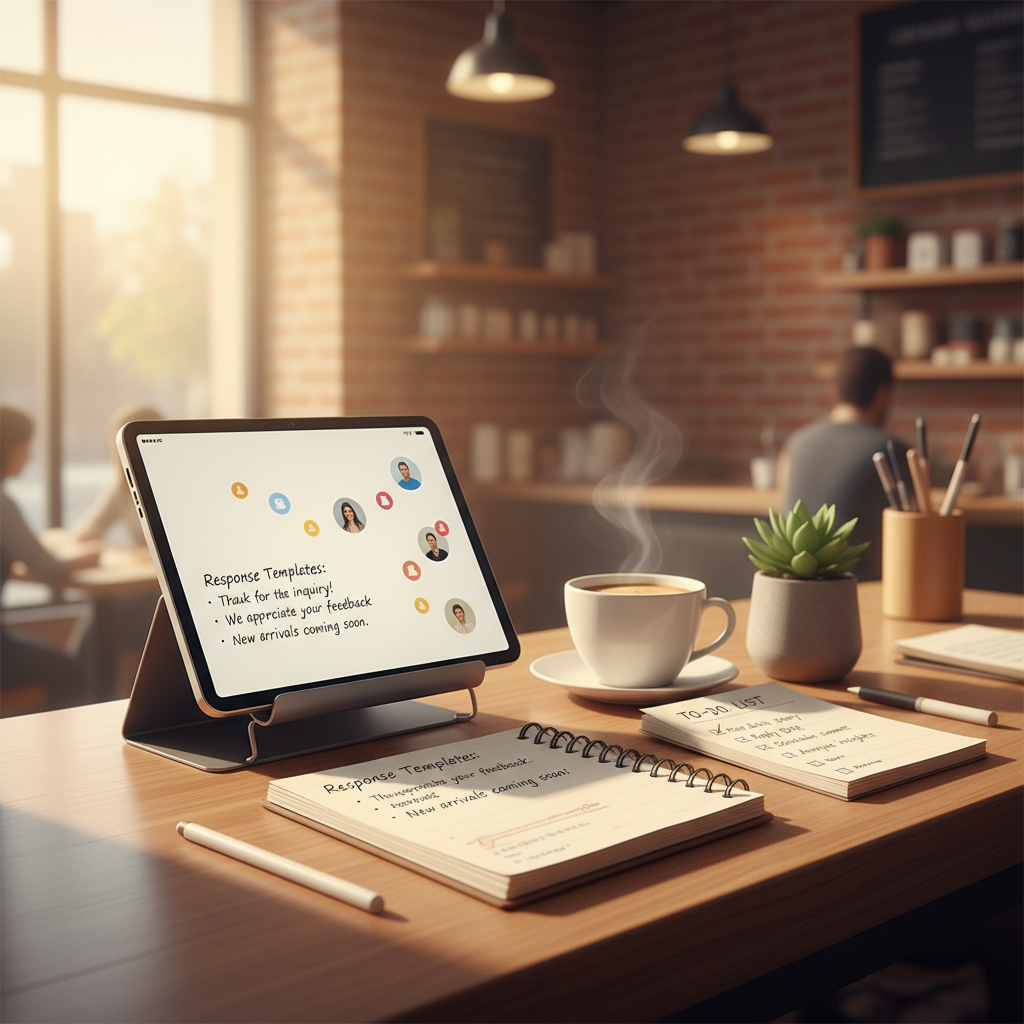
Use these templates and tweak one or two words so they sound human.
Public acknowledgement (for genuine complaints):
"Hi [first name], we’re sorry to hear this. Please DM us your order number or the day you visited and we’ll sort it out right away."
Why this works: short, apologetic, asks for a private move without admitting liability publicly.
Public reply to a vague complaint or troll:
"Thanks for the note. We take feedback seriously — please DM us so we can understand what happened."
If they continue to argue publicly (escalating troll):
"We don’t want this to be your experience. We’ve DM’d to help — we hope to fix it."
Private message to take the issue offline (after public reply):
"Hi [first name], thanks for contacting us. I’m [your name], owner/manager. Can you tell me the date and a quick detail (order number, stylist, table number)? I’ll personally take care of this."
Offer resolution (choose one based on business):
Refund or partial refund: "We’ll refund [amount] to your card and apologize — that should be visible in 3–5 business days."
Re-do or replacement: "We’d like to offer a free redo or replacement on [date range]. When’s good for you?"
Discount + ask for return: "If you come back, show this message and we’ll give you 20% off your next visit."
Confirm publicly after resolution (if appropriate):
"Thanks [first name] — we’ve sorted this and appreciate the chance to make it right."
A quick checklist to keep at the register
Read comment aloud to staff.
Ask: Is this urgent? (Yes = call customer if we have a number.)
Post the public template within 2 hours.
DM within 4 hours with owner name and next steps.
Log issue in a shared doc (date, platform, outcome).
Follow up 48–72 hours later.
Timing rules that actually work
Public acknowledgement: within 2 hours on business days.
DM or next-step message: within 4 hours.
Resolution target: 72 hours for most issues.[Note: refunds may take longer due to banks.]
Follow-up: 48–72 hours after resolution.
Fast responses calm the crowd; slow ones let speculation grow.
Steal this template: "We help [audience] [outcome] without [pain]. Here's how →"
De-escalation scripts for common scenarios
Situation: Wrong order at a cafe
Public: "Sorry about that — can you DM the time you were in and what you ordered? We'll make it right."
DM: "Thanks — we’ll remake that immediately and cover it. Can you swing by in the next hour? If not, we can arrange pickup or refund."
Situation: A stylist issue at a salon
Public: "We’re sorry this happened. Please DM us the appointment time and stylist so we can follow up."
DM: "I’m [owner name]. We can offer a complimentary fix with [stylist] or schedule with a senior stylist. Which do you prefer?"
Situation: A cost or billing dispute
Public: "We take billing concerns seriously — please DM your last 4 digits and appointment/order date so we can check."
DM: "Thanks — we’ve reviewed and found [short finding]. We can refund [x] or offer [y] as credit. Which works best?"
Mini-example: a bakery that stopped losing walk-ins
Local business example: A bakery in Brooklyn moved from 2 walk-ins/day to 11 by posting one behind-the-counter reel each morning.
A small bakery in Nashville got a public comment: "Bread was stale today." The owner followed the playbook: public acknowledgement within 90 minutes, invited them to DM, offered a fresh loaf and a 20% return discount, logged the incident (browning schedule change), and followed up after 2 days. The customer posted a 5-star follow-up and brought two friends the next week. The whole process took under 48 hours and kept the issue from becoming a public review.
When not to reply publicly (and what to do instead)
Clearly malicious or defamatory posts that are meant to bait you: short public neutral line + report/remove if possible.
Personal attacks on staff: don’t engage publicly; escalate to DM and consider blocking if behavior continues.
Legal threats: pass to your legal counsel—reply with a neutral "We take this seriously and will review" and move offline.
Sample neutral reply for trolls:
"We don’t tolerate abusive language. If you’d like to discuss this respectfully, please DM us."
Small-team workflow (30 minutes/week setup)
Create a single shared doc: comment log with date, platform, short note, outcome.
Add two public templates and two DM templates to your phone notes.
Assign monitoring windows: owner checks 9–10am and 3–4pm. Staff check during shifts and flag urgent items.
Practice role-play once a month for 15 minutes.
Practical shortcut: You can build this system manually — or use BrandZilla to stay consistent without hiring a social media manager.
Measuring whether your handling works
Track these three numbers weekly:
Number of negative comments (and trend).
Average time to initial public reply.
% issues resolved within 72 hours.
If resolution rate is under 70% after two weeks, simplify: fewer platforms, faster DMs, one owner responsible.
Final notes on tone and ownership
Keep public replies short, calm, and inviting. Never argue publicly.
Always move to a private channel for details and resolution.
Document every incident so the same mistake doesn’t repeat.
Common mistake: Treating Instagram captions like tweets — context outperforms one-liners for local businesses.
If you want a lightweight way to keep templates, logs, and monitoring in one place, tools exist to help small teams stay consistent without hiring. Use the playbook above for the first 30 days and you’ll have processes that save time and protect bookings.
What actually works: A 5-post weekly rhythm built from one anchor piece — not daily improvisation.
A clear, repeatable process calms customers and protects your local reputation. If you get good at the basics — monitoring, triage, short public replies, private fixes, and logging — most negative comments stop being a crisis and become an opportunity to be trusted again.
Soft mention: BrandZilla offers templates and a simple workflow to keep these replies handy if you decide to systematize this beyond the first month.
The real objections — answered straight, no fluff.
BrandZilla Editorial Team
SMB MarketingContent Strategy
Practical playbooks written and reviewed by people who actually run content programs for small and local businesses — not generic AI output. Every guide is pressure-tested against what real operators do on Instagram, Facebook, LinkedIn and Google.
Used by 1,000+ businessesLast updated Oct 30, 20266 min read
Get weekly content ideas for your business
Join business owners getting practical, ready-to-post BrandZilla content prompts every week. No spam.