How to Run a Limited-Time Offer That Actually Brings Customers
Short-term promotions can work — if you plan them to attract new customers, protect margins, and avoid teaching people to wait for sales. This playbook gives an exact timeline, pricing rules, promotional scripts and measurement checklist.
6 min read
BrandZilla EditorialReviewed by marketing operators· Updated Sep 26, 2026· 6 min read
Open with the real business problem in the reader's own words.
I want a quick promotion to fill the calendar this month, but every time I run a sale customers ask "when's the next one?" and I end up with lower margins. How do I bring people in this week without training them to only buy on sale?
If that sounds like you, this article is a practical, shop-floor-tested playbook. It walks through timing, pricing, channels, staff scripts, and measurement so your limited-time offer brings incremental customers — not just discounts.
1. Decide the offer type (don’t default to a percentage off)
Pick one of three offer types. Each behaves differently with your regulars and margins.
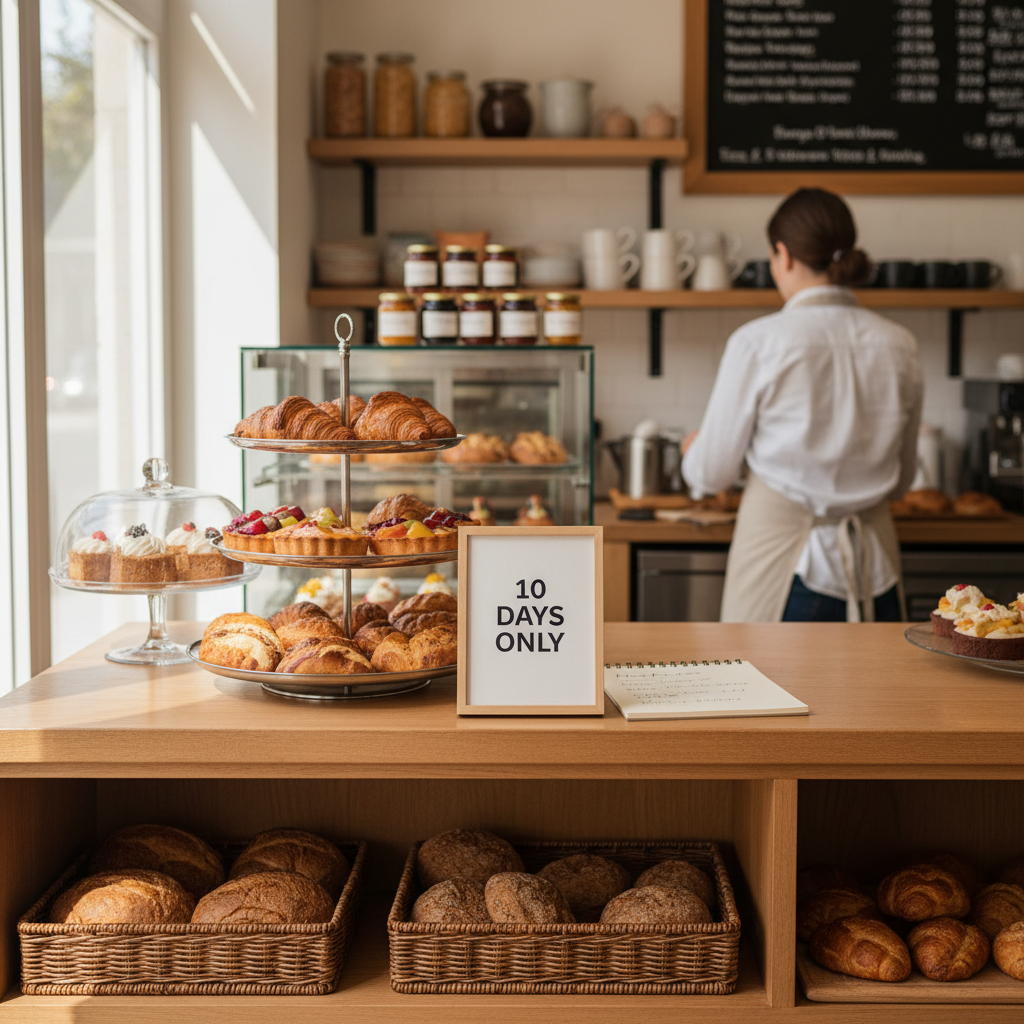
Value-add package: bundle in a small extra (free add-on, upgrade, or complimentary service) that costs you little but reads as premium. Example: a bakery offers a free coffee with any loaf for 10 days.
Time-limited convenience: offer earlier or later appointment slots at a slightly discounted rate for off-peak times. Example: a salon sells 2pm weekday slots at 15% off for 7 days.
True discount, capped and targeted: if you must discount, set a clear cap (10–20%) and restrict to new customers or specific inventory.
Why not deep discounts? Deep or frequent discounts train customers to wait. Value-adds increase perceived value without erasing your price anchor.
Reality check: Most small businesses post 3x then quit. Consistency beats creativity 9 times out of 10.
2. Rules that protect your margins and future pricing
Set three hard rules before you promote. Write them down and share with staff.
Length: 7–14 days is usually best. Too short and nobody sees it; too long and it becomes the new normal.
Eligibility: new customers only, first-time service, or specific SKUs. Don’t let regulars stack the offer.
Limit per customer: one use per person, no combining with other offers.
Pick numbers now and treat them like immutable. When staff waver, customers notice and your anchor erodes.
3. Timeline: a 3-week playbook (ready-to-run)
Week 0 — Prep (3 days)
Price and rules finalised. Update POS, website, booking system.
Day 1: Email + SMS to current customers (if eligible rules allow). Post on main social channels.
Day 3: Paid local boost (optional) focusing on new customers within 3–5 miles.
Day 6: Reminder posts and a staff push to ask in-person customers.
Week 2 — Close and measure (3–4 days)
Final 48-hour reminder across channels.
Pull report: bookings, source, average sale, and repeat-rate 14 days later.
Quick win: Repurpose one customer review into a 3-post mini series this week.
4. Exact copy you can paste
Use these templates. Edit only the bracketed parts.
Email announcement
Subject: [Name], a small offer — 10 days only
Body: We’re offering [value-add or discount] from [start date] to [end date]. This is available for [new customers / off-peak slots / specific service]. Book now — slots are limited. [link to booking]
[Hook one line: “Summer refresh — 10 days only.”]
What’s included: [short bullets]. Who it’s for: [new customers / weekdays / first-time]. Book: link in bio or tap to call. Limited spots.
Facebook post (local):
We’re running [offer name], [dates]. Only [number] spots per day. Tag a friend who needs this and we’ll hold one spot for them. Book: [link]
Point-of-sale sign
“10 days only — [offer]. One per customer. Ask staff how to book.”
Staff script (3 lines)
“Quick heads-up: we’re running a short [offer name] from [start] to [end]. It’s for [who]. If you know someone looking for [benefit], we can book them in now.”
Common mistake: Treating Instagram captions like tweets — context outperforms one-liners for local businesses.
5. Where to promote (prioritise reach and speed)
Booking confirmation emails: add a one-line promo snippet to confirm emails.
SMS: highest open rate for urgent promotions. Use for last-chance messages.
Organic social: announcements + daily reminder stories or short videos behind the scenes.
Local paid boost: a small $50–150 boost targeted to new customers in a 3–5 mile radius works better than broad campaigns.
In-store signage and staff mentions: converts walk-ins and existing appointments.
6. Measure the right things (not vanity metrics)
Track these each time you run a promotion:
Incremental bookings: total bookings during promo minus average bookings in the prior same-length period.
New customers: how many first-time clients booked because of the offer.
Average order value: did it fall or hold? If it fell more than 10–15% you likely discounted too deep.
Repeat rate at 14–30 days after visit: are these customers coming back at full price?
A neighborhood salon averages 40 appointments/week. They run a 10-day "Summer Refresh" value-add (free deep conditioning with color) and cap to new clients. Results: 18 incremental bookings in the promo window (+45%), average ticket held steady (product upsells covered conditioning cost), and 6 of the 18 returned within 21 days at full price. Profit-positive and did not change regular pricing expectations.
7. Avoid the five pricing traps
Never run the same offer twice in the same quarter.
Don’t discount across the board; target new customers or specific times.
Avoid open-ended “while supplies last” if inventory is plentiful—set firm end dates.
Don’t mix promos with your loyalty or referral program unless you want permanent expectation.
Don’t rely on a single channel — combine SMS + social + in-store mention.
What actually works: A 5-post weekly rhythm built from one anchor piece — not daily improvisation.
8. Quick A/B test you can run
Split the promotion into two identical offers but change one element: channel or benefit.
Test A: 10% discount for new customers promoted via Facebook.
Test B: Free add-on (same perceived value) promoted via SMS.
Run both for a week each and compare new customer bookings and average order value. The winner tells you whether price or convenience drove the decision.
Steal this template: "We help [audience] [outcome] without [pain]. Here's how →"
9. Post-promo follow-up (turn one-off into repeat)
Send a thank-you email within 48 hours with a next-step offer (not a discount—try a small bundle or priority booking window).
Ask for a review within 7 days. One good review can power the next promo’s organic reach.
Track the repeat purchases and add the new customers to a soft nurture list only for full-price offers.
Local business example: A bakery in Brooklyn moved from 2 walk-ins/day to 11 by posting one behind-the-counter reel each morning.
Practical shortcut: You can build this system manually — or use BrandZilla to stay consistent without hiring a social media manager.
How often should you run a short-term promotion?
Once every 8–12 weeks for most service businesses is a safe cadence. Retail that relies on turnover can do 6-week windows if offers are rotated and always positioned as seasonal or limited collection items.
Final thought
The most important discipline is discipline: set the rules, stick to the dates, measure the lift and repeat only what increased new customers without hurting margins. Done correctly, short-term offers are not discounts — they’re acquisition tools.
If you want an organized set of templates and a simple calendar format to reuse, a template-driven system can save the guesswork and keep you consistent.
The real objections — answered straight, no fluff.
BrandZilla Editorial Team
SMB MarketingContent Strategy
Practical playbooks written and reviewed by people who actually run content programs for small and local businesses — not generic AI output. Every guide is pressure-tested against what real operators do on Instagram, Facebook, LinkedIn and Google.
Used by 1,000+ businessesLast updated Sep 26, 20266 min read
Get weekly content ideas for your business
Join business owners getting practical, ready-to-post BrandZilla content prompts every week. No spam.