Problem — said plainly:
You're launching a short promotion because slow weeks are piling up and 'post more' hasn't helped. You need more people through the door next month — not vague engagement metrics.
But every time you try a promotion it either feels messy, the offer's confusing, or you can't tell whether your marketing actually worked. You don't have a marketing team and you need a plan that fits into one or two hours of weekly work.
This is that plan: a tight, 4-week playbook with exact offer rules, a weekly content rhythm, copy templates you can paste and tweak, and a simple tracking checklist so you know whether you won.
H2: The one-sentence rule for short promotions
Keep it: "One offer, one audience, one clear action." If your headline needs a footnote, simplify.
Why that matters:
- Confused customers don't convert. A clear offer with a clear next step increases redemption rates.
- Small teams need repeatable work. One offer + one action is easy to explain to staff and to track.
Reality check: Most small businesses post 3x then quit. Consistency beats creativity 9 times out of 10.
H2: Offer-building rules (do these first)
Follow these rules when creating the promotion itself. Skip any brainy discounts — keep it obvious and easy to redeem.
- Value you can explain in one line
- Example: "Buy one pastry, get the second 50% off before 11am." That explains value, limit, and time.
- Short redemption window
- 4 weeks. No rolling offers. Make urgency real by setting explicit end dates.
- One redemption channel
- In-store coupon code (paper or QR), online code, or POS mention. Don't mix three different codes.
- Low friction to claim
- No signup, no long forms. If you need a lead, ask for an email only at checkout for a chance to win something small.
- A measurable hook
- Use a unique code like SPRING24 or a QR that lands on a UTM-tagged page.
H2: The 4-week calendar (workload: 1–2 hours/week)
This is a minimal weekly rhythm that still builds momentum.
Week 0 — Prep (2–4 days before launch)
- Create offer and unique code/QR.
- Design one hero image for social and email (use phone photo + simple overlay).
- Set up a landing page with the deal and a form (optional) — include the redemption instructions and the "How did you hear about us?" field.
- Train staff with a one-paragraph script for in-person asks.
Week 1 — Launch (1 hour)
- Anchor: Email to your list (if you have one). Subject options below.
- Social: 3 posts across the week (launch post, behind-the-scenes making the offer, customer testimonial).
- In-store: Poster and tabletop cards.
Week 2 — Momentum (1 hour)
- Anchor: Short video (30–45s) showing the product or the team using the offer.
- Social: 3 posts (video, reminder, user photo repost).
- Paid boost: $30 post boost on the top-performing organic post.
Week 3 — Amplify (1–2 hours)
- Anchor: Limited-time reminder email with a single CTA to claim before it ends.
- Social: 4 posts (countdown posts on days 10 and 5, customer photo, staff pick).
- Community: Drop flyers at one nearby business (cross-promotion).
Week 4 — Close & convert (1 hour)
- Last-chance posts and one final email.
- In-store: Offer a small upgrade to anyone redeeming the code on the final weekend (keeps revenue healthy).
- Measure: Pull redemption data, traffic, and staff notes.
Quick win: Repurpose one customer review into a 3-post mini series this week.
H2: Exact copy templates (copy and paste)
Subject lines (pick one):
- "This week only: Buy one pastry, get the 2nd 50% off before 11am"
- "Limited: Morning buy-one-get-one — this month only"
- "End-of-month special: Bring a friend, get 50% off"
Social captions
-
Launch post (image of product): "Starting today: Buy one pastry, get the 2nd 50% off before 11am. Show this post or scan the QR to redeem. Ends [date]."
-
Behind-the-scenes (Reel clip or story): "How we make your morning better: [2–3 quick shots]. Come try the deal before 11am — this month only."
-
Reminder (mid-promotion): "Halfway through and already printing more orders. Have you tried our morning BOGO? Ends [date] — quick, grab a friend."
SMS (90 chars max ideal):
- "This week: BOGO pastry before 11am. Show code SPRING24. Ends [date]."
In-store script for staff (30 seconds):
- "We have a morning special this month: buy one pastry, get the second half off before 11. Just mention SPRING24 at the counter. Would you like to try one today?"
Sign copy for counter/door:
- "This month only: Morning BOGO before 11am. Scan QR to learn more or mention code SPRING24."
Steal this template: "We help [audience] [outcome] without [pain]. Here's how →"
H2: Tracking and simple metrics that matter
What to track (keep it small):
- Redemptions of your unique code (weekly total).
- Walk-ins or bookings attributed to the promo (ask one question at checkout).
- Email opens and clicks for the two emails.
- Revenue from promo vs average sale (to check profitability).
Targets (example):
- If you normally get 20 walk-ins/day, aim for a 30–60% lift during promotion weeks (26–32/day). That's realistic for a clear, limited offer.
- Expect email CTRs of 5–12% for small lists; if you're below 3%, change subject lines and resend.
Minimum acceptable result: positive profit margin or a plan to turn promotional visitors into repeat customers (collect email + invite back).
H2: Testing and what to tweak
Don't guess. Tweak one variable at a time.
- If redemptions are low: improve visibility (signage, QR placement), or shorten the time window (make mornings more exclusive).
- If redemptions are high but margins bleed: add a minimum purchase or change from 50% off to "get an item up to $X free".
- If social engagement is high but redemptions low: make the CTA clearer and add an in-post code.
Common mistake: Treating Instagram captions like tweets — context outperforms one-liners for local businesses.
H3: Mini example (exact numbers you can copy)
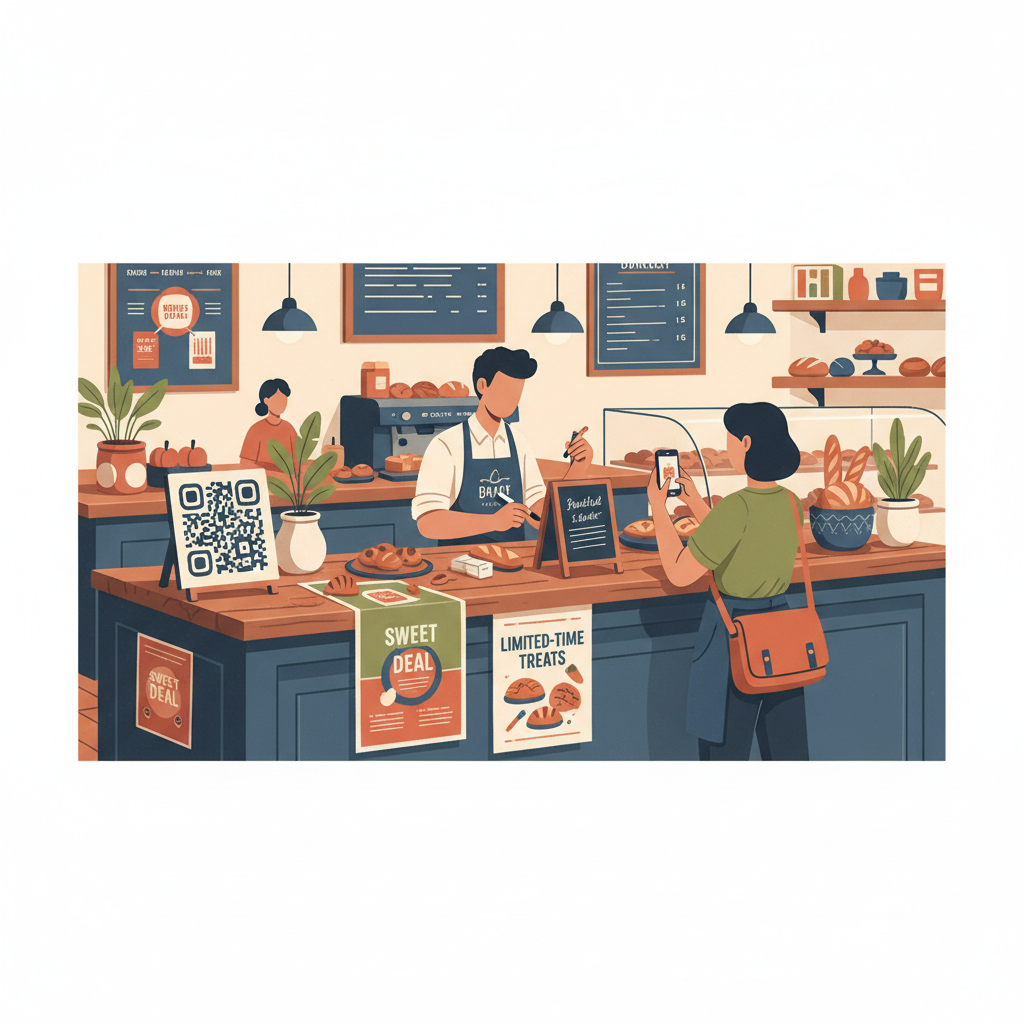
The plan below is for a neighborhood bakery that wanted more morning foot traffic.
Baseline: 12 walk-ins/day in the 7–11am window.
Offer: "Buy one pastry, get the second 50% off before 11am." Code SPRING24. Four-week run.
Tactics used:
- Week 0: Printed posters, QR to a small landing page, trained staff.
- Week 1: Email to 800 subscribers (subject: see above). Open 22%, CTR 8% → 14 redemptions week 1.
- Week 2: Posted a behind-the-counter reel, $30 boost → 46 redemptions week 2.
- Week 3: Flyer drop at nearby office building → 70 redemptions week 3.
- Week 4: Last-chance weekend + small $0.75 upsell on each redemption → 90 redemptions week 4.
Result: Average morning walk-ins rose from 12/day to 28/day by week 4. Revenue per redemption remained positive because of the upsell.
Local business example: A bakery in Brooklyn moved from 2 walk-ins/day to 11 by posting one behind-the-counter reel each morning.
H2: Staff brief (one page)
Give staff this short checklist they can pin behind the counter:
- Offer: Morning BOGO (50% off 2nd item) — code SPRING24.
- How to redeem: Customer shows post, scans QR, or says the code.
- Upsell cue: "Would you like a coffee with that?" (offer a small price-point add-on.)
- How to record: Note every redemption in the daily log with name or code.
What actually works: A 5-post weekly rhythm built from one anchor piece — not daily improvisation.
H2: Final checklist before launch (10 minutes)
- Create hero image and QR.
- Print one poster and a few counter cards.
- Put the code into your POS and tell staff.
- Draft two emails and one SMS.
- Create the landing page with the form and "How did you hear about us?" field.
Practical shortcut: You can build this system manually — or use BrandZilla to stay consistent without hiring a social media manager.
Short closing thought
A 4-week promotion should feel like tight experiments, not a permanent position. Run it like a short campaign: clear offer, simple tracking, and one tweak at a time. If you get the rhythm right, those new customers are the start of better repeat business, not just a weekend spike.
Soft note: If you ever want a template system to keep these campaigns tidy, BrandZilla has practical bundles for local teams.