How to Get Local Customers from Facebook — Without Ads
Stop posting random updates and hoping for customers. This playbook shows a 5-step Facebook system for local businesses that produces steady inquiries without paid ads — with exact post templates, a weekly rhythm, and a 6‑week testing plan.
6 min read
BrandZilla EditorialReviewed by marketing operators· Updated Sep 20, 2026· 6 min read
You post once, get a couple of likes, and then nothing. Or you try copying what big brands do and it feels wrong for your shop. Either way: you need customers, not impressions.
If you can't afford consistent ads, Facebook still works — but only when you treat it like a local storefront: clear info, the right rhythm, and simple social proof that makes people pick up the phone.
This is a hands-on, 6‑week plan to turn Facebook activity into bookings and foot traffic. No agency jargon, no paid-ads trickery — just a repeatable content system and exact wording you can use this week.
The 5-step local Facebook system (high level)
Fix the front door (profile, hours, CTA).
Build an anchor piece each week and spin five posts from it.
Ask for tiny engagement that leads to messages or calls.
Use local social proof (customer photos, results, numbers).
Track a single conversion metric and iterate for 6 weeks.
Reality check: Most small businesses post 3x then quit. Consistency beats creativity 9 times out of 10.
1 — Fix the front door (15–30 minutes)
Checklist: what a customer must see in 15 seconds
Business address and map pin. Confirm Match with Google Maps.
Phone number that rings during business hours.
One-line offer in the About section: what you do and who you serve.
Clear call-to-action button (Book Now / Call Now / Message).
Current hours and holiday closures.
Why it matters: People who find you on Facebook are often ready to act. If details are missing they leave immediately.
Quick copy for About: “We help [neighborhood] homeowners fix urgent plumbing without surprise bills. Call for same-day slots.”
2 — Weekly anchor + 5-post spin (the content engine)
Pick one meaningful piece each week — the "anchor" — then repurpose it into five distinct posts. This creates enough variety to stay visible without inventing new topics daily.
Anchor examples (pick one per week):
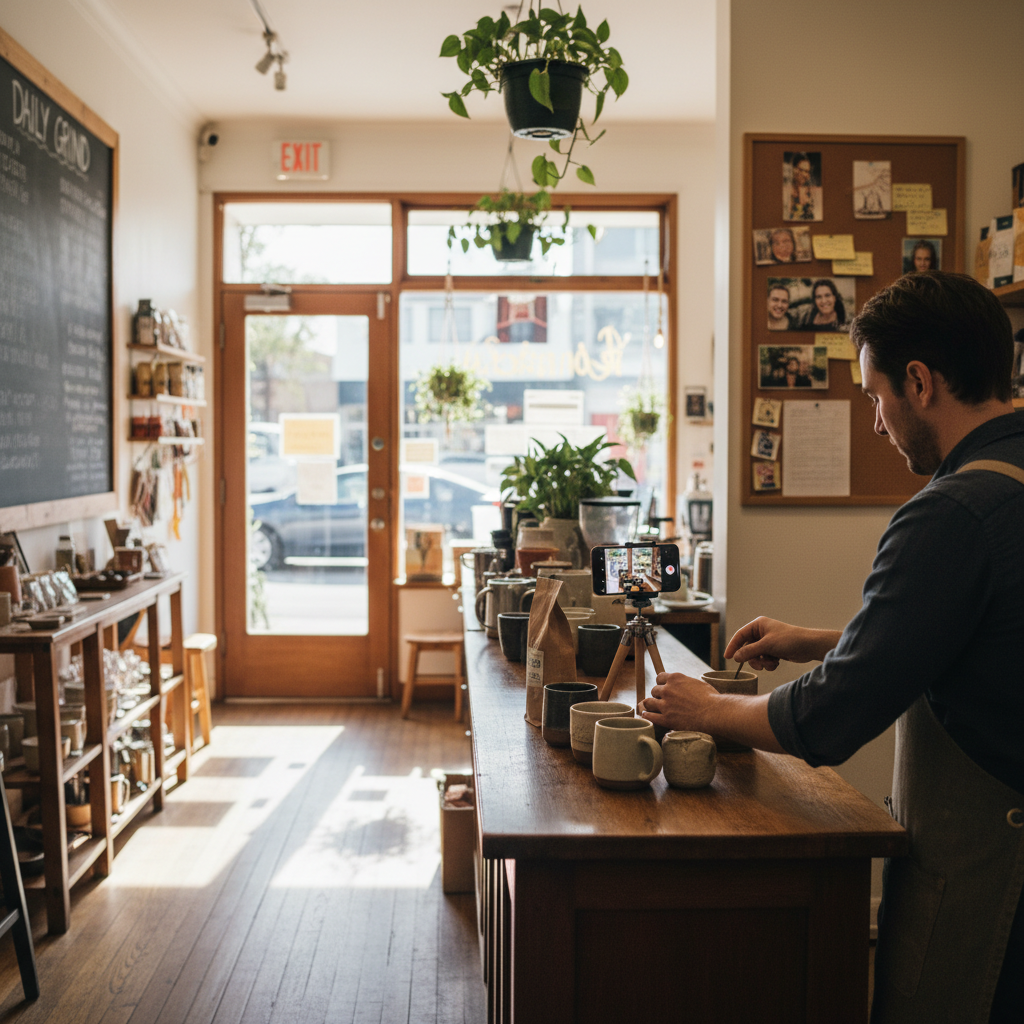
A 60–90s behind-the-counter video showing how a product is made.
A before/after project photo with short notes.
A one-minute customer story (permission granted).
A short how-to demo (e.g., “How to stop a leaking tap in 3 steps”).
From that anchor, create this 5-post rhythm:
Anchor post (video or carousel) — 60–90s or 4–6 images.
Local tip — one practical line that helps the neighborhood.
Customer result (photo + quote) — social proof.
FAQ or myth-bust — answer the most common question.
Micro-CTA — direct booking push or limited offer.
Quick win: Repurpose one customer review into a 3-post mini series this week.
Mini-example: Joe's Bike Shop (12-week micro-test)
Week 1 anchor: 45s reel of a custom tune-up.
Posts: anchor, quick chain-care tip, customer before/after, FAQ (“How long does a tune-up take?”), CTA (“Call to book weekend spots”).
Result: week-on-week message volume rose from 3 to 11 after 6 weeks; two of those messages turned into $120 weekend tune-ups.
3 — Exact captions and scripts you can copy
Use short, targeted copy. Local context beats cleverness.
A — Anchor post caption (video or carousel):
"We fixed this commuter’s broken chain in 20 minutes — same-day tune-up spots on Saturdays. Book by message or call 555‑1234."
B — Local tip caption:
"Cold mornings = stiff brakes. Rub a little lubricant on brake pivots — 30 seconds that saves you a trip. Need a check? Message us and we’ll fit you in today."
C — Customer result caption:
"Before → After: bike had wobble, now smooth. ‘Saved my commute’ — Jess, Greenpoint. Book weekend slots: message us."
D — FAQ caption:
"Q: How long does a tune-up take? A: 45–60 minutes. Drop-off and pick-up options available. Want a slot today? Send a message."
E — Micro-CTA caption for a limited offer:
"This Friday: 10% off weekend tune-ups for people who message us before 3pm. Only 6 spots. Want one? Say ‘Friday’ in a message."
Use the same CTA phrasing in post comments when someone likes a post: “Want a slot? Say ‘yes’ and we’ll message you available times.” Small nudges get replies.
Steal this template: "We help [audience] [outcome] without [pain]. Here's how →"
4 — Engagement mechanics that actually convert
Don’t chase vanity metrics. Aim for actions that lead to a conversation.
Prompt simple replies: ask one easy question (“Which color do you prefer — red or blue?”).
Use comment-to-message follow-up scripts to move the conversation to Messenger or phone.
When someone comments, reply publicly then send a private message within 20 minutes with availability.
Comment-to-message script (copy-paste):
Public reply: "Great pick — red looks awesome on that model. I’ll DM you a quick availability check."
DM follow-up: "Hi [name], thanks for the comment — we’ve got 2 spots left this Saturday (9am, 11am). Want one?"
Why speed matters: People expect quick replies on Facebook. Slow replies lose bookings.
5 — Local social proof you can collect fast
Ask every satisfied customer for one small thing: a two-sentence comment or a photo with the finished result.
How to ask in-person: "Could you snap one quick photo of this? If you post it and tag us we’ll give you 10% off your next visit."
How to ask in Messenger after service: "Thanks again — would you mind sharing a 1‑line review on our Facebook page? It helps us keep weekend spots open."
Display proof: pin the best customer post each week as a featured post or photo.
Common mistake: Treating Instagram captions like tweets — context outperforms one-liners for local businesses.
Measure one thing and iterate (6-week plan)
Pick a single conversion to track: messages that request booking, phone calls during business hours, or completed bookings. Track week-over-week.
Sample 6-week test plan:
Weeks 1–2: Fix profile, post anchor + 4 spins twice a week, collect baseline messages.
Weeks 3–4: Increase to 3 anchor weeks, A/B the CTA phrasing (message vs call).
Weeks 5–6: Double down on the best post type and run a local promotion tied to a booking (e.g., 10% off midweek slots).
Benchmarks to expect: many small businesses see message volume rise by 2–4x in 4–8 weeks if they post consistently and reply under 20 minutes.
What to do when you don’t have time
Post once a week: make an anchor and schedule the spins for the week.
Reuse customer photos and tips — they are evergreen.
Delegate time-consuming parts (editing video) to a VA or a staff member — the captions and CTA are what move customers.
Practical shortcut: You can build this system manually — or use BrandZilla to stay consistent without hiring a social media manager.
Bonus: 7-minute daily engagement checklist
Check new messages and reply within 20 minutes.
Reply to last 3 comments on recent posts with a helpful line.
Share one community post (local event, shout-out) per week.
Pin or update the featured photo with the best recent customer image.
Tracking template (simple table you can copy)
Week | Posts | Messages | Calls | Bookings
Week 1 | 6 | 3 | 2 | 1
Week 2 | 6 | 7 | 3 | 2
Use this to spot whether messages are turning into bookings. If messages rise but bookings don't, fix the booking process (link in bio, shorter forms, phone-first option).
Local business example: A bakery in Brooklyn moved from 2 walk-ins/day to 11 by posting one behind-the-counter reel each morning.
Final practical notes on tone and timing
Keep it local and specific — mention neighborhoods and nearby landmarks when relevant.
Be useful first. People book when you’ve helped them solve a small problem.
Post timing: test 11am–1pm and 6pm–8pm for local businesses; those windows capture lunch and after-work browsing.
If you want a tidy starting kit, take one week to build a single anchor, schedule the five spins, and follow the 7-minute daily checklist. That one week of structured work is the difference between noisy posting and a system that actually brings customers.
If you decide to use a tool to stay consistent, BrandZilla is one non-hype option that helps small teams stick to this plan.
Short, practical next step: pick this week’s anchor topic and schedule the five posts. You can test results in 6 weeks.
The real objections — answered straight, no fluff.
BrandZilla Editorial Team
SMB MarketingContent Strategy
Practical playbooks written and reviewed by people who actually run content programs for small and local businesses — not generic AI output. Every guide is pressure-tested against what real operators do on Instagram, Facebook, LinkedIn and Google.
Used by 1,000+ businessesLast updated Sep 20, 20266 min read
Get weekly content ideas for your business
Join business owners getting practical, ready-to-post BrandZilla content prompts every week. No spam.