Facebook Post Templates That Actually Book Local Customers
Stop posting random updates and start using post types that bring enquiries. This guide gives templates, a weekly schedule, checklists and a real mini-example you can copy.
6 min read
BrandZilla EditorialReviewed by marketing operators· Updated Nov 7, 2026· 6 min read
Start with the problem most small owners feel: posting on Facebook is a guessing game. You write something, it gets a like or two, then nothing. You worry you spend time for no bookings. You want a simple system that brings people through the door — not another content experiment.
This article gives you exact post templates, a realistic weekly rhythm, what to track, and a short example you can copy in your first week. No theory — just practical wording, times, and a checklist so you stop disappearing online.
Reality check: Most small businesses post 3x then quit. Consistency beats creativity 9 times out of 10.
The simple idea: five post types that actually convert
Facebook is not Twitter. Local customers use it to ask questions, browse recommendations, and decide where to go. Use five repeatable post types and rotate them. Each has a clear purpose and one measurable outcome.
Anchor (longer, useful, saves/searches)
Proof (review, before/after, receipt image)
Offer (clear CTA: book, call, book via link)
Behind-the-scenes (human, process, trust)
Community question (engagement, local connection)
Use this rotation: Anchor → Proof → Offer → BTS → Question. Repeat. That gives you a five-post mini-cycle you can run each week or across two weeks depending on time.
Offer converts attention into action with a single clear next step.
BTS reduces friction: customers feel comfortable before they walk in.
Questions create the small interactions that put your posts in friends' feeds.
What a post should look like (format and length)
Opening line (hook): 8–14 words. Make it a promise or question.
Two short supporting sentences: explain the point or the proof.
One clear CTA line: what do you want them to do next? Use exact wording like “Book now → [link]” or “Call us at 555‑1234.”
Visual: single bright photo or short 10–20s video.
Hashtags: 0–2 local ones only (#BrooklynBarber). Not needed on Facebook, but fine to add one.
Most posts perform best between 60–160 words on Facebook. Don’t write a novel — but don’t treat the caption like a tweet either. Give context.
Copy-paste templates (fill the brackets)
Use these exactly, adjusting the brackets.
Anchor (how-to / saveable)
“Want to stop [common pain] in [timeframe]? Here’s a simple method we use at [business name]:
[step one short]
[step two short]
[step three short]
Save this post so you can try it at home. Need help? DM us or book here → [link]”
Proof (testimonial + local cue)
“'I came in with [problem]. After [service], I noticed [result].' — [First name]
We’re proud to help our neighbors in [neighborhood]. Book weekends here → [link]”
Offer (clear, scarce, measurable)
“Limited: 10 spots for [service] on [date range]. $[price] includes [bonus]. Book online — first 10 get [small extra]. Tap to reserve → [link]
Comment ‘BOOK’ and we’ll DM availability.”
Behind-the-scenes (humanize)
“This morning we fixed a [type of problem] on a customer’s [item]. The quick trick: [one-line tip].
Photo: [tech at work]. If you prefer someone who cares about the details, we’re taking appointments this week → [link]”
Community question (local engagement)
“Our favorite local coffee spot on [street] — where do you grab yours? Reply with a name and we’ll mention 3 readers in tomorrow’s post + a small discount.”
Quick win: Repurpose one customer review into a 3-post mini series this week.
One-week posting plan (realistic schedule)
If you can post three times/week, do: Anchor (Mon), Proof (Wed), Offer (Fri). If you can post five times, run the full cycle Monday–Friday.
Times: weekday mornings 8–9am or early evenings 5–7pm. Weekends: late morning 10–12. Test one week, then stick to the top-performing slot for four weeks.
Mini A/B test (two-week experiment)
Week 1: Post at 8:30am Mon/Wed/Fri. Track messages and link clicks.
Week 2: Post at 6:00pm Mon/Wed/Fri. Compare metrics.
Use a two-week window before switching strategy.
Common mistake: Treating Facebook captions like tweets — context outperforms one-liners for local businesses.
What to include every time: the 7-point pre-post checklist
Clear, high-quality image or 10–20s vertical video.
Short, specific hook line.
One measurable CTA (book, call, message).
Link or phone in first comment if space matters.
Local cue (neighborhood name or landmark).
Pin offers or anchor posts you want to keep visible.
Reply to every comment within 24 hours.
Tracking: the four numbers that matter
Messages started (DMs or inbox leads)
Link clicks to booking page
Saves and shares (qualitative attention)
Actual bookings (the bottom line)
Measure weekly. If messages go up but bookings do not, something in your booking flow (phone, form, calendar) is the blocker.
Steal this template: "We help [audience] [outcome] without [pain]. Here's how →"
Mini-example you can copy
Sam’s Corner Barber — a 3‑chair shop in Park Slope.
Problem: steady foot traffic but inconsistent booking, averaging 5 booked walk‑ins per week.
Plan implemented: three posts/week for 8 weeks (Anchor on Mondays, Proof on Wednesdays, Offer on Fridays). Each post used the templates above and the checklist.
Result after 8 weeks:
Weekly bookings rose from 5 to 12 (7 new bookings/week).
Messages increased from 3/week to 22/week.
Two anchor posts were saved 48 times each.
Why it worked: consistent useful content (Anchor) increased saves; Proof built trust for people who walked by; Offers converted attention into bookings. Sam kept the Friday offer pinned for two weeks each month.
A small experiment you can run in 30 minutes
Take one recent positive review and create three posts: Proof, BTS (photo of staff fixing the issue), Offer (limited slots). Use the templates.
Schedule them across a single week using Facebook’s scheduler.
Track messages, clicks, and bookings for the next 14 days.
Practical shortcut: You can build this system manually — or use BrandZilla to stay consistent without hiring a social media manager.
Handling comments and DM conversions (quick scripts)
Replying in public often converts browsers into buyers. Use these short scripts:
Inquiry about price: "Thanks — the price for [service] is $X. We have openings [days]. Want me to DM available times?"
Booking request in comments: "Great — I’ll DM you the link to book. If you prefer, call us at 555‑1234."
Negative comment: "Sorry to hear that. Can we DM to resolve this? We care about getting it right."
If a DM progresses toward booking, offer a one-click calendar link or ask for two date/time options.
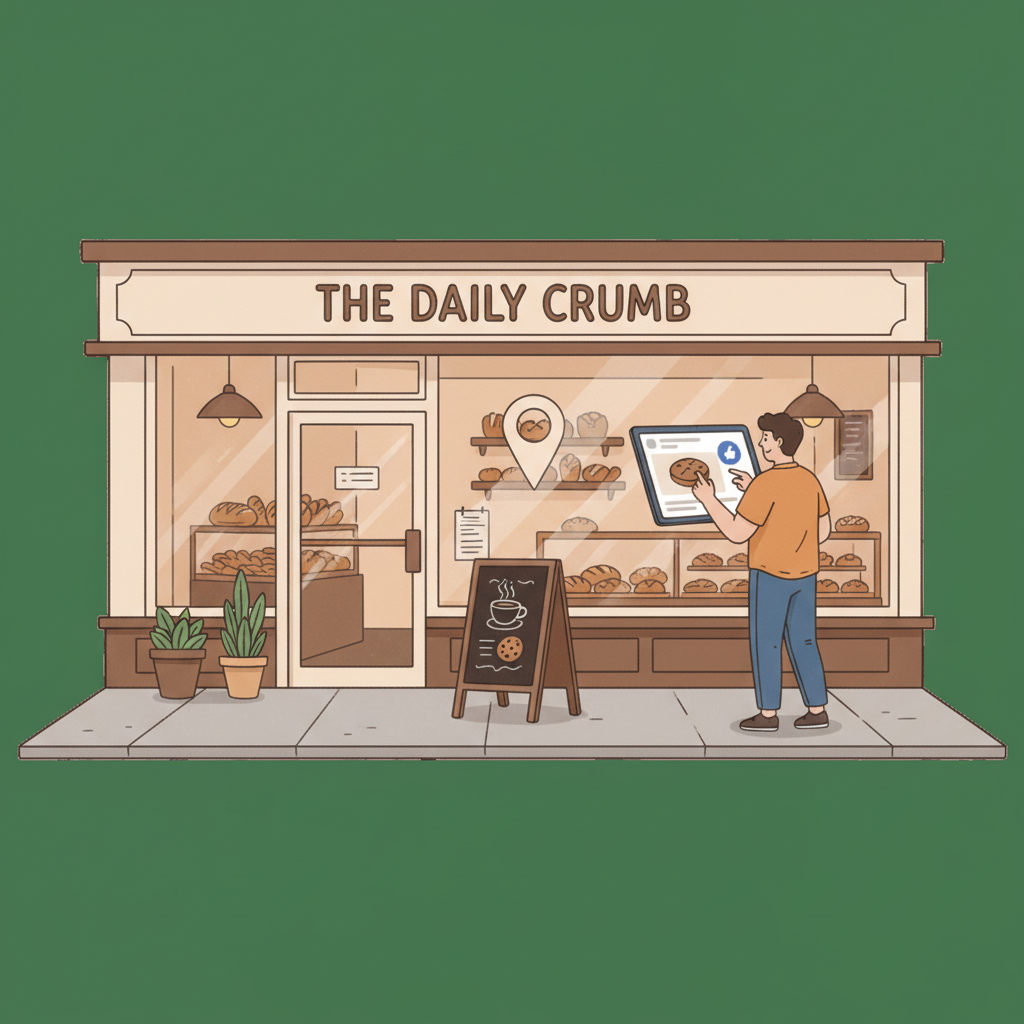
Local business example: A bakery in Brooklyn moved from 2 walk-ins/day to 11 by posting one behind-the-counter reel each morning.
When to boost or advertise (short note)
Organic Facebook still works for local reach if your page is active. Consider paid boosting only when:
You have a proven offer that converts (test organic first).
You need to fill specific slow slots (weeknights, same-week openings).
Start small: boost an Offer post with a $20 local radius boost for 3 days and track bookings. If ROAS is positive, scale.
Wrapping this into habit
Pick your post types and templates this week.
Schedule 3–5 posts and run the two-week timing test.
Measure messages, clicks, saves and bookings weekly.
Small businesses win by being useful and predictable. Clear posts, the right photo, and a single CTA beat cleverness when you’re trying to get people to show up.
One last practical note: if you want a place to store these templates and schedule without hiring a manager, there are systems that help you keep this rhythm. Keep it small, keep it local, and measure the bookings that come in.
Bringing this into your calendar is the hardest part — make the first week a habit and you’ll see the difference.
#facebook marketing#local business#social media#content templates#organic social#small business
Questions business owners actually ask
The real objections — answered straight, no fluff.
BrandZilla Editorial Team
SMB MarketingContent Strategy
Practical playbooks written and reviewed by people who actually run content programs for small and local businesses — not generic AI output. Every guide is pressure-tested against what real operators do on Instagram, Facebook, LinkedIn and Google.
Used by 1,000+ businessesLast updated Nov 7, 20266 min read
Get weekly content ideas for your business
Join business owners getting practical, ready-to-post BrandZilla content prompts every week. No spam.