Your customers type "[service] near me" when they need someone this afternoon. You know your business should show up, but your service page either sits on page 5 or doesn't show at all. You're publishing posts and hoping for the best, but the traffic you're getting isn't turning into phone calls.
This is the problem: local intent is high, but most small businesses skip the predictable, mechanical work that actually pushes a page into the local pack and top organic results. You don't need a miracle — you need a focused 60‑day plan and a handful of exact templates you can copy and paste.
Below is a practical, week-by-week system to rank a single service page for ‘near me’ queries in 60 days. No fluff — titles, meta descriptions, H1, FAQ snippets, Google Business Profile (GBP) actions, internal links, and outreach tasks. Use it for one priority service first, then repeat.
The strategy in one line
Make one service page the best, most trusted, locally specific answer for a single search phrase. Treat it like a local landing page, not a brochure. Then send signals (GBP, citations, reviews, links, internal links) that it's the obvious local choice.
Reality check: Most small businesses post 3x then quit. Consistency beats creativity 9 times out of 10.
Target selection: pick one phrase and own it
Steps:
- Pick a specific phrase: "[service] near me" or "[service] in [neighborhood/city]". Example: "emergency plumber Austin" or "dog grooming brooklyn heights". Avoid vague phrases.
- Use Google: search the phrase and note the top 3 competitors. Look at their title tags, H1s, FAQ, review count, and GBP listing.
- Confirm local intent: the results should show a local pack and local business pages.
If multiple services compete, pick the one where you already have at least one positive recent review and a clear price or estimate — you want social proof to push early gains.
The 60-day roadmap (week-by-week)
Weeks 1–2: On-page foundation
-
Create or rework one focused service page. Keep it single-purpose: one URL, one primary phrase.
-
Exact title tag template (copy/paste and replace): "Primary service in City — Quick same‑day [service] | BusinessName"
-
Exact meta description template (150–155 chars): "Same‑day [service] in [City]. Transparent pricing, licensed team, free estimate. Call [phone] or book online — slots available today."
-
H1 template: "Local [primary service] in [City/Neighborhood]"
-
URL structure: business.com/service-city (short, readable)
-
First 150 words: include the phrase, a short sentence about service area, and one quick trust signal (years in business or number of reviews).
Content structure (on the page)
- Opening (100–150 words): promise + the phrase.
- Three short paragraphs: process, what’s included, pricing/estimates.
- 3 local proof blocks: 1 recent quote from a review, 1 small case study (name + neighborhood + short result), 1 badge (license, guarantee).
- FAQ section with 3–6 questions addressing booking, arrival window, price transparency.
Add internal links from your home page and any related blog posts directly to this service page. Aim for 2–4 internal links pointing to it in Week 1.
Quick win: Repurpose one customer review into a 3-post mini series this week.
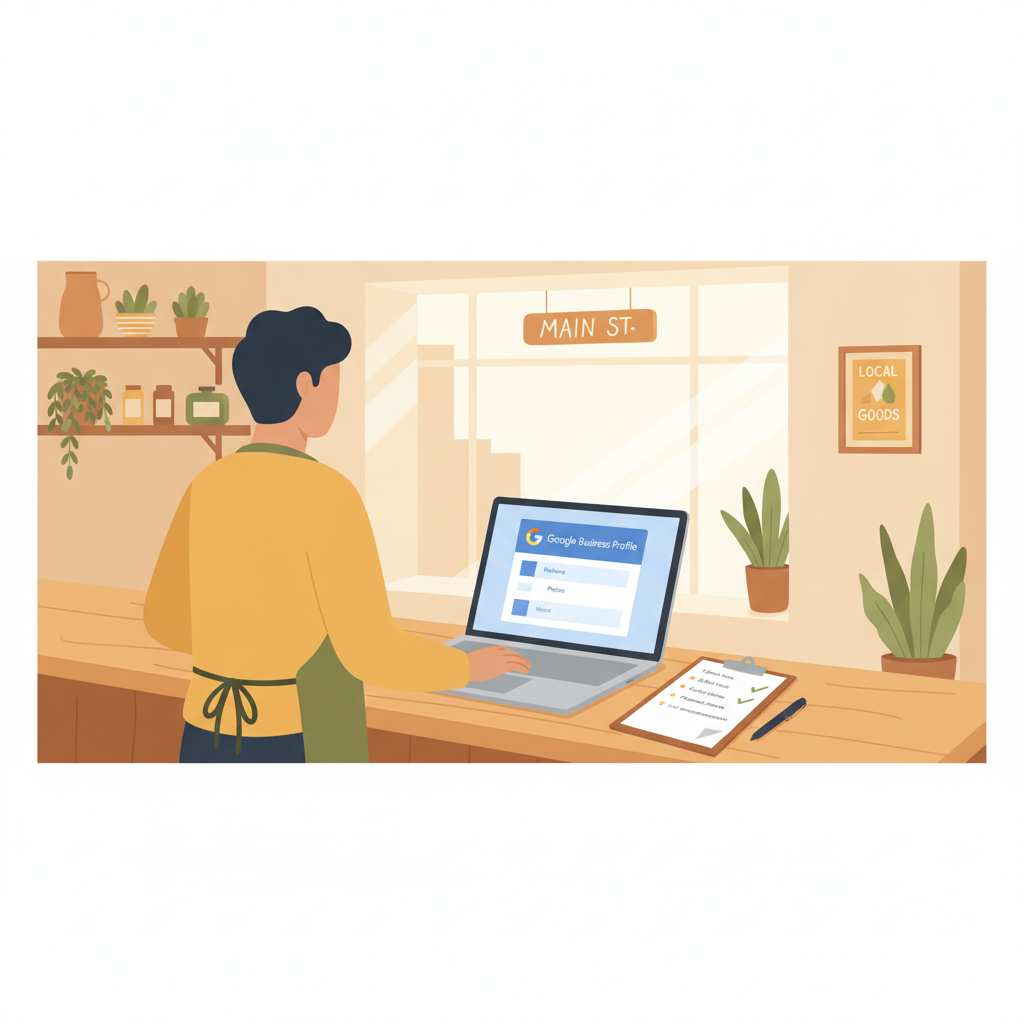
Weeks 3–4: Google Business Profile and review push
-
Make sure your GBP service list includes this exact service phrase and the service area.
-
Publish 3 GBP posts over two weeks: each post should reference the page and include a call to action like "Book now" or "Call for estimate".
-
Ask for 5 focused reviews within this period: send an SMS or email with this exact script: "Hi [Name], thanks for choosing us. If you can, would you mind leaving a quick review about the [service] we did at your [neighborhood]? Here's a short link: [shortlink]. It helps small businesses like ours—thank you!"
-
Reply to every review within 48 hours with a short, personal message.
Weeks 5–6: Local links, citations, and structured data
-
Check NAP (name, address, phone) consistency across top citations (Yelp, Facebook, Apple Maps). Fix any mismatches.
-
Place 3 small local link wins: guest post on a local blog, sponsor a youth sports team (sponsor page link), or contribute an expert quote to a neighborhood news site.
-
Add FAQ schema to your service page. Use these exact sample Q&A lines (copy/paste):
Q: How quickly can you arrive for [service] in [City]? A: We offer same‑day slots and typically arrive within 2–4 hours for emergency calls in [City]. Call [phone] for immediate help.
Q: Do you provide free written estimates? A: Yes. We give a written estimate onsite or by photo within 30 minutes after inspection.
-
Publish the FAQ using your CMS and include the same text in visible HTML so search engines can index it.
Common mistake: Treating Instagram captions like tweets — context outperforms one-liners for local businesses.
Weeks 7–8: Local PR, outreach, measurement, and iteration
-
Outreach template (email):
Subject: Quick local resource for [neighborhood or publication]
Hi [Name],
I run [BusinessName], a local [service] in [City]. We just published a short guide on getting same‑day [service] in [City] and thought it might help your readers. Link: [URL]
If useful, I’m happy to provide a short quote or local tip for an upcoming story.
Best, [Name]
-
Track: weekly rank checks and GBP views. Use a simple spreadsheet: date, ranking for phrase, GBP map visibility (yes/no), calls reported.
-
If rank hasn't improved by week 8, revise title/meta to test another angle (price-led or emergency-led), add 2 more local links, and double review volume.