How to Prove Social Media Brings Local Customers in 90 Days
If you feel social posts are a guessing game, use this 90-day plan to measure real customer results. Exact tracking steps, daily scripts, UTM templates, and a weekly review routine.
6 min read
BrandZilla EditorialReviewed by marketing operators· Updated Aug 24, 2026· 6 min read
If you think "social media is a black box" or "I don't see new customers from posts" — this article is the operating manual you need.
You don't need expensive dashboards or a marketing degree. You need simple, repeatable ways to: set realistic goals, track customer touch points, and make one small change every week that moves the needle.
This is a 90-day plan built for a busy owner or manager who wants to stop guessing and start proving which posts bring people through the door.
The one-sentence promise and metric
Decide what "works" means for your business in one sentence. Example: "Increase weekday lunch walk-ins by 30% from social referrals in 90 days." Choose one primary metric — calls, bookings, walk-ins, or coupon redemptions.
Why one metric? Multiple metrics dilute focus. Pick one you can accurately track without fancy tools.
Reality check: Most small businesses post 3x then quit. Consistency beats creativity 9 times out of 10.
Week 0: Setup (2–4 hours total)
What to set up this week:
Pick the primary metric and baseline it for the past 30 days (or nearest month). Example: average 10 weekday lunch walk-ins/day.
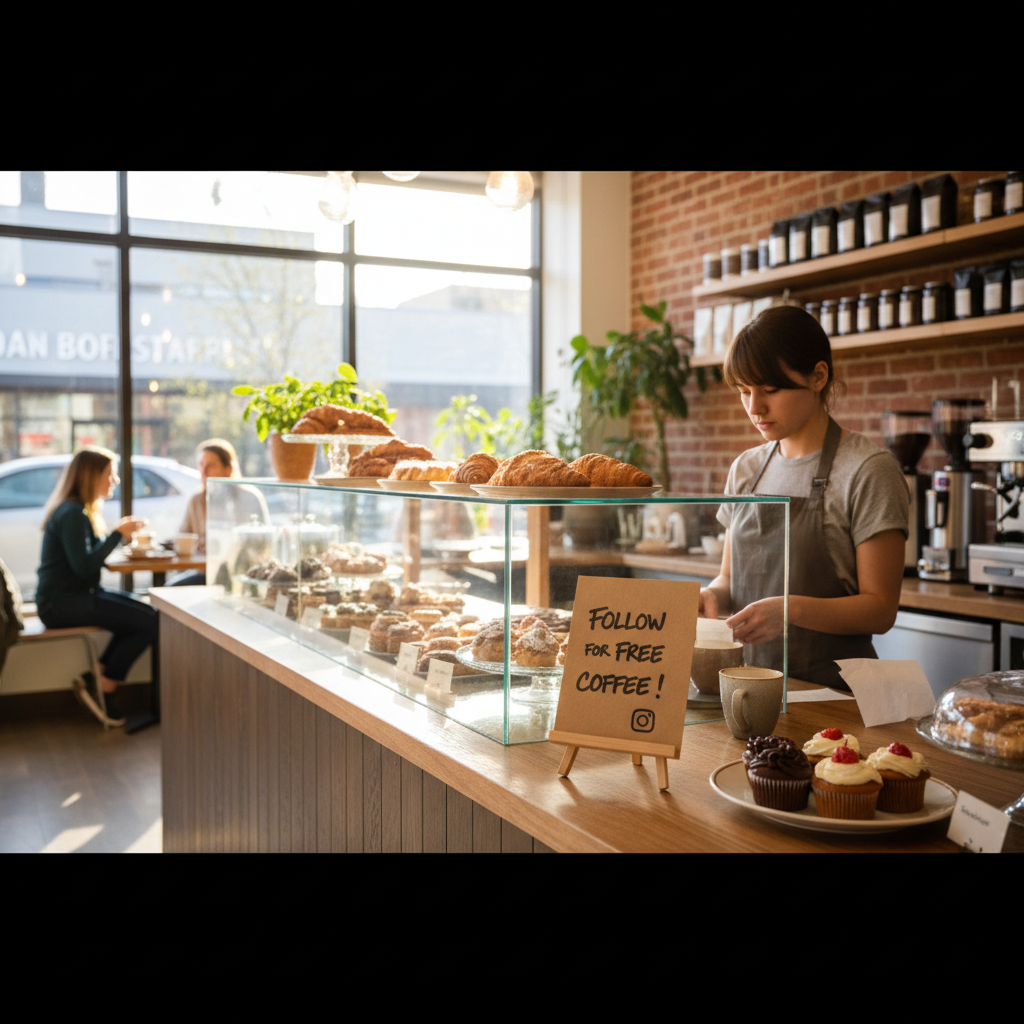
Create one tracked offer for social only (e.g., "Show this post for $2 off any lunch sandwich").
Make two simple tracking channels: a short promo code and a single phone extension or booking link UTM.
Add a one-line note at the register and in your booking system: "Was this visit because of social?" with Yes/No.
Exact offer template (copy-paste):
"This week only: $2 off any lunch sandwich. Show this post at the counter or use code SOCIALLUNCH at checkout. Valid Mon–Fri."
Offer: "$10 off a quick blowout — mention SOCIALBLOW at check-in."
Tracking: booking link with UTM + register checkbox.
Result after 90 days: owner tracked 180 redemptions from social-only offers, average weekday walk-ins rose to 17.
Weekly routine (30–60 minutes)
Monday morning: Post the anchor offer and pin it to top of feed or story highlights.
Midweek: Post behind-the-counter and proof posts.
Friday: Post the reminder and review the weekend schedule.
End of week (30 minutes): tally redemptions, calls from social, and any UTM bookings. Note what changed.
Use a single spreadsheet with these columns: Date, Channel, Offer Code Used, In-store Redemptions, UTM Bookings, Calls from Social, Notes.
Common mistake: Treating Instagram captions like tweets — context outperforms one-liners for local businesses.
What to change if numbers are flat (simple experiments)
If your baseline hasn't moved after two weeks, try one change per week and measure:
Change the creative: swap a static photo for a 20-second video.
Change the incentive: increase the perceived value (bundle product with a quicker win).
Change the placement: pin the offer to your profile and boost the post locally for $10.
Change the ask: move from "show this post" to "book with code" if more reliable.
Run each change for one full week. Don't jumble three changes at once.
Staff scripts and register checklist (exact wording)
Put this on a laminated card behind the counter.
Script for staff when customer arrives:
"Hi, welcome back. Are you here for the social offer? If so, did you show the post or use code SOCIALLUNCH?"
Register checkbox fields (yes/no):
Showed post? Y / N
Used social code? Y / N
If using phones, train staff to ask: "Did you find us on Instagram or Facebook?" and record the answer.
What actually works: A 5-post weekly rhythm built from one anchor piece — not daily improvisation.
How to attribute online interactions (simple rules)
Direct redemption (code shown or entered) = 100% social.
UTM link booking = 100% social channel listed in UTM.
Call where customer says "saw on Instagram" = social.
If unsure, count it as unknown but collect the data for next week.
Don't overcomplicate with multi-touch attribution. For local retail, last-touch is usually good enough.
What success looks like at 30 / 60 / 90 days
30 days: consistent posting and baseline tracking in place. Expect small bumps and learn which post types get the most engagement.
60 days: see measurable redemptions or UTM bookings. If you have 30 redemptions from social in 60 days, calculate revenue per redemption.
90 days: you should be able to answer: "Does social bring paying customers, and which posts work best?" If yes, scale the posts that work and keep the offers rotating.
Financial check: if average sale is $15 and you get 100 redemptions in 90 days, that's $1,500 in tracked revenue — minus cost of discounts and small ad spends.
Reporting — what to share with your team each week
Keep it simple. Share three numbers each Friday in a 5-minute huddle:
Redemptions from social this week.
Calls/bookings attributed to social.
One learning (what we tested and what changed).
Celebrate the wins and keep experiments small.
Steal this template: "We help [audience] [outcome] without [pain]. Here's how →"
One common pushback and the real answer
"I don't have time to track all this." — Then cut the plan in half: pick only one tracking method (a redemption code) and one post type (anchor + reminder). Do that for 90 days before adding complexity. Small businesses that win are the ones that do less, consistently.
Practical shortcut: You can build this system manually — or use BrandZilla to stay consistent without hiring a social media manager.
If you get the basics right — a single, tracked offer, one primary metric, weekly reviews — you'll stop guessing and start making decisions. That change alone separates businesses that post for months with no result from those that get steady local customers.
Final thought: Treat social media like a sales channel, not a creative hobby. Measure the thing that matters, change one variable at a time, and give the process 90 days.
P.S. If you want templates for the spreadsheet and the offer card, keep a copy on your phone so staff can use it tomorrow. BrandZilla has ready-made checklists if you'd rather plug in a system than build one from scratch.
The real objections — answered straight, no fluff.
BrandZilla Editorial Team
SMB MarketingContent Strategy
Practical playbooks written and reviewed by people who actually run content programs for small and local businesses — not generic AI output. Every guide is pressure-tested against what real operators do on Instagram, Facebook, LinkedIn and Google.
Used by 1,000+ businessesLast updated Aug 24, 20266 min read
Get weekly content ideas for your business
Join business owners getting practical, ready-to-post BrandZilla content prompts every week. No spam.