

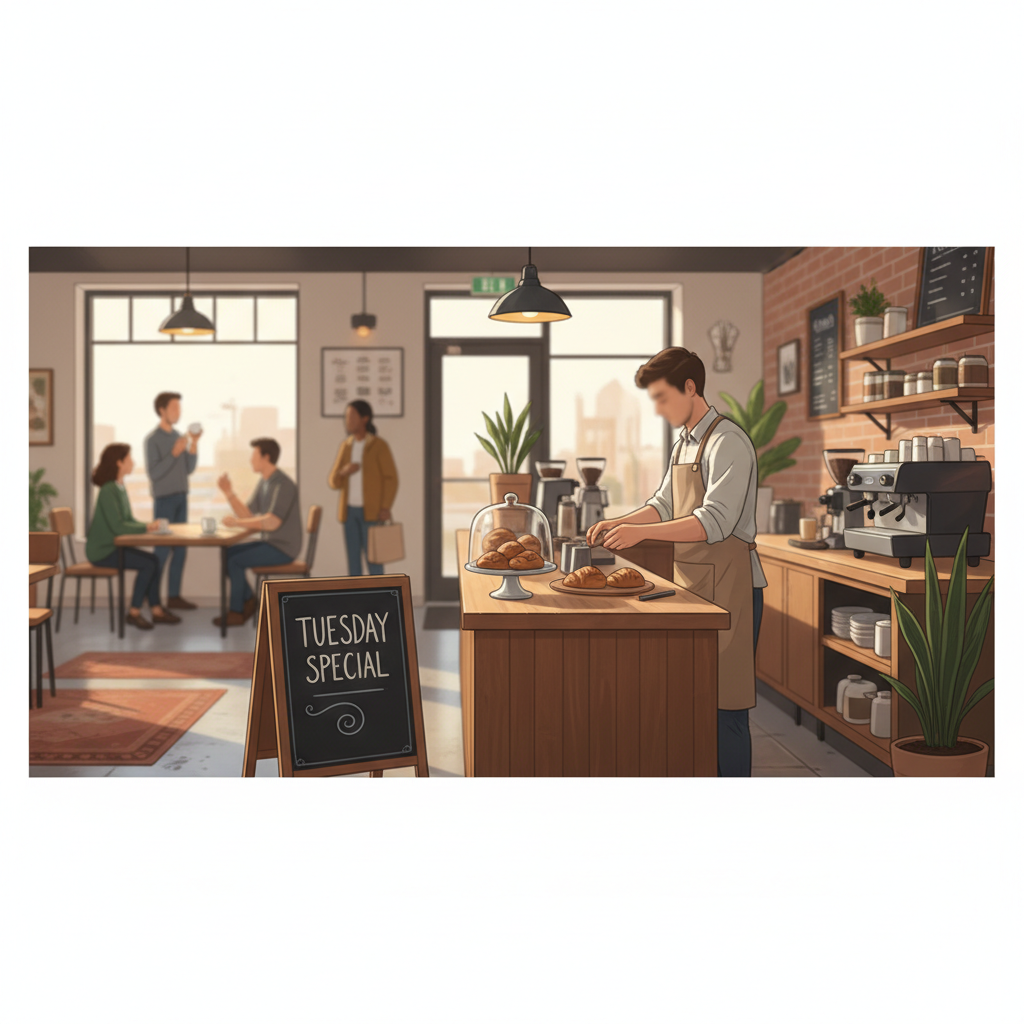
You run a small local business. You try a weekly special — a $5 lunch plate, a midweek haircut deal, a Tuesday pastry offer — and you expect people to show up. Instead, crickets. Either nobody sees the post, or they see it and don’t bother because the offer is unclear, or the timing is wrong.
Weekly specials are one of the easiest levers local businesses have to increase visits, smooth slow days, and build habitual customers. But they fail most of the time because execution is sloppy, inconsistent, or purely reactive.
This is a practical operator's playbook: a short, repeatable system you can run every week. No content theory, no vague advice — exact post templates, timing, and a one-week test you can run without hiring anyone.
Reality check: Most small businesses post 3x then quit. Consistency beats creativity 9 times out of 10.
Why weekly specials fail (so you can avoid it)
- No clear promise: The offer is vague (“special this week!”) so people don’t change plans.
- Poor timing: Posts go up at the wrong hours or too late to influence decisions.
- No repetition: You post once and expect results; customers need multiple exposures across channels.
- Weak measurement: No simple way to see if the special moved customers versus normal week.
What to run (simple offers that convert)
- Time-based discount: $5 off between 2–5pm on Wednesdays.
- Product bundled deal: Coffee + pastry for $6 on weekday mornings.
- Limited-quantity item: First 20 customers get a free sample.
- Service add-on: Free beard trim with any haircut on Tuesdays.
Pick one offer, keep it the same for 6–8 weeks while you test the system.
The 4-step weekly special system (do this every week)
- Plan your offer and promise (Monday)
- Exact wording: “Tuesdays: $6 lunch sandwich + small drink, 11–2, two slices per customer.”
- Decide measurement: a checkbox on receipts, a specific coupon code, or verbally mention how they heard about it.
- Build a 5-item content set (Tuesday run)
- Anchor post: High-quality photo or short video of the item (30–60 sec). Use the exact caption below.
- Reminder post (same day, afternoon): Short carousel showing item + price + hours.
- Story/update posts: 2–3 stories (or reels) showing behind-the-counter prep + “2 hours left” update.
- Local push: Pin the offer to your Google Business profile and post in neighborhood Facebook groups.
- Repeat and amplify (Wednesday–Thursday)
- Repost the anchor as an organic post with a slightly different caption.
- Boost $10 on a single high-performing post (optional) targeted to a 5-mile radius.
- Share customer photos and reshare tags.
- Measure and tweak (Friday)
- Count offer redemptions. Compare to the previous week.
- Keep the same offer 6–8 weeks unless it’s clearly failing.
Quick win: Repurpose one customer review into a 3-post mini series this week.
Exact copy templates you can use (copy-paste)
Anchor post (Facebook/Instagram feed)
- Image: Clean photo of the product with staff in background.
- Caption: "TUESDAY SPECIAL: $6 lunch sandwich + drink, 11–2. Fresh-baked bread, locally roasted coffee. No coupon needed — just tell the counter you saw this post. First 30 served."
- Hashtags: #YourTownEats #LunchSpecial #SupportLocal
- CTA (end of caption): "Come early — we sell out fast."
Short afternoon reminder (same day)
- Caption: "2 hours until our $6 lunch special. We’ve already served 12 — swing by! ⏰"
- Use a clock emoji and location tag.
Stories / Reels script (30 sec)
- Clip 1 (5s): Close-up of sandwich being assembled. Text overlay: "Today only: $6 lunch"
- Clip 2 (10s): Barista pouring coffee. Text: "11–2. No coupon needed."
- Clip 3 (10s): Smiling customer bite + short on-screen caption: "First 30 served — come now"
- End card (5s): Shop entrance + hours + CTA: "See you soon"
Customer reply template (in DMs or comments)
- "Thanks for asking! The special runs 11–2, today only. We hold a few aside for takeout — call ahead at (555) 123-4567."
Mini-example: barber shop that filled slow Tuesdays
Joe’s Clip Joint, a 3-chair barber in Austin, tested a Tuesday "Trim & Brew"—$20 trims plus a free coffee, 10–2. He posted an anchor reel Monday night, two stories Tuesday morning, and a reminder at 10:30am. They tracked by asking customers "Did you come for the Tuesday special?" Result: first week +5 appointments, second week +9, and by week 6 they averaged 14 extra Tuesday customers, enough to keep one part-time barber busy.
Timing and frequency (when to post)
- Anchor post: 24 hours before the special (builds anticipation).
- Reminder post: 2–4 hours before the start time.
- Stories: Morning-of and mid-window (e.g., 11:30 for 11–2 specials).
- Local push (Google Business): Update on the morning of the special.
Promotion checklist (one-page)
- Offer wording written and simple
- Redemption method chosen (code, verbal, receipt tick)
- Anchor post ready 24 hours before
- Two reminders scheduled (AM and mid-window)
- Google Business post updated
- Count redemptions and note results Friday
Tracking that won’t take hours
You don’t need fancy analytics. Use one of these simple methods:
- A tally box on the paper receipt station.
- A dedicated coupon code for online orders.
- A staff question at checkout: "Are you here for the Tuesday special?"
If you want slightly more polish and to avoid trying to remember everything:
Practical shortcut: You can build this system manually — or use BrandZilla to stay consistent without hiring a social media manager.
How to avoid discount erosion and keep margin
- Limit the window or quantity so it doesn’t cannibalize full-price sales.
- Tie the special to a lower-cost upsell (add fries for $2) to maintain average ticket.
- Rotate the special every 6–8 weeks so it stays interesting but predictable.
What to measure (simple numbers that matter)
- Incremental customers: redemptions vs. previous week.
- Incremental revenue: number of redemptions × average order value.
- Cost of promotion: staff time + any ad spend.
- Repeat rate: number of repeat redemptions over 4 weeks.
Common mistakes and how to fix them
Steal this template: "We help [audience] [outcome] without [pain]. Here's how →"
- Mistake: Changing the offer every week. Fix: Keep the same offer for 6–8 weeks while testing distribution.
- Mistake: Posting too late. Fix: Schedule the anchor post 24 hours before the special.
- Mistake: No local push. Fix: Update Google Business and neighborhood groups the morning of.
Short plan for the first 6 weeks
Week 1: Run the system as written. Track redemptions. Week 2–3: Optimize caption and story timing based on what worked. Week 4: Add a small $10 boost to the top-performing post to test local paid reach. Week 5–6: If redemptions up by 25% vs. baseline, keep the offer and consider a weekday partnership (nearby coffee shop cross-promo).
Local business example: A bakery in Brooklyn moved from 2 walk-ins/day to 11 by posting one behind-the-counter reel each morning.
Scripts for staff (so the front counter doesn’t fumble)
- If asked if the special is still on: "Yes — it runs 11–2 today. If you want to reserve one, I can put your name on the pickup list."
- If they don’t know if they can combine offers: "This special is only for in-store purchases, but you can add extras at regular price."
FAQ
Q: What if I don't have time to post every day? A: Do the anchor post and one reminder. Use Stories for quick updates. If you only post twice, schedule them and track redemption — you’ll still see a lift. Next step: schedule the anchor 24 hours ahead.
Q: Can I reuse old content without looking repetitive? A: Yes — rotate the same anchor photo with different captions and customer shots. Repetition works if you change the context (time, testimonial, behind-the-scenes). Next step: swap one image each week.
Q: Do small businesses actually need a content calendar? A: Yes, but it can be tiny: one row for weekly specials with dates and a checkbox for when posted. It prevents the "post once" mistake. Next step: make a two-column calendar in Google Sheets.
Q: How long before posting consistently actually brings in customers? A: You can see results in the first week if the offer is clear and the timing is right. Reliable habits take 4–6 weeks to stabilize. Next step: run the system for six weeks and track redemptions.
A closing practical thought
A weekly special isn’t magic; it’s a disciplined, repeatable routine that nudges customers into your schedule. The gap between a post that fails and a post that brings people in is often one clear sentence, the right timing, and a repeatable checklist. Do the same thing reliably for six weeks, measure simply, and improve.
If you want a starter calendar and exact post templates you can copy into your scheduling tool, BrandZilla has a set built for this exact use case.