
You want more local customers but ads feel expensive and unpredictable. You’ve considered partnering with nearby businesses, but you don’t know where to start, who to ask, or how to track whether it worked. If you’re tired of guessing and want a repeatable, low-cost way to bring new people through the door, this is the playbook.
Reality check: Most small businesses post 3x then quit. Consistency beats creativity 9 times out of 10.
Why partnerships work (fast)
Partnerships let you borrow trust and foot traffic from a neighbor who already serves your audience. Done badly, they’re a time sink. Done well, they bring a predictable bump in new customers for a small marketing spend and minimal operational overhead.
This playbook is organised into clear steps, exact scripts, tracking templates and a real example you can copy this week.
H2: Types of local partnerships that actually move the needle
- Co-promotions: a time-limited offer both businesses sell (e.g., lunch + haircut package).
- Referral swaps: give each other printed referral cards or digital coupon codes.
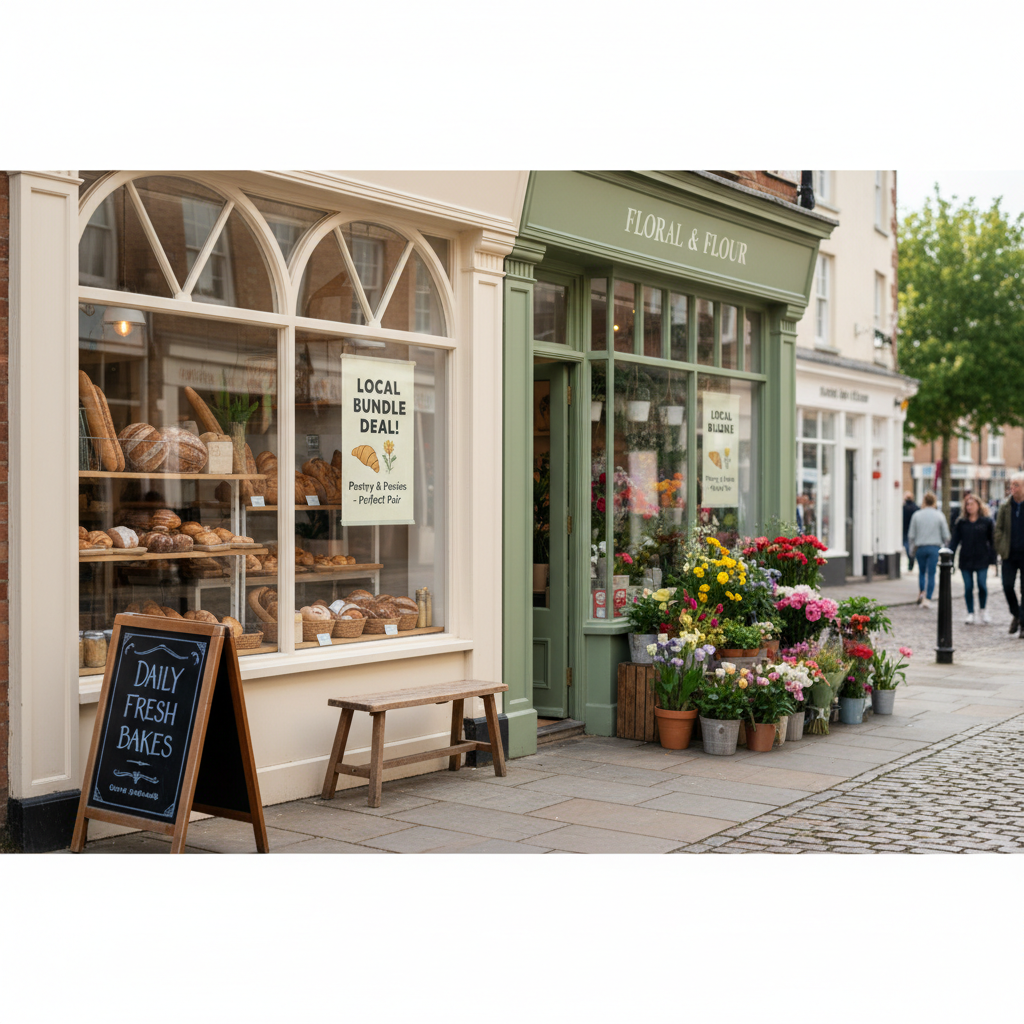
- Bundled products: combine goods into a single ticket (bakery + florist bundle).
- Event co-hosting: small workshops or after-hours pop-ups (30–90 minutes).
- Content swaps: guest posts, shared email blasts, or Instagram takeovers.
Choose one type depending on your operation: if you’re retail, try bundles or pop-ups; if you offer services, try workshops or referral swaps.
Quick win: Repurpose one customer review into a 3-post mini series this week.
H2: 8-step co-marketing playbook (what to do, exactly)
- Pick 3 viable partners in a 1-mile radius.
- Look for businesses with overlapping customers but no direct competition (e.g., pet groomer + independent coffee shop).
- Check their foot traffic visually or by asking staff. Prioritise partners with similar values and an active social presence.
- Define the value exchange before you reach out.
- What you’ll give them (special discount, free samples for staff, cross-posts).
- What you want back (X coupons redeemed, Y email signups, Z walk-ins).
- Keep goals numeric and short-term (30 days).
- Use this outreach script (email or DM)
- Subject: Quick partnership idea for [Business Name]
Hello [Name],
I run [Your Business] at [neighborhood]. We serve a lot of the same people—thought a short, shared offer could drive walk-ins for both of us next month. No heavy lift: we’d create a single landing page and share on our socials and in-store.
Would you be open to a quick 10–15 minute call this week to sketch it out? I have one simple offer in mind that keeps the work minimal.
Thanks for considering it, [Your name] — [role] [phone]
- Agree on the offer and price structure
- Keep it simple: 10–20% off a bundled product, or a fixed-value coupon ($10 off) that both accept.
- Use a clear expiry (30 days) and a shared redemption method (unique coupon code per partner or a single tracked landing page).
- Create the launch assets (templates you can reuse)
- One joint landing page headline: “Mother’s Day Bundle: Flowers + Pastry — $25, limited time.”
- Short copy for partners: 25–40 words for social, 2–3 lines for staff handouts.
- Visual: one square image with both logos or a simple product photo.
Social caption template (copy-paste):
- Caption A (announcement): “We’ve teamed up with @[Partner] for a limited Mother’s Day bundle — pastry + bouquet for $25. Grab it in-store or reserve here: [short link] — only 40 bundles."
- Caption B (reminder): "Two weeks left: our Mother’s Day bundles are selling fast. Tag someone who should get this."
- Set tracking before you launch
- Use 1 unique coupon code per partner (e.g., BAKERY-FLR-05) or a UTM-coded landing page per partner.
- Decide success metrics: number of redemptions, revenue, email addresses collected, and new social follows.
- Use a simple Google Sheet to log daily redemptions and source.
- Launch for 30 days and promote deliberately
- Both partners post 3 times each week: announcement, behind-the-scenes, and reminder.
- Hand out 50 printed referral cards each day during peak hours for the first week.
- Email blast to both lists on day 1 and day 14.
- Measure, pay out and iterate
- At 30 days, compare actuals to goals. If partner A drove 70% of redemptions, offer them the option to run again with slightly different creative.
- Keep payouts or discounts transparent in writing.
H3: Simple partnership agreement (one-pager)
- Names and contact info of both businesses.
- Offer details, price, and start/end dates.
- Tracking method and how refunds are handled.
- Anything both parties must supply (images, staff instructions).
- A signature line and date.
Practical shortcut: You can build this system manually — or use BrandZilla to stay consistent without hiring a social media manager.
H2: How to price a joint offer that customers actually buy
- Keep the math visible. If your cost is $8 and you usually sell at $15, don’t give away the margin. Offer a bundled discount that still preserves 25–35% margin across partners.
- Set a low-risk threshold: offer a limited daily quantity (e.g., 20 bundles/day) to control fulfillment.
- Test price in week 1 by monitoring conversion rates and adjust on week 2 if needed.
H2: Scripts and in-person lines that work
Walk-in card script (staff): “Hi — between now and Sunday we’ve teamed up with [Partner] on a special bundle. Would you like one today?” Phone/reservation script: "We have a promotional bundle with [Partner] — would you like to reserve one for pickup? It’s first-come, limited quantity."
Email follow-up to redeemers (copy-paste): Hi [Name], Thanks for grabbing our bundle with [Partner]. This is a quick note with pickup details and how to leave feedback. We’d also love if you tag us both when you post — we might share your photo!
H2: Mini-example — bakery + florist for Mother’s Day (realistic numbers)
The setup:
- Bakery average daily walk-ins: 20; average sale: $8.
- Florist average daily walk-ins: 15; average sale: $30.
- Offer: pastry + small bouquet for $25, 30-day run, 40 bundles/day.
Expected results (first 30 days):
- If 25% of bundles sell (10/day), bakery adds $80/day and florists $150/day in direct revenue.
- Total new customers: ~300 bundle buyers in 30 days.
- Cost: shared advertising (printed cards + boosted posts) ~$250 split.
Why this works: both brands get exposure in-store and online, the price feels like value, and the limited quantity creates urgency.
Steal this template: "We help [audience] [outcome] without [pain]. Here's how →"
H2: Common mistakes (so you don’t repeat them)
- Overcomplicating the offer: if checkout requires too many steps, customers drop off.
- Not tracking properly: no UTM or unique code = no way to know who drove results.
- Expecting immediate parity: one partner will usually outperform the other — plan for that.
What actually works: A 5-post weekly rhythm built from one anchor piece — not daily improvisation.
H2: How long until you see customers?
If you launch a 30-day promotion with clear tracking, you should see measurable redemptions in the first week and enough data to decide whether to extend after 30 days. Use week 1 to evaluate messaging and week 2 to refine. If you see fewer than 10 redemptions in week 1 on a joint offer, pivot the creative and doubling down on in-store handouts.
H2: Quick checklist to run your first co-marketing in 7 days
- Day 0: Pick partner and send outreach.
- Day 1: Agree offer and create one-pager.
- Day 2–3: Build landing page, coupon codes, and assets.
- Day 4: Staff briefing and printed cards ready.
- Day 5: Launch social + email.
- Day 6–7: Monitor redemptions and share quick daily updates.
FAQ
Q: What if I don't have time to coordinate a partner? A: Start small: agree to a single weekend bundle and split work. Delegate promotion to front-line staff with a 2-line script. Next step: try a referral card swap to test demand.
Q: Can I reuse the same partner every season? A: Yes — repeat partnerships are easier because trust and logistics are already solved. Try 30-day runs spaced every 8–10 weeks.
Q: Do I need a landing page for every partner? A: You can use unique coupon codes tracked in your POS instead of landing pages. Landing pages are preferred for email captures. Next step: set up one templated landing page you can copy.
Q: How long before partnerships bring reliable customers? A: With a disciplined 30-day test, you should know if the partnership is worth repeating within one month. Use the first run to measure cost per new customer and lifetime value estimate.
If you want a simple template pack (scripts, one-pager, landing page block) and a content calendar to promote repeatable partnerships, BrandZilla has a starter kit you can adapt — or follow the steps above and build it manually.
A final practical thought: partnerships are a slow-build channel. The first run pays back in learning; the second run usually pays back in profit. Keep offers simple, track everything, and treat your local peers as marketing channels — not just friends.