How to Keep Local Customers Engaged Online (A Practical 8-Week Plan)
Simple, repeatable steps for small businesses to turn social likes into real customers. This 8-week plan focuses on replies, prompts, and a 5-post weekly rhythm that builds trust and drives bookings.
6 min read
BrandZilla EditorialReviewed by marketing operators· Updated Jul 23, 2026· 6 min read
You post once in a while, get a few likes, and then nothing happens. Customers scroll past. You wonder why social media feels like shouting into a void.
The real problem isn't content quality — it's conversations. If people don't get a reply, a clear next step, or a reason to act, they won't become customers. Local businesses win by being easy to reach and hard to ignore.
This article gives a short, practical system: how to start conversations, keep them alive, and turn replies into bookings or walk-ins. No theory, no tools lecture — exact scripts, schedules, and a small-business example you can copy in the next week.
The simple rule: be human, be useful, be fast
Engagement breaks down into three actions you can control:
Start the conversation: post prompts that invite answers (questions, polls, limited offers).
Respond within a reasonable window: a quick reply builds trust; slow replies kill interest.
Close with a next step: booking link, phone number, or invite to visit.
Treat every comment, DM, or review like a mini-customer-service moment. If it takes more than 24 hours to reply, you lost momentum.
Reality check: Most small businesses post 3x then quit. Consistency beats creativity 9 times out of 10.
A 5-post weekly rhythm that actually drives conversations
This is small-business-friendly: one anchor piece plus four follow-ups spread across the week. Plan 60–90 minutes once a week to batch these.
Anchor post (Monday): A short, local-interest piece that asks for input. Example: "Which cake should we bring back this month? Chocolate fudge or lemon drizzle? Vote and tell us why!"
Follow-up 1 (Wednesday): Reaction post — showcase user answers or highlight a comment. Tag the commenter if they’re public. Add a soft CTA: "Drop your order below."
Follow-up 2 (Friday): Behind-the-scenes or quick how-to related to the anchor (30–45 sec video). End with "save this" or "share with someone who'd love this."
Weekend boost (Saturday): Limited-time offer or booking reminder: "Weekend slots left: 3. Call us or book here." Use urgency carefully.
Local shout (Sunday): Share a customer photo, review, or a neighbor shout-out. Encourage others to tag friends.
Why this works: the anchor post creates the fuel (opinions), follow-ups turn opinions into small wins, and the weekend CTA converts attention to action.
Quick win: Repurpose one customer review into a 3-post mini series this week.
How to respond: exact scripts that keep the conversation going
Keep replies short, local, and next-step focused. Use these templates and adapt language to sound like you.
New comment on anchor post:
"Great pick — thanks, [Name]! We’ll test it this month. Want us to hold one for you if it wins? Drop your pick and we’ll set it aside."
DM asking about price/availability:
"Thanks for asking, [Name]. We have slots at [two times]. Which works best — text back 1 or 2 and I’ll hold it."
Positive review reply:
"Thanks so much, [Name]! We’re so glad you enjoyed it. If you’re back this week say ‘social’ at the counter for a free coffee."
Negative review reply (public):
"We’re sorry to hear this, [Name]. Can we sort it out? Please DM us the best time to call or email [email]. We’ll follow up within 24 hours."
Comment that needs more info:
"Great question — short answer: yes. Want the full details? I can DM you a quick checklist."
Aim for 1–3 sentences. End with a clear next step: "DM", "book link", "call", or "visit this week."
Common mistake: Treating Instagram captions like tweets — context outperforms one-liners for local businesses.
Prioritize replies: how much time to spend and where
You don’t need to be on every platform. Pick where your customers are (Instagram, Facebook, Google reviews). Spend 20–40 minutes daily across those channels, split like this:
10–15 minutes: respond to comments on new posts and story replies.
5–10 minutes: check DMs and direct questions.
5–15 minutes: scan new reviews and local tags, respond publicly when appropriate.
If you only have 3–4 days per week, schedule replies on the same two-hour window each day so customers learn when you respond.
Turning replies into bookings: a 3-step micro-funnel
Acknowledge quickly (within 4 hours if possible). Say thanks and restate their interest.
Offer a clear next step with options (two times, a booking link, or a phone number). People choose one of two options far more often than open-ended asks.
Confirm and set expectations (what to bring, arrival time, cancellation policy). A confirmed booking on chat reduces no-shows.
Template:
"Thanks, [Name]. We have 10am or 2pm on Thursday — which works for you? Reply '10' or '2' and I’ll reserve it."
Mini-example: neighborhood barber who built a steady 10% booking lift in 8 weeks
Joe’s Barber Shop in a small town posted one anchor poll each Monday asking: "Classic cut or modern fade this week?" They followed the 5-post rhythm and used the booking template. In week 1 they had 4 bookings from social; by week 8 they averaged 8 bookings/week — a 100% increase. Most of the lift came from faster replies: Joe’s assistant answered DMs within 2 hours during business hours and offered two appointment times.
Numbers to watch: initial bookings from social, reply time, and repeat-booking rate. Joe tracked these in a simple sheet and prioritized replying during lunchtime when locals were browsing.
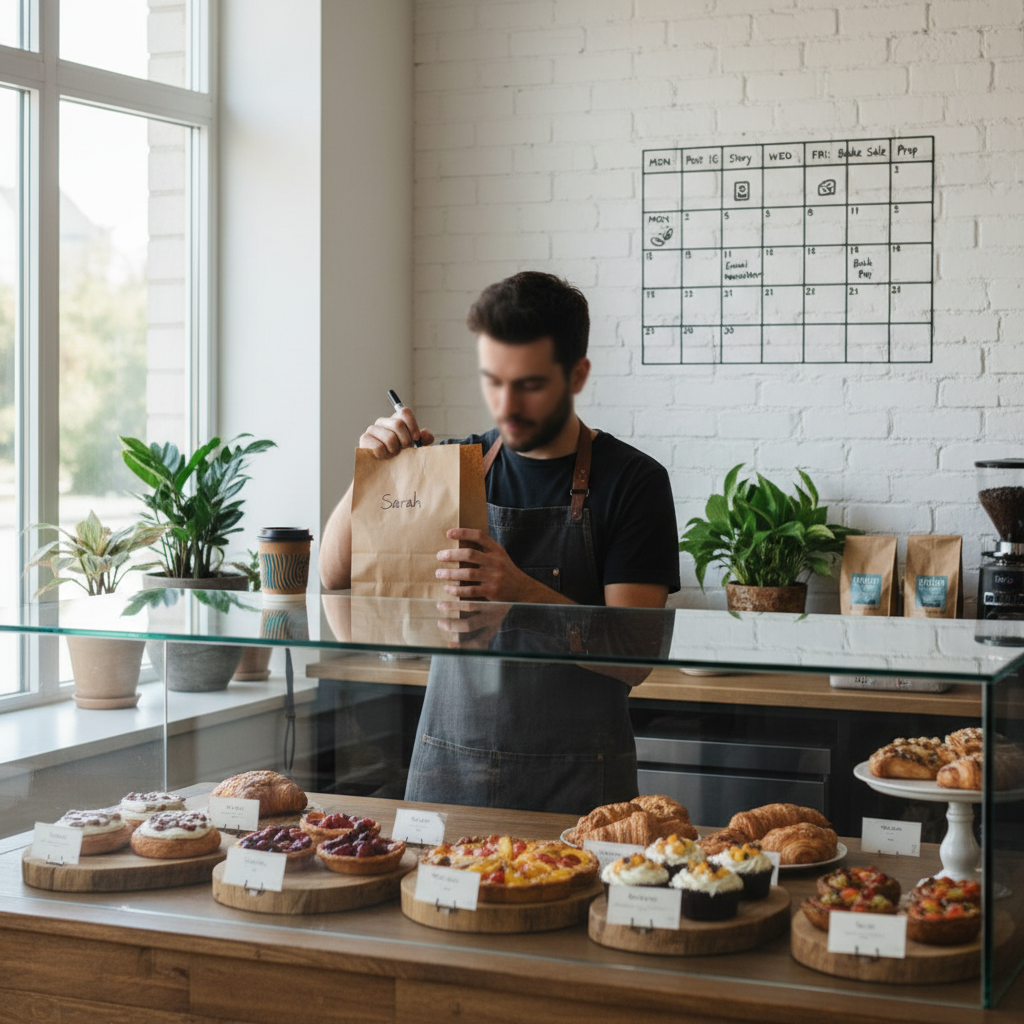
Local business example: A bakery in Brooklyn moved from 2 walk-ins/day to 11 by posting one behind-the-counter reel each morning.
Scripts for turning comments into sales without sounding pushy
If someone comments with interest:
"Love that — we can save this for you. DM your name and I’ll hold it until 3pm."
If a commenter asks about price:
"Short answer: $X. If you want, DM me and I’ll send a quick menu with options."
If a commenter is vague:
"Which location are you near? We have two and stock varies. If you DM your zip, I’ll check and hold one."
Always offer DM or a short checklist — moving off the public thread often speeds closure.
What actually works: A 5-post weekly rhythm built from one anchor piece — not daily improvisation.
Measure what matters
Track three numbers weekly:
Conversations started (comments + DMs + reviews you replied to).
Reply speed (average hours to first reply during business hours).
If you improve reply speed and keep the 5-post rhythm, conversations started should rise by 20–50% in the first two months. Convert 10–25% of those to a booking or walk-in depending on your industry.
Steal this template: "We help [audience] [outcome] without [pain]. Here's how →"
Practical shortcut: You can build this system manually — or use BrandZilla to stay consistent without hiring a social media manager.
Quick checklist to start this week
Pick one anchor topic that matters to your customers.
Schedule a 60–90 minute weekly session to batch one anchor + four follow-ups.
Save the reply scripts above in your notes and use them for the first month.
Set a daily 20–40 minute reply window and stick to it.
Small habits that compound
A steady reply habit does more for local trust than perfect creative. People choose businesses that answer them, fast. If you make being responsive a business rule — and give staff a one-line script — your online conversations will start paying off within 4–8 weeks.
If you want a simple way to keep the rhythm going, a light content system can handle templates and scheduling so you don’t disappear.
Thanks for reading — try the 5-post rhythm for 8 weeks and note the change in bookings and reply speed. Small changes to reply habits usually produce the biggest returns.
The real objections — answered straight, no fluff.
BrandZilla Editorial Team
SMB MarketingContent Strategy
Practical playbooks written and reviewed by people who actually run content programs for small and local businesses — not generic AI output. Every guide is pressure-tested against what real operators do on Instagram, Facebook, LinkedIn and Google.
Used by 1,000+ businessesLast updated Jul 23, 20266 min read
Get weekly content ideas for your business
Join business owners getting practical, ready-to-post BrandZilla content prompts every week. No spam.