How to Get Customers to Tag Your Business — A Practical Playbook
Stop hoping customers tag you and start asking in ways that feel natural. This playbook walks through exact asks, templates, and a 60-day test plan for local shops.
6 min read
BrandZilla EditorialReviewed by marketing operators· Updated Oct 29, 2026· 6 min read
People don’t tag your business because they forgot, they didn’t get the cue, or the ask felt awkward. You’ve probably tried “tag us!” in a post once and got crickets. That’s normal — asking for tags needs a simple system that works both in-person and online.
This playbook gives you exact wording, signs, staff scripts and a realistic 30/60-day test plan so you can get measurable UGC (tags, mentions, shares) that feed your social channels and bring more walk-ins.
Why asking for tags fails (and how to fix it)
Most small businesses make one of three mistakes:
The ask is buried — customers don’t see it when they’re excited about a purchase.
The ask is vague — “Tag us!” with no handle, hashtag or reason.
There’s no payoff — customers don’t get anything for their trouble.
Fix those with a simple framework: Cue → Ask → Make it Easy → Reward → Amplify. Stick to that and you’ll get predictable results.
Reality check: Most small businesses post 3x then quit. Consistency beats creativity 9 times out of 10.
A 5-step system you can use today
Pick a single promise the tag will unlock (reason).
Examples: Feature in our stories, enter a weekly $25 gift card draw, unlock a permanent discount code, be entered in a local spotlight reel.
Keep it simple. Don’t promise a complicated prize that’s hard to deliver.
Design the cue — where and when customers notice the ask.
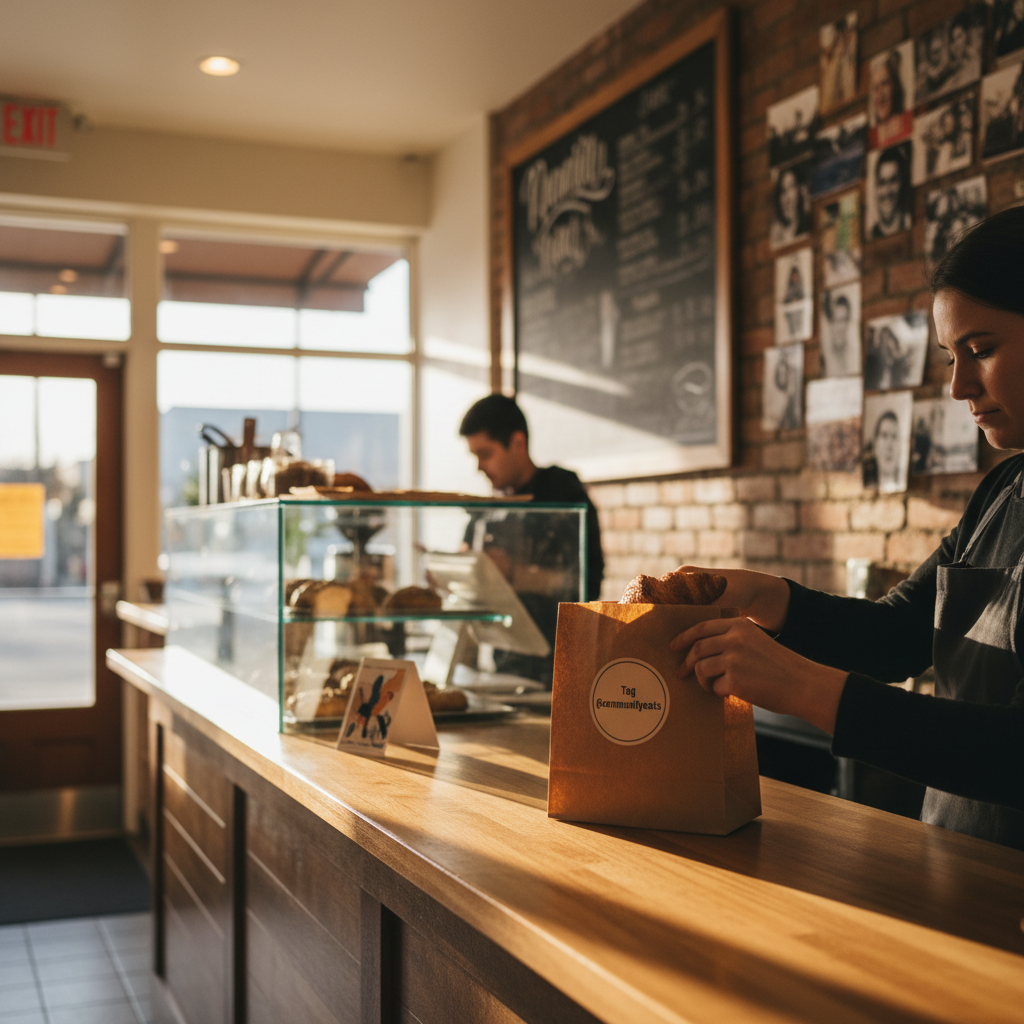
In-store: receipt footers, tent cards at POS, stickers on bags.
Online: order confirmation emails, checkout thank-you page, Instagram captions.
Use one clear instruction (handle + hashtag + action).
Exact wording: “Tag @OldTownBakery and use #OldTownTreats to be featured.”
Avoid generic language. Customers need the handle and the hashtag written out.
Make participation frictionless.
Allow screenshots, reposts, and captions; don’t require perfect lighting or a branded filter.
If you want permission to repost, ask for it simply: “By tagging us you give us permission to share — we’ll always credit you.”
Amplify and reward quickly.
Post daily or weekly UGC with a shoutout. Immediate recognition is the reward most people want.
Occasionally pick one tag to win a tangible reward to keep momentum.
Quick win: Repurpose one customer review into a 3-post mini series this week.
Exact copy: signs, receipts, captions and team scripts
Use these verbatim — tweak only the handle and small details.
Small counter sign (4" x 6"):
"Love it? Tag @YourHandle + #YourNeighborhood for a chance to be featured every Friday. We repost our favorites."
Receipt footer (1 line):
"Snap & tag @YourHandle for a chance to win a $25 gift card. Winners announced Friday."
Instagram caption (short):
"New: Caramel oat latte ☕️ Tag @YourHandle + #YourNeighborhood with your cup and we’ll feature you in stories all week."
SMS or email checkout line:
"Thanks for your order! Share a photo and tag @YourHandle to be featured and enter our weekly draw."
Staff script (face-to-face):
"Thanks so much — if you snap a photo later, tag @YourHandle and we’ll share it on our stories. We pick one photo each Friday for a $25 gift card."
In-store POS quick pitch (10 seconds):
"If you post a photo and tag us we’ll feature you on our page — and every Friday a tagged photo gets a $25 card."
Common mistake: Treating Instagram captions like tweets — context outperforms one-liners for local businesses.
Two contest templates that don't feel spammy
A. Feature-first (low-cost, high trust)
Mechanic: Anyone who tags you is eligible to be featured in your weekly story and pinned highlight.
Reward: Visibility + small monthly prize (one $50 voucher).
Rules (short): Tag @YourHandle + #YourCampaign. By tagging you give permission to repost. Winner announced first Monday.
B. Entry + instant coupon (good for repeat customers)
Mechanic: Tag to enter. Everyone who tags during the week gets a 10% off code via DM.
Reward: Immediate value increases repeat business.
Rules (short): Tag @YourHandle + #YourCampaign. Qualifying tags sent a one-time code within 48 hours.
Both templates are simple to explain at point-of-sale and to automate manually with a weekly check.
How to repost UGC the right way (and avoid upsetting customers)
Always credit the original handle in the caption: “Photo: @customerhandle” and add a short line about what you’re highlighting.
Ask before editing — if you crop or color-correct, DM first. Small courtesy avoids bad feelings.
Keep a public highlight called “Local Shots” so new customers see real people.
Steal this template: "We help [audience] [outcome] without [pain]. Here's how →"
Measurement and a realistic 30/60-day test plan
KPIs to track weekly:
Tags per week (raw): aim for 20 in week 4 for a small shop.
Reposts per week: aim for 4–8.
Footfall lift: measure same-days-of-week vs prior month — look for a 5–10% bump.
DM signups / coupon redemptions (if using instant coupon template).
Week 2–4: Post UGC daily in stories, run one weekly feature. Target: 20 tags/week by week 4.
Week 5–8: Add the coupon or weekly prize if tags slow. Target: 50 tags/week by week 8 and at least 1% of taggers converting to purchase next visit.
Mini-example: A neighborhood coffee shop with 40 daily transactions started the feature-first plan. After 30 days tags rose from ~2/day to 9/day. They reposted 3 times a week. By week 8 they estimated a 7% lift in weekday morning footfall and one regular who converted from a tagged post into a catering order worth $300.
Common problems and fixes
Not enough tags: Make the cue more visible (sticker on cups) and train staff to say the script every transaction.
Low-quality photos: Encourage casual photos — don’t insist on staged images. Most customers will send natural shots that feel authentic.
Legal concerns: Keep rules simple. Never claim ownership beyond permission to repost. For contests with valuable prizes check local regulations.
Local business example: A bakery in Brooklyn moved from 2 walk-ins/day to 11 by posting one behind-the-counter reel each morning.
What to say when you DM someone you want to repost
Short, friendly, human:
"Hi @handle — love this shot! Would you mind if we reposted it on our feed? We’ll credit you."
If you need permission in writing for a contest win, send a short follow-up with the prize detail and a checkbox consent sentence to save for records.
Practical shortcut: You can build this system manually — or use BrandZilla to stay consistent without hiring a social media manager.
Final operational checklist (what to do Monday morning)
Print small tent cards and put one at the POS.
Update receipt footer and checkout email with the exact caption above.
Train staff with the 10-second script and run one role-play.
Schedule a weekly UGC-post hour (30 minutes) — pick the best 4 photos to repost.
Track tags in a simple spreadsheet or the platform’s mention view.
Small, consistent asks win. You don’t need complex campaigns — you need the same clear ask in three places (in-person, on the receipt, and online) and a plan to reward people quickly.
A final note: if you ever feel stuck, test one small change for a week — a sticker on the cup, a line in the receipt, or picking one day to feature tagged photos — and measure the difference.
BrandZilla helps teams keep this routine running if you want a tool to reduce the busywork.
The real objections — answered straight, no fluff.
BrandZilla Editorial Team
SMB MarketingContent Strategy
Practical playbooks written and reviewed by people who actually run content programs for small and local businesses — not generic AI output. Every guide is pressure-tested against what real operators do on Instagram, Facebook, LinkedIn and Google.
Used by 1,000+ businessesLast updated Oct 29, 20266 min read
Get weekly content ideas for your business
Join business owners getting practical, ready-to-post BrandZilla content prompts every week. No spam.