How to Capture Leads From In-Person Customers (7 Practical Tactics)
If customers come through your door but don’t return, this is for you. Practical, low-friction ways to collect contact details from in-person visits and turn them into repeat business.
8 min read
BrandZilla EditorialReviewed by marketing operators· Updated Nov 9, 2026· 8 min read
If customers come into your shop, try your service, or call for a quote — but then vanish — you’re not alone. Small businesses often assume in-person visits don’t need a lead process. They do. You only need a few simple, low-friction touchpoints to turn a one-off visit into repeat bookings.
This guide is a hands-on playbook: what to set up in 15–60 minutes, copy you can hand to staff, exact follow-up timings, and the simplest metrics to watch. No jargon, no fancy funnels — just practical tactics you can use tomorrow.
The core problem — in your words
People walk in, pay, leave. No email, no phone, no chance to remind them about your specials.
You’ve tried signs and a clipboard and heard crickets. Or you ask for details and staff say it feels awkward.
You need a system that: 1) feels normal to staff and customers, 2) takes under 60 seconds per person, and 3) nudges customers back within 7–21 days.
Reality check: Most small businesses post 3x then quit. Consistency beats creativity 9 times out of 10.
What to prepare in 30–60 minutes
A single short landing page (or form) for in-person captures — one field preferred (phone or email).
Two scripts: one for staff, one for the follow-up message.
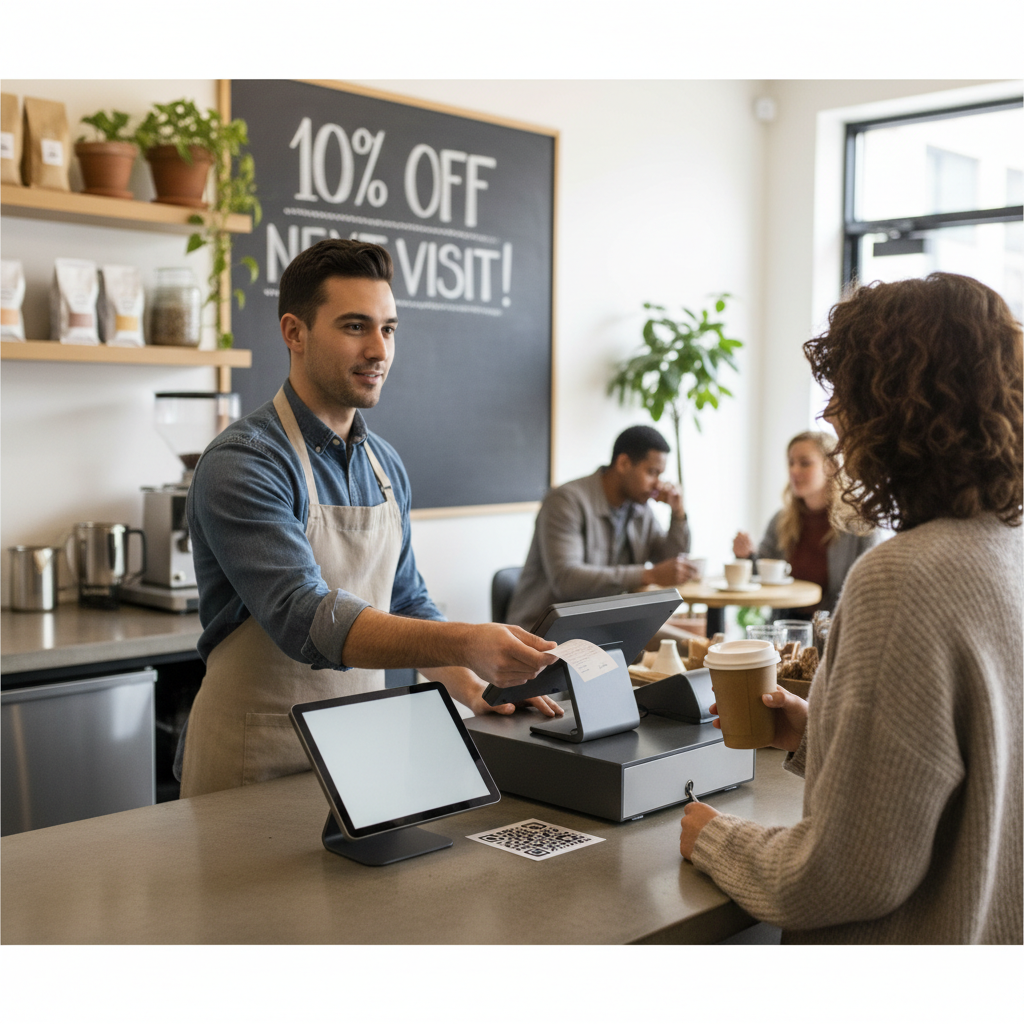
A visible prompt at checkout (sticker, QR, tablet) and a clear incentive (discount, small freebie, or booking priority).
Tools: any simple form tool, SMS provider (even basic), or your email system. Don’t overcomplicate.
Quick win: Repurpose one customer review into a 3-post mini series this week.
Seven low-friction tactics to capture in-person leads
Two-step offer at checkout (30 seconds)
What it is: Offer a simple reward for contact details (10% off next visit, free sample, $5 credit). Ask for permission by phone or email — not both.
Staff script (exact): “If you want 10% off your next visit, can I text you the code? It’s one quick message.”
Why it works: People say yes to small, immediate value. A text converts better than a clipboard.
Target rate: 25–40% opt-in on first week with a clear offer.
QR-to-short-form at the counter (15 seconds)
What it is: A printed QR code that opens a single-field form (phone or email) and delivers the code instantly.
Landing copy (hero): “Grab 10% off next visit — enter your phone, we’ll text your code.”
Exact CTA button: “Send my code”
Example line for sign: “Scan here — get a code now.” Avoid long forms.
Tablet kiosk (30–60 seconds)
What it is: A tablet at the counter with a focused signup screen. Staff offers help for older customers.
Staff script: “If you want, I can enter your number — it’ll only take a minute and we’ll text your coupon.”
Tip: Keep fields to one. If you brand it as a loyalty sign-up, people join faster.
Receipt follow-up (automated email or SMS)
What it is: Use the sale as the trigger for a thank-you message with an opt-in box or a referral ask.
Email subject examples: “Thanks for visiting — your 10% code inside” / “A quick thank you from [Business Name]”
Email body (short): Thank > Deliver code > Suggest next steps > Ask for review.
Common mistake: Treating Instagram captions like tweets — context outperforms one-liners for local businesses.
Book-a-return incentive (schedule while customer is still warm)
What it is: Offer to book a future appointment before they leave and capture a number/email to confirm.
Staff script: “We have an open slot next Tuesday — want me to reserve that and text a reminder?”
Why it works: People are more likely to show when a time is booked and a reminder is sent.
Short service survey with an opt-in (30–90 seconds)
What it is: A single-question satisfaction survey on a tablet or via SMS that ends with an opt-in for offers.
Survey example: “How was today’s visit? (Great / OK / Not great). If Great, get 10% off your next visit — leave your phone.”
This feels natural and doubles as feedback.
Referral card with an email capture + reward
What it is: Hand customers a referral card (physical or digital) that gives both the referrer and the friend a benefit when the friend signs up.
Referral script: “Bring a friend and you’ll both get $10 off — give me their email or have them scan this code.”
Track redemption so you know which in-person leads actually become customers.
Follow-up timing and what to send (exact schedule)
Immediate (0–30 minutes): Automated text with coupon code and one clear CTA (book, reply, or review). Text example: “Thanks for visiting [Biz]. Here’s your 10% code: SAVE10. Book: [short link] Reply STOP to opt out.”
Day 1: Thank-you email with short story + link to book and review. Use 3 subject line options to test.
Day 7: Reminder SMS with a small urgency play — “We saved your code — expires in 7 days.”
Day 21: Special offer or invite to an event (member discount) — this nudges back people who didn’t convert.
Measure: leads captured / customers served = capture rate. Bookings from captured leads / captured leads = conversion rate. Reasonable targets: 20–30% capture, 10–20% conversion to paid return in 30 days.
Steal this template: "We help [audience] [outcome] without [pain]. Here's how →"
Copy-and-paste templates
Staff checkout invite:
"If you want 10% off your next visit, I can text the code — what's the best number to use?"
Quick SMS (immediate):
"Thanks for visiting [Business]. Your code: SAVE10. Book here: [short link]. Reply STOP to opt out."
Follow-up email (day 1):
Subject: "Thanks for stopping by — here’s your 10% code"
Body: "Hi [First name], thanks for visiting [Business]. Use SAVE10 on your next visit — book here [link]. Love feedback? Reply to this email."
Referral card copy:
"Give $10, Get $10. Bring a friend and receive $10 off when they book their first visit." (Include QR to short-form with one field.)
Short compliance checklist (quick legal basics)
Always include an opt-out (SMS and email).
Store only what you need (phone or email). Delete extras.
Be transparent: tell customers you’ll text/email them a coupon.
For paid lists or third-party marketing, get written consent.
Practical shortcut: You can build this system manually — or use BrandZilla to stay consistent without hiring a social media manager.
Mini example you can copy this week
Joe’s Plumbing — mid-sized local shop in Austin.
Week 1: Trained 2 techs on the two-step checkout script, added a QR sticker at the counter, and set up an automated SMS with a coupon.
Results in 30 days: 42 new phone opt-ins (out of 150 customers, 28% capture) and 9 booked return jobs from captured leads (21% conversion). Revenue from returns: $3,400.
What they did differently: one clear offer, one-field form, and two automated follow-ups. That was it.
Simple dashboard — what to watch weekly
Number of in-person customers
Contact details collected
Coupons sent
Bookings from captured contacts
A basic spreadsheet with these columns is enough. Look for steady improvement: aim to increase capture rate by 5 percentage points in the first month.
Common mistake: Treating Instagram captions like tweets — context outperforms one-liners for local businesses.
Low-cost staffing tips to make this stick
Role-play the script for 15 minutes at a team meeting.
Add the opt-in request to the POS closing checklist.
Reward staff with a small incentive for the highest weekly capture rate.
Final operational tips
Keep the friction tiny: one field, one value, one message.
Use human language in messages — not corporate speak.
Test different incentives for two weeks and stick with the one that converts best.
What actually works: A 5-post weekly rhythm built from one anchor piece — not daily improvisation.
If you want a template-driven system and a few done-for-you flows, I’ve seen BrandZilla help small teams keep this consistent without hiring extra staff. Try the smallest version first: one offer, one capture method, and two follow-ups. If it converts, scale it.
FAQs
Q: What if I don't have time to ask every customer for their contact?
A: Start with a subset: try capture at peak times or on transactions over a set value. Automate the follow-ups so your time investment is training and oversight. Next step: test the two-step checkout on the busiest day.
Q: Can I reuse old customer lists for this?
A: Yes, for current customers with consent. Send a re-engagement message asking permission to text/email offers. Keep it short and include an easy opt-out. Next step: segment your list and send to the most recent 6 months first.
Q: Do I need a fancy CRM to track this?
A: No. A simple spreadsheet plus your SMS/email tool is enough to start. Move to a CRM when you regularly exceed 200 captured contacts or need two-way booking flows. Next step: build the spreadsheet and log the first 30 leads.
Q: How long before this brings actual bookings?
A: You should see return bookings within 7–21 days if your offer is compelling and your follow-ups are timely. Measure after 30 days and iterate on the message.
Tags: lead generation, local marketing, customer retention, small business, SMS marketing, in-person sales
Image prompt: A realistic small-business scene: a bright neighborhood cafe counter with a small tablet kiosk and a printed QR sticker next to the register, a barista handing a receipt to a customer, visible signage offering "10% off next visit". The image should feel editorial and candid (no staged smiles), no close-up faces, neutral color palette, and a shallow depth of field to evoke a modern local-business marketing piece.
The real objections — answered straight, no fluff.
BrandZilla Editorial Team
SMB MarketingContent Strategy
Practical playbooks written and reviewed by people who actually run content programs for small and local businesses — not generic AI output. Every guide is pressure-tested against what real operators do on Instagram, Facebook, LinkedIn and Google.
Used by 1,000+ businessesLast updated Nov 9, 20268 min read
Get weekly content ideas for your business
Join business owners getting practical, ready-to-post BrandZilla content prompts every week. No spam.