

Engagement

How to Ask Customers for Photos and Use Them to Drive Walk‑Ins

Stop waiting for perfect content. Learn a simple permission-first system to collect customer photos, turn them into five daily engagement pieces, and watch walk‑ins climb.

6 min read
BrandZillaBrandZilla EditorialReviewed by marketing operators
How to Ask Customers for Photos and Use Them to Drive Walk‑Ins

I can't keep inventing content. Customers take great photos, but I don't know how to ask to use them. Or when I do post them, they get crickets. I need something that doesn't require hiring someone or learning fancy tools.

If you've ever thought "my customers post better photos than I do, but I can't reuse them," this guide is for you. It shows exactly how to collect, get permission, and reuse customer photos in ways that actually bring people through the door — no PR, no ads, no guesswork.

The problem in plain terms

Small businesses miss low-effort content all the time because they treat customer photos like bonus material instead of an owned content source. That means inconsistent posting, bland captions, and missed chances to turn social proof into walk‑ins.

You need a repeatable checklist your staff can run in 2 minutes, plus 3 ready-to-post formats that perform on Instagram, Facebook, and Google Business Profile.

Reality check: Most small businesses post 3x then quit. Consistency beats creativity 9 times out of 10.

The three-part system: Ask, Collect, Reuse

Follow these three actions every week. They take less than 90 minutes of total staff time and scale as you collect more photos.

  1. Ask (how to get permission). 2. Collect (where to store photos). 3. Reuse (what to post and how).

1) Ask — exact scripts that work

Use short, polite language with a clear benefit for the customer. Train staff to use one of these lines depending on the moment.

  • In-person (at register): “Love your photo — would it be OK if we shared it on our page and tagged you? We’ll credit you and you can say ‘no’ anytime.”
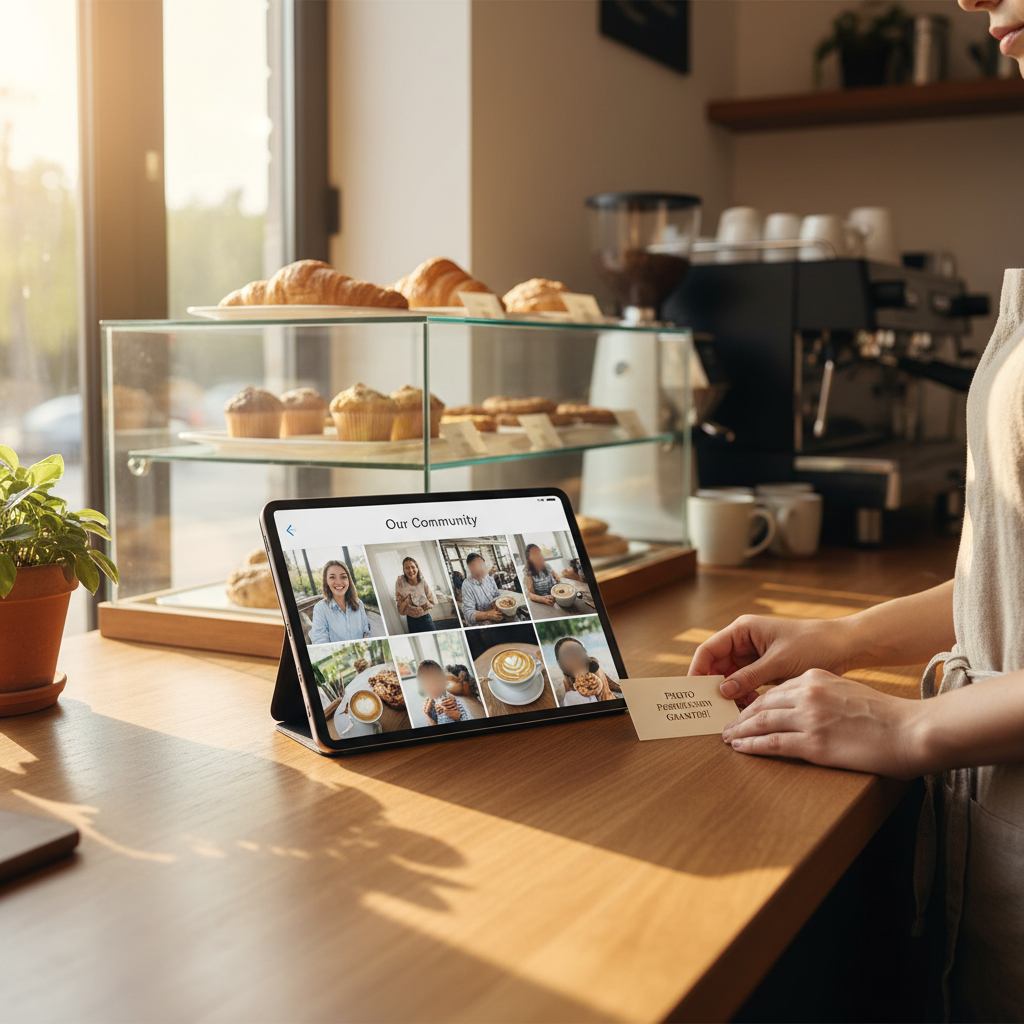
  • Printed card (hand to customer): “Share your photo with #OurShopName and we may feature it. Want us to tag you? Circle: YES / NO” (card is quicker than typing a handle).
  • Reply to a tagged story/comment: “Thanks! Mind if we repost your photo on our feed? We’ll tag you and add a discount code next time you visit.”

Legal-safe written permission (copy-paste):

“I, [customer name/handle], give [business name] permission to use my photo(s) posted on [platform] for social media and marketing. I understand I will be credited by my handle. Date: [MM/DD/YYYY].”

Train staff to collect a handle + a yes/no on a sticky notepad or a phone note — not a lengthy sign-up form.

Quick win: Repurpose one customer review into a 3-post mini series this week.

2) Collect — the minimal switch that saves time

You don't need a fancy DAM. Use one simple, shared place for all assets.

  • Shared phone album (iPhone: Shared Album, Android: Google Photos album) titled "UGC — [month-year]".
  • A single Google Drive folder for higher-res files.
  • A tiny spreadsheet: date, customer handle, what they signed for (feed/stories/ads), permission text saved.

Process: staff adds photo to the shared album right after asking permission. If they got a written note, snap a photo of the signed card and upload it.

Why this works: when it’s one tap to save, staff do it. No form means fewer abandoned asks.

3) Reuse — 5 formats from one photo

Each photo can become multiple posts over time. Use this sequence per photo:

  • Format A — Feed post: credit the customer, short story, local CTA. Example caption: “@sarahbakes snapped this at 10am — that flaky almond croissant is why people come early. Pop in before 11am and say ‘croissant’ for 10% off.”
  • Format B — Story: 3 panels — 1) the photo, 2) quick behind-the-scenes note (how it’s made), 3) CTA with tap-to-call or directions sticker.
  • Format C — Reel/Short: 10–15s slideshow of the photo + 3 quick text overlays: “Customer fave,” “How it’s made,” “Stop in today.” Add a local audio snippet that’s popular in your town.
  • Format D — Testimonial graphic: photo on left, 1-sentence quote on right, small logo, posted to feed and saved as a highlight.
  • Format E — Google Business Profile post: photo + 1-line update and CTA to call or book.

Schedule: 1 anchor feed post, then 2 stories, 1 reel, 1 GBP post spread over 10–14 days.

Common mistake: Treating Instagram captions like tweets — context outperforms one-liners for local businesses.

Copy templates you can use now

Use these exact captions. Swap the bracketed bits.

Feed caption (social proof + offer):

“@{handle} loved their visit today. {one-sentence detail about what they bought or did}. Drop by today between {time}–{time} — say {keyword} for {offer}.”

Story sequence (3 frames):

  1. Photo with sticker: “Customer photo 📸”
  2. Short text: “Made fresh at 8am — always sold by noon.”
  3. CTA: “Tap for directions →” (add a location sticker)

Reel script (shots + text overlays):

  • Shot 1 (1–2s): customer photo. Text: “Customer favorite”
  • Shot 2 (3–4s): quick clip of how it’s made. Text: “Baked fresh”
  • Shot 3 (3–4s): staff smile + callout. Text: “Stop by today — {time}”

Permission message to DM (short):

“Hi @{handle}, love your photo! Mind if we share it on our page and tag you? We’ll give you a 10% off code for next visit.”

Mini example — a real, believable run

Maple & Main Coffee (neighborhood café). Week 1: staff ask every customer who takes a pic. They collected 12 permission slips and 20 tagged photos. Week 2: they posted 6 feed posts and 9 stories using the system above. By week 4 they saw a measurable rise: morning walk-ins from 8/day to 18/day. They spent 45 minutes each Monday scheduling the five posts and a single staff member handled requests.

Steal this template: "We help [audience] [outcome] without [pain]. Here's how →"

Objections and fixes

  • "I don’t want to bother customers." — Keep asks under 10 seconds and offer a small incentive (10% off next item or a freebie raffle entry). Most people say yes if asked politely and briefly.
  • "I’m worried about legal stuff." — Use the one-line permission copy above and save the handle + a timestamp. For higher-risk uses (paid ads, print), get a signed note.
  • "We don’t have time to post." — Batch once per week: 45–90 minutes to pick 4 photos and schedule them across platforms.

What actually works: A 5-post weekly rhythm built from one anchor piece — not daily improvisation.

Practical shortcut: You can build this system manually — or use BrandZilla to stay consistent without hiring a social media manager.

Measurement — what to track in 30 days

Track these three numbers weekly:

  • Photos collected with permission (goal: 8–12 per month).
  • Social engagement lift (likes + comments per post; aim for +25% vs baseline).
  • Walk-ins tied to social (ask new customers “Did you see our post?” for a simple proxy).

If you collect 12 permissioned photos in a month and follow the reuse plan, expect a visible engagement lift in 3–6 weeks and more walk‑ins within the same period.

Staff checklist (2-minute routine)

  • Ask permission at point of sale or when you see a photo.
  • Add photo to shared album immediately.
  • Note handle + consent in the spreadsheet or paper log.
  • Add the photo to next Monday's schedule queue.

Keep the routine under 2 minutes so it doesn’t feel like extra work.

Final practical notes

Be consistent with crediting. Always tag the handle the customer gave you and include a brief local CTA. Don’t over-edit the photo — customers prefer authenticity.

If you want a lightweight system to keep this running without extra hires, there are tools that help schedule and store assets — a small monthly fee can save hours each week.

Local business example: A bakery in Brooklyn moved from 2 walk-ins/day to 11 by posting one behind-the-counter reel each morning.

Answering the ask, in one line: treat customer photos like an owned content source — ask once, store simply, and reuse five ways. Do that for a month and you’ll stop running out of local content.

Soft note: if you'd like a ready-made checklist and caption pack, BrandZilla offers a template built for this exact system.

#engagement#user-generated-content#local-marketing#social-media#content-systems

Questions business owners actually ask

The real objections — answered straight, no fluff.

BrandZilla

BrandZilla Editorial Team

SMB MarketingContent Strategy

Practical playbooks written and reviewed by people who actually run content programs for small and local businesses — not generic AI output. Every guide is pressure-tested against what real operators do on Instagram, Facebook, LinkedIn and Google.

Used by 1,000+ businessesLast updated Jul 10, 20266 min read

Get weekly content ideas for your business

Join business owners getting practical, ready-to-post BrandZilla content prompts every week. No spam.

No spam. Unsubscribe anytime.

Related articles