How to Run a 7‑Day Local Offer Test That Actually Drives Walk‑Ins
Stop guessing whether an offer will bring people through the door. This playbook gives a 7‑day test you can run from Monday to Sunday with exact wording, simple tracking, and a clear go/no‑go rule at the end.
7 min read
BrandZilla EditorialReviewed by marketing operators· Updated Sep 1, 2026· 7 min read
You want more people through the door this week. You can’t wait months for vague strategies or expensive ad campaigns. You need a short, measurable test that proves an offer brings real customers.
A 7‑day local offer test lets you do that: a focused promotion, a handful of assets (sign, post, SMS), and a simple tracking method. Run it, measure the lift, then decide to scale or stop.
This guide gives a day‑by‑day plan, copy you can paste, budget examples, and the decision rule to know whether the offer worked for your business.
Why a 7‑day test works for local businesses
Short tests force clarity. Seven days is long enough to reach regular customers and short enough that you can pivot quickly if it flops.
You’ll avoid two common traps: over-complicating the offer, and waiting too long for data. A tight window focuses staff, signage, and social posts so nothing fades into background noise.
Reality check: Most small businesses post 3x then quit. Consistency beats creativity 9 times out of 10.
The 5‑step framework (quick version)
Hypothesis: Pick one measurable goal (more walk‑ins, more bookings, or more calls).
Offer: Make it simple and time‑boxed (7 days only). Choose discount, BOGO, or add‑on.
Channels: Sign on the window, 2 social posts, one email, one SMS, in‑store script for staff.
Tracking: Track daily walk‑ins, redemptions, and revenue. Compare to baseline.
Decision: Use a clear go/no‑go rule on day 8 (example below).
Day‑by‑day schedule (do this one week)
Day 0 (before launch): Print a vinyl sign for the window, write the social copy and SMS, train staff on the script, set a note in your booking system to tag redemptions.
Day 1 (Monday): Put sign in the window by 8am. Post a clear social post with the offer and hours. Send an SMS to the most recent 200 customers.
Day 2 (Tuesday): Track morning and afternoon separately. Run a boosted local post (or a $5/day ad) targeting 1–3 mile radius, peak hours.
Day 3 (Wednesday): Email your list with the subject line that includes the offer and dates. Post a behind‑the‑counter photo showing the offer.
Day 4 (Thursday): Midweek check: tally redemptions. If underperformance is obvious, try changing the social image or adjust the ad creative.
Day 5 (Friday): Promote the weekend urgency. Staff hand out a physical coupon to customers today for an extra incentive.
Day 6 (Saturday): Peak day — staff should be ready. Record every redemption and ask one quick question: “How did you hear about us?”
Day 7 (Sunday): Final push: social post with ‘last day’ language and extended hours if possible. Close evening by consolidating the week’s numbers.
Day 8: Decision day — run the math (template below) and decide whether to scale, repeat, or stop.
Quick win: Repurpose one customer review into a 3-post mini series this week.
Offer ideas that actually work locally (pick 1)
Flat discount: 15% off one item or service. Simple to understand and to track.
Time-limited BOGO: Buy one get one half price before 11am — drives early foot traffic.
Add‑on upgrade: Free drink with a sandwich — higher perceived value, lower margin risk.
Trial service: 50% off first visit for new customers, redeemable with an email signup.
Pricing tip: Aim for an offer that turns browsers into buyers without training your regulars to always wait for discounts. If your gross margin is 60%, a 15% discount can be affordable if it brings incremental customers.
Exact wording you can paste
Window sign (short):
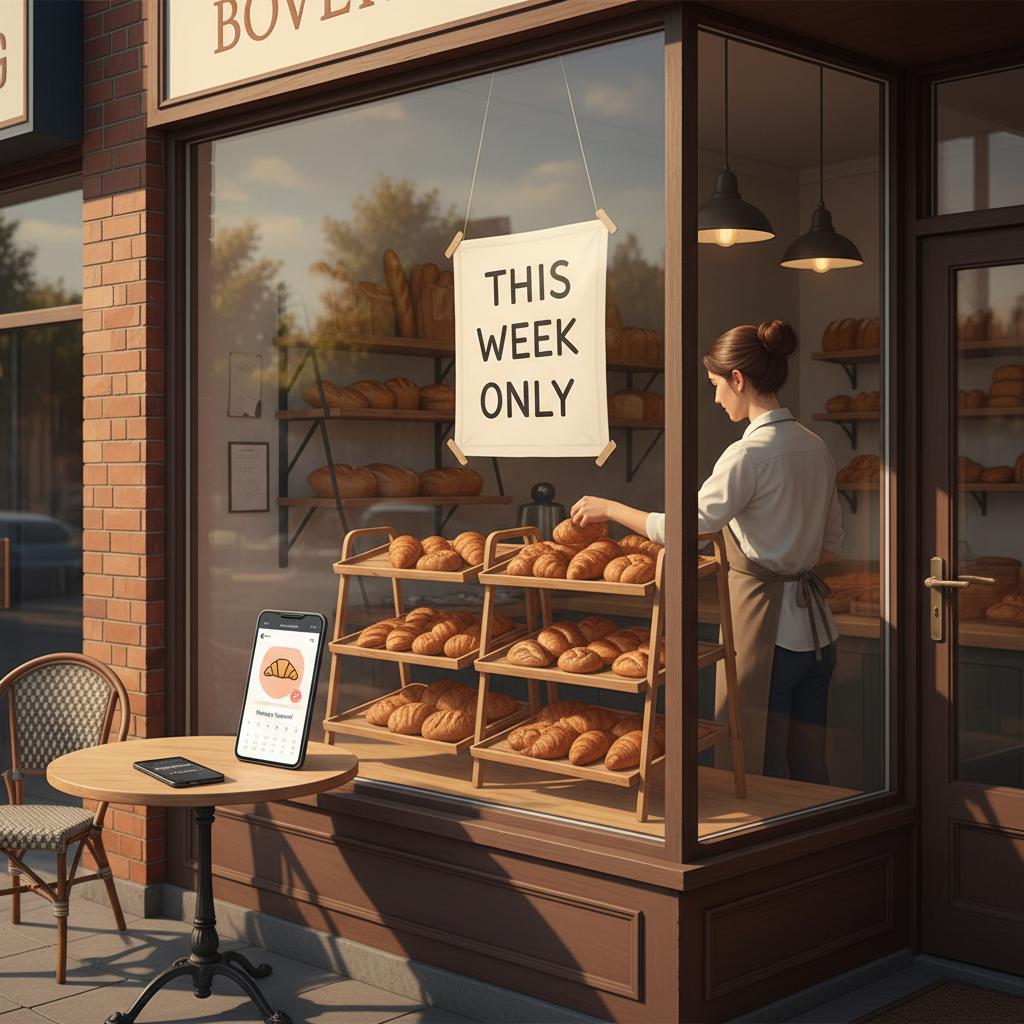
"This week only — 15% off any purchase. Show this sign at checkout. Mon–Sun."
Social post (copy + CTA):
"7 days only: Get 15% off any purchase at [Your Shop Name]. Show this post in store or say '7‑day special' at checkout. Open 9–6. Tag a friend who needs to know."
SMS (short):
"This week: 15% off at [Your Shop]. Show this text in store. Mon–Sun. Reply STOP to opt out."
Email subject line options:
"Only 7 days: 15% off at [Your Shop]"
"Limited time: save this week" (preheader: "Show this email in store")
Staff script at register:
"Thanks for coming in — quick heads up: we’re offering 15% off everything this week. Just show this sign or say ‘7‑day special’ to redeem."
Redemption question:
"How did you hear about the offer? (Sign / SMS / Email / Social / Friend)"
Steal this template: "We help [audience] [outcome] without [pain]. Here's how →"
Tracking template (simple spreadsheet)
Columns: Date | Walk‑ins | Redemptions | Redemptions by channel | Revenue | Notes
How to use:
Baseline: average walk‑ins per day from last 4 weeks.
Offer ROI = (extra revenue from redemptions − cost of promotion) / cost of promotion
Decision rule (example): If average daily walk‑ins increase by at least 40% and the offer ROI is >1.5x, scale the offer next month.
Example: A bakery test that worked (mini case)
A Brooklyn bakery averaged 2 walk‑ins/day in weekday mornings. They ran a 7‑day test: "Buy 1 pastry, get the 2nd half price before 11am." They used the window sign, posted daily photos to Instagram, sent one SMS to 400 customers, and boosted a local post for $25.
Results: Week average went from 2 to 11 walk‑ins/day during the morning window — a 450% lift. Revenue per redemption covered the discount and the $25 ad. They kept the weekday early‑bird offer for the following month and shifted staff hours accordingly.
Local business example: A bakery in Brooklyn moved from 2 walk-ins/day to 11 by posting one behind-the-counter reel each morning.
Promotion budget examples (small, realistic)
Bare minimum: $0 — rely on window sign, staff, and organic social posts.
Low spend: $25–$50 total — boost two posts or run a $5/day local ad.
Modest spend: $100–$300 — target 1–3 mile radius with creatives for peak hours.
Tip: If you pay for local ads, start with very small budgets and compare ad click-to-redemption ratios. Most tests are won by better copy and clearer signage — not bigger budgets.
Practical shortcut: You can build this system manually — or use BrandZilla to stay consistent without hiring a social media manager.
Common problems and quick fixes
Low awareness: Your sign isn’t clear from the sidewalk. Fix: larger type, brighter colors, clear benefit line.
Staff forgets to ask: Print a one‑line reminder taped to the register.
Poor tracking: Nobody tags the booking. Fix: add a single checkbox in the register system for "offer redeemed."
When to scale (and how to do it)
If your decision rule passes, scale by:
Extending hours or adding staff during peak times.
Repeating the same offer every other week for a month to build habit.
Turning the offer into a loyalty entry point (collect email or phone at redemption).
If the test fails, don’t panic. Run a second 7‑day test with a different offer or a different messaging angle. Small tests are cheap lessons.
FAQs
Q: What if I don't have time to post every day?
A: Use two anchor posts (start and midweek) and echo them with a different image or short staff story. Train staff to hand out a printed coupon so you get in‑store reach without daily posting. Next step: schedule two posts in your calendar for launch day and midweek.
Q: Can I reuse old content without looking repetitive?
A: Yes — change the headline and the call to action. Old photos + new offer copy perform well because visuals stay familiar while the message changes. Next step: pick one past photo and write two new captions this week.
Q: Do small businesses need to run timed offers to get customers?
A: Not always, but timed offers create urgency and measurable tests. Use them when you want to know whether price or timing will drive short-term behavior. Next step: pick one slow day and run a morning-only deal.
Q: How long before posting consistently brings in customers?
A: You can see a lift from a good offer in 7–14 days. Consistent content builds trust and repeat visits over weeks and months. Next step: run this 7‑day test, then plan a 4‑week follow up if it works.
Try this 7‑day test when you have a clear baseline and a small team ready to track results. The biggest wins come from clear offers, a single measured goal, and a strict decision rule at the end of the week.
Keep the offer simple, train staff once, and treat the week like an experiment — not a permanent change. If you want a quick way to keep the next 12 weeks consistent, think about building a simple content system so you stop disappearing online.
BrandZilla quietly helps businesses keep that kind of system running without hiring extra staff.
The real objections — answered straight, no fluff.
BrandZilla Editorial Team
SMB MarketingContent Strategy
Practical playbooks written and reviewed by people who actually run content programs for small and local businesses — not generic AI output. Every guide is pressure-tested against what real operators do on Instagram, Facebook, LinkedIn and Google.
Used by 1,000+ businessesLast updated Sep 1, 20267 min read
Get weekly content ideas for your business
Join business owners getting practical, ready-to-post BrandZilla content prompts every week. No spam.