How Local Businesses Build Authority Online: 9 Practical Tactics
If customers choose the familiar brand over you, this guide makes your small business look like the obvious, local authority. Nine specific tactics, templates, and a 30‑day plan.
6 min read
BrandZilla EditorialReviewed by marketing operators· Updated Sep 24, 2026· 6 min read
If customers walk past your door and choose the familiar name because they 'know' it better, you're not alone. Small-business owners say the biggest online problem is being visible and trusted at the exact moment someone decides where to spend money.
You don't need a big budget or an agency. You need a repeatable system that makes your expertise obvious, reduces risk for the customer, and surfaces social proof where people are already looking.
This is a practical playbook — not theory. Read it with a notepad. Each tactic includes exact wording you can copy, a short checklist to implement it in a week, and one 30‑day mini plan to start building authority now.
The simple framework behind every tactic
Start with three content pillars and use one anchor piece per week to feed smaller assets:
Proof (reviews, before/after, case studies)
Process (how you do the job, what to expect)
Personality (team, values, local ties)
If you publish five pieces from one anchor each week, you will be consistent without daily improvisation.
Reality check: Most small businesses post 3x then quit. Consistency beats creativity 9 times out of 10.
9 practical tactics to build local authority (with templates)
Claim and optimize one profile that matters this month
Pick the platform used by your customers — for most local businesses that's Google Business Profile, Facebook, or Instagram. Fill these fields: service list, short business description, hours (including holidays), and at least five recent photos that show real work.
Quick checklist:
Add 5 real photos: workspace, team, finished job, tools, storefront.
Write a 30–40 word business description using this sentence: "We help [audience] with [primary outcome] in [location]." Example: "We help Brooklyn renters fix leaky pipes quickly so they can get back to their day without water damage."
Confirm phone, booking link, and categories are correct.
Make your best customer story a repeatable template
Turn one good job into a short case study: problem, solution, outcome, and proof (photo or estimate). Use this headline: "How we fixed [problem] for [type of customer] in [neighborhood]."
Three-sentence template for a social post:
"[Customer first name] had [problem] that was causing [pain]. We did [3-step fix] and now they have [result]. If you have the same issue, call us — we can be there in [timeframe]."
Quick win: Repurpose one customer review into a 3-post mini series this week.
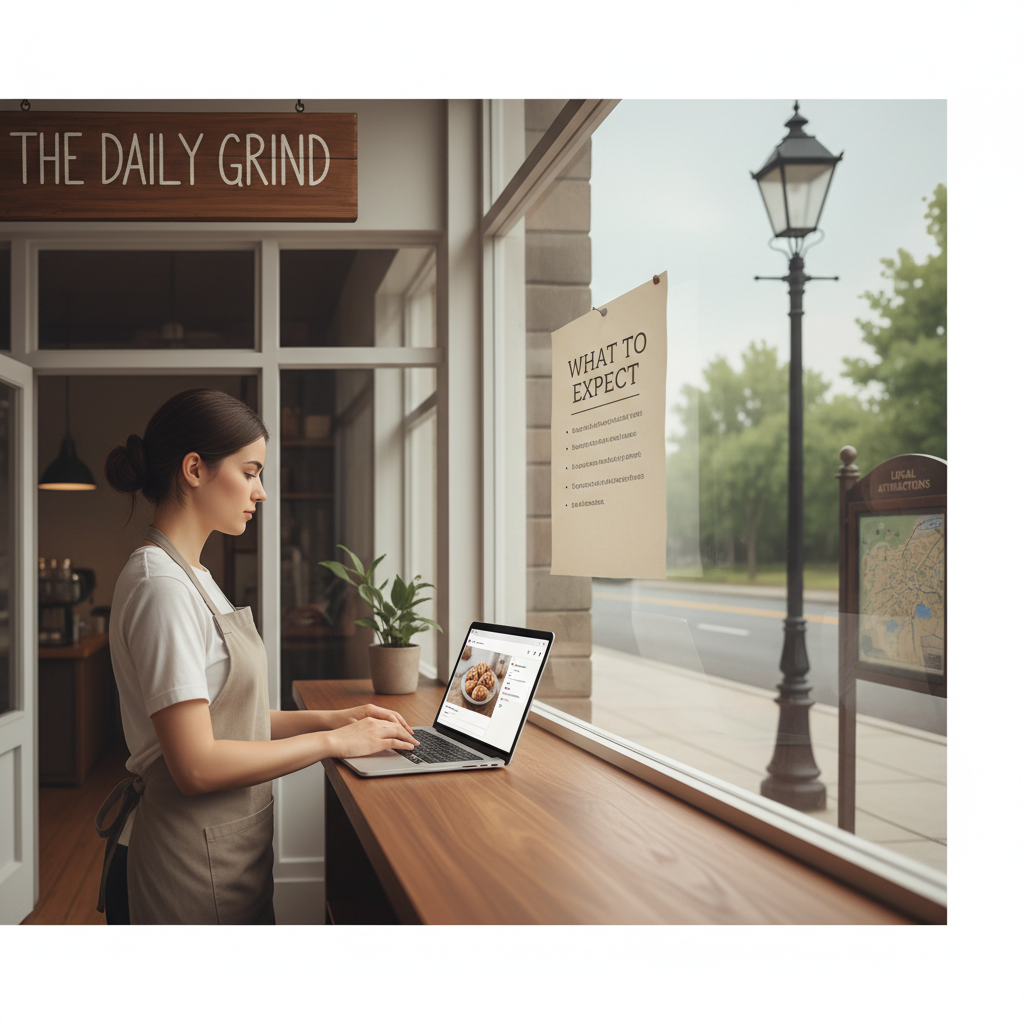
Publish a short 'What to Expect' page or post
This removes fear. Write 300–500 words that walk a first-time customer through the experience, timings, costs, and what you won't do. Use explicit phrases like "no-obligation inspection" and "cleanup included." Link this everywhere.
Exact subhead examples:
Arrival & inspection (what we look for in 10 minutes)
How long the job usually takes
What stays with you (warranty, receipts)
Use local proof where it matters (neighborhood, not just city)
People trust neighbors. Whenever possible, reference neighborhoods or landmarks. "Served the Upper East Side for 6 years" beats "Serving NYC" for local searches and trust.
Mini-example: A locksmith in Park Slope replaced 24 locks in a condo building and posted the story with a photo and the line: "Park Slope condo, Saturday emergency call — back inside 45 minutes." That post led to three neighborhood referrals in two weeks.
Run a simple micro-case study series (5 posts) across channels
Pick one job, document it across five short posts: intro, process, challenge, before/after, outcome + call to action. Post on your profile and pin the best post.
Post templates:
Post 1 (intro): "Today: fixing [problem] at [neighborhood]. Follow for the full before/after."
Post 3 (challenge): "The tricky part: [specific issue]. We solved it by [step]."
Ask for reviews with a tight script and two options
People need prompts. Use an in-person ask and a follow-up text with two clear options (Google review or direct testimonial).
In-person script: "If we did a great job, would you mind leaving a short review? It helps our neighbors find us." If they say yes: "I'll text you a link — takes 90 seconds."
Follow-up text (copy-paste):
"Hi [Name], thanks again today. If you're happy with the job, would you leave a 1-sentence review here: [short link]? Or reply to this message and we'll add it to our website. Thanks — [First name] from [Business]."
Common mistake: Treating Instagram captions like tweets — context outperforms one-liners for local businesses.
Be useful before you're asked (one local resource a month)
Create one short resource that helps locals: a PDF checklist, a short video on seasonal care, or a quick local guide (e.g., "Winter prep for wood floors — 3 steps"). Use it as a small lead magnet or a pinned post.
Exact caption to promote a resource: "Free 2-minute checklist — stop winter water damage. DM 'CHECK' and I'll send it now."
Introduce your team with a repeatable intro format
People hire people. Use this formula for team posts: name, role, one quirky fact, one promise.
Template: "Meet [Name], our [Role]. Fun fact: [quirky detail]. Promise: [what they guarantee on every job]."
Local outreach that actually works (not press releases)
Pick 10 local micro-influencers, hyperlocal Facebook groups, or neighborhood newsletters. Send a short, specific offer: "We ran a free safety check for 12 neighbors last month — would you let us offer the same at [local event] on [date]? We'll promote and handle bookings." Keep the ask small and the value obvious.
Mini-example (30-day plan):
Week 1: Publish the 'What to Expect' page and post the first micro-case study.
Week 2: Ask every customer for a review with the text script and collect 3 new reviews.
Week 3: Post the team intro series and run the 5-post micro-case study across channels.
Week 4: Pitch 10 local groups with the free safety check offer and pin your best social post.
Steal this template: "We help [audience] [outcome] without [pain]. Here's how →"
How to measure authority without vanity metrics
Focus on the actions that move business: calls, clicks to your booking page, requests for estimates, and referred customers. Track these weekly.
Simple tracking sheet columns:
Date
Channel (Google, Instagram, Facebook, Walk-in)
Asset (case study, team post, review)
Leads (calls/messages/bookings)
Outcome (booked/sent estimate/referred)
If a single post brings two bookings in a week, double down on that format.
Practical shortcut: You can build this system manually — or use BrandZilla to stay consistent without hiring a social media manager.
One concrete example — a small clinic's 30‑day lift
Clinic: Oakwood Physiotherapy, single-location clinic in a 35k-population suburb.
Problem: New patient numbers plateaued at 12/month.
Action in 30 days:
Week 1: Published 'What to Expect' page and posted a 5-post case study of a runner's loaded rehab.
Week 2: Asked every patient for a Google review using the exact follow-up text; collected 7 reviews.
Week 3: Posted two team-intro videos and a short local resource: "3 stretches before your run".
Week 4: Pitched the local running club with a free 20-minute workshop and got featured in their newsletter.
Result: New patient bookings rose from 12 to 23 in 30 days. Two of the new patients explicitly said they read the clinic's 'What to Expect' page before calling.
Where people trip up — and how to avoid it
Trying to be on every platform. Pick one anchor and make it great for 90 days.
Waiting for perfect content. People respond to useful honesty, not polish.
Not tracking outcomes. If a post doesn't move bookings after 30 days, stop doing it.
Common mistake: Treating Instagram captions like tweets — context outperforms one-liners for local businesses.
What to do first this week
Publish a 300–500 word 'What to Expect' page.
Ask the next five customers for a review using the text script.
Choose one recent job and turn it into a 5-post micro-case study.
If you can do those three steps, you will start looking like the safer, smarter choice to people who matter.
One last practical thought: authority is built where trust meets convenience. Make the next step obvious and easy — clear call, clear booking link, a short 'what to expect' page — and you'll win more customers without adding complexity.
If you'd rather not DIY the content system, there's a lightweight option that helps small businesses keep this rhythm without hiring a full-time social media person.
The real objections — answered straight, no fluff.
BrandZilla Editorial Team
SMB MarketingContent Strategy
Practical playbooks written and reviewed by people who actually run content programs for small and local businesses — not generic AI output. Every guide is pressure-tested against what real operators do on Instagram, Facebook, LinkedIn and Google.
Used by 1,000+ businessesLast updated Sep 24, 20266 min read
Get weekly content ideas for your business
Join business owners getting practical, ready-to-post BrandZilla content prompts every week. No spam.