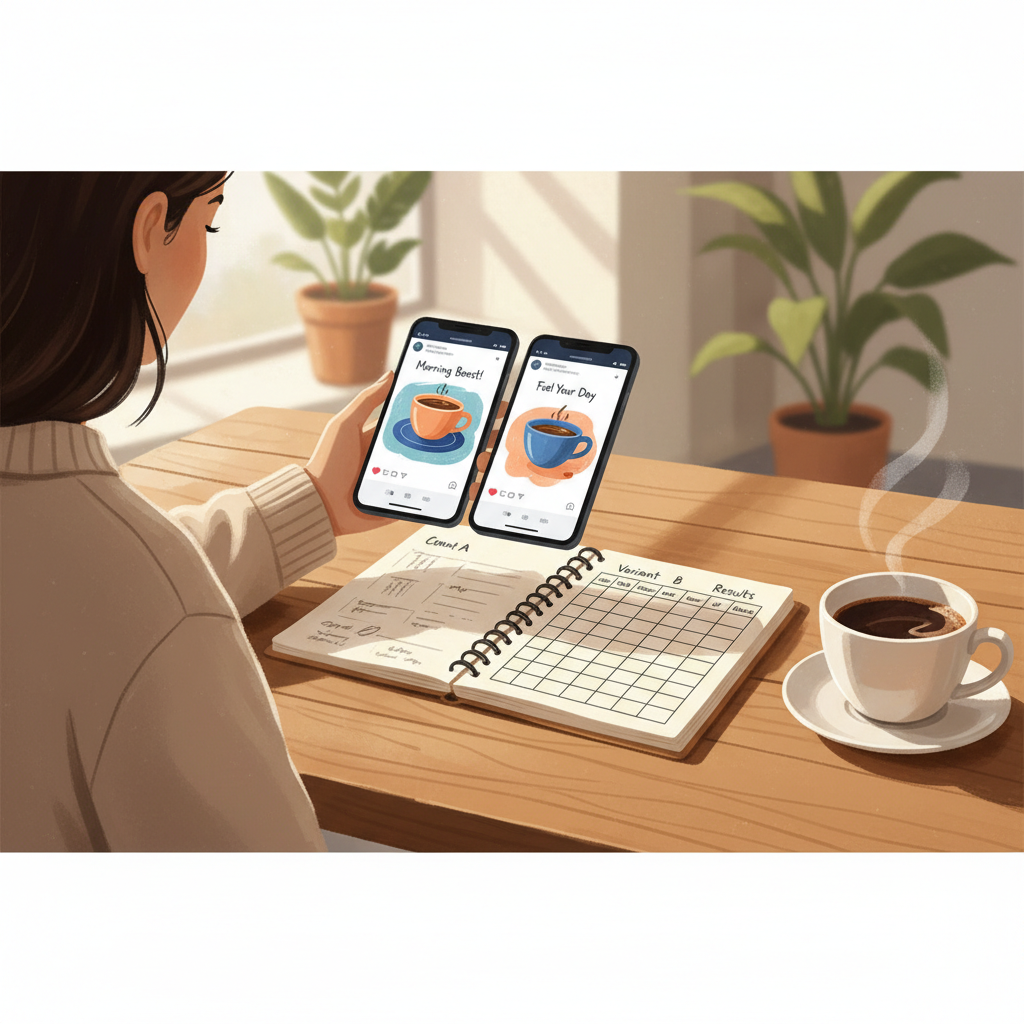
How to A/B Test Social Posts and Short Ads on a Small Budget
A practical 5-step A/B testing plan small businesses can run in two weeks to find which social posts and short ads actually drive calls, bookings, or walk-ins. Includes templates and an exact mini-example.
7 min read
BrandZilla EditorialReviewed by marketing operators· Updated Jul 31, 2026· 7 min read
Open problem
Most small business owners know they should 'test' posts and ads, but the usual result is posting a few variations, seeing nothing, and giving up. Tests often fail because they try to compare ten things at once, measure the wrong metric, or treat a test like a one-off experiment.
You don't need fancy software or big budgets. You need a clear 5-step process, small, measurable changes, and the right way to read results. This article gives practical steps, copy-paste templates, and a short local example you can copy next week.
The simple rule: one change per test
If your headline, image, caption, and CTA all differ, you won't know what moved the needle. Run a single-variable test: keep everything the same and change only one element.
Pick the element you'll test first (headline/caption, image/video, CTA, or offer). Run a small, controlled test for 7–14 days, then decide whether to keep the winner or run a second test to refine.
Reality check: Most small businesses post 3x then quit. Consistency beats creativity 9 times out of 10.
5-step A/B testing plan that fits a small business schedule
Pick the outcome and the metric (what matters).
For organic social: measure calls, online bookings, or direct messages that reference the post. Avoid relying only on likes.
For short paid ads: measure CTR, cost per click (CPC), and cost per result (call, booking, or lead form completion).
Form a clear hypothesis.
Example: "A photo of our owner working will get more click-to-call than a product-only image because it feels local." Make the expected direction clear.
Create two variants (A and B) that differ by one thing.
Use the same caption length, same posting time, and same primary CTA. Only change the image or headline.
Run the test for 7–14 days or until you have a minimum sample size.
For paid ads: aim for at least 300-500 impressions per variant.
For organic posts: aim for a minimum of 50 actions (clicks or messages) across variants; if you get fewer, run the test longer or test on paid placements.
Read the results and decide.
If one variant shows a clear 20%+ lift in your chosen metric, roll it into your next posts.
If results are within a 10–20% range, consider a second test with the next single variable.
What to test first (priority list)
Offer or CTA (book now vs. call vs. message).
Primary visual (owner/inside shot vs. product close-up vs. action shot).
Headline/first sentence.
Social proof element (rating, short review snippet).
Caption length (short vs. 2–3 sentence mini-story).
Quick win: Repurpose one customer review into a 3-post mini series this week.
Exact templates and variants you can copy
Use these to test headline and visual. Keep tracking simple: a spreadsheet with columns: Date, Variant (A/B), Post URL, Impressions, Clicks, Calls, Bookings, Notes.
Sample base caption (for a local HVAC business):
Variant A (owner shot)
Caption first sentence: "We fixed 12 stuck thermostats last week — here's what to check first."
Body: "If your heating feels uneven, call or book a same-day visit. We serve [neighborhood] and often have same-day openings. Call 555-0123 or book online → [link]."
CTA at end: "Call 555-0123 for same-day checks."
Variant B (product/tech shot)
Caption first sentence: "Why your furnace keeps turning off — and the quick fix." (rest same)
Post these at the same time of day (your busiest hour). Track calls and bookings that reference the post or that arrive within 2 hours of the post.
Short ad copy templates (30–40 words)
Variant A: "Local plumber—same day repairs. 4.8★ on Google. Call 555-0123 for fast response." (CTA: Call)
Variant B: "Burst pipe? We arrive same-day. Free inspection with repair. Book online now." (CTA: Book)
Test the CTA (Call vs Book) as a single-variable test later if the visual/hook is settled.
Common mistake: Treating Instagram captions like tweets — context outperforms one-liners for local businesses.
Mini-example — exactly what to do next week
Local example: "Maple & Main Bakery, Brooklyn"
Goal: increase morning walk-ins.
Plan: run a 10-day organic test with two variants.
Variant A: 7:30 AM post with behind-the-counter reel (30s) of baker pulling croissants. Caption: "Fresh croissants out now — grab one before 10AM. Reply 'croissant' and we'll hold one for you."
Variant B: 7:30 AM post with product-only still photo of croissants. Caption identical.
Tracking: staff note on receipts whether customer said 'grab a croissant' or used the reply channel. Week 1 baseline: 2 walk-ins/day from social posts.
Result after 10 days: Reel variant brought average 11 walk-ins/day on posting mornings vs. 2 for the still photo. Winner: behind-the-counter reel.
How to scale: turn the winning reel into a short paid post (boost) for $20/day for two days targeting a 1-mile radius and compare calls/bookings.
Local business example: A bakery in Brooklyn moved from 2 walk-ins/day to 11 by posting one behind-the-counter reel each morning.
How to read messy results (the real world)
If both variants show similar likes but different business outcomes (calls/bookings), trust the business outcomes. Social metrics are noisy.
If neither variant moves the business metric, test a new variable (offer or CTA). Don't blow the budget testing visuals that don't change behavior.
Low sample size? Run a paid micro-test (small boost) to reach 300–500 impressions quickly.
Quick checklist before you press post
One test at a time (one variable changed).
Same posting time and caption length.
Clear primary metric and minimum sample size.
Recording method for business outcomes (call notes, booking source, or in-store mention).
Run 7–14 days unless you hit your sample size earlier.
Practical shortcut: You can build this system manually — or use BrandZilla to stay consistent without hiring a social media manager.
Small-budget paid tests — how to keep costs low
Use local boosts on Facebook/Instagram targeting a 1–3 mile radius with $10–20/day for 2–3 days per variant.
Pause campaigns early if a variant has a clearly worse CTR after 24–48 hours.
Optimize to the simplest conversion: clicks to call or a short booking form (fewer fields = lower cost).
When to stop testing and roll winners into a system
If a variant shows a stable 15–25% improvement in your main metric across two runs, make it the baseline for future posts. Then use the next test to refine another variable (e.g., CTA after visual).
Measurement shortcuts small teams can use
Set up a simple spreadsheet and a shared Slack channel for staff to note incoming calls/messages linked to posts.
Use unique short links (bit.ly) for Book links so you can attribute clicks.
Ask callers a single quick question: "Did you see us on Instagram/Facebook today?"
FAQ
Q: What if I don't have time to post every day?
A: Schedule one test post per week and track for two weeks. You can condense tests by using small paid boosts to reach sample size faster. Next step: pick one variable and schedule two posts this week.
Q: Can I reuse old content without looking repetitive?
A: Yes. Turn a past high-performing post into a new variant by changing only the CTA or visual and running a fresh test. Next step: pick one post and swap its CTA for a week.
Q: Do small businesses actually need a content calendar?
A: Yes, a simple calendar keeps tests organized. You only need one row per planned test with the variant details and tracking columns. Next step: make a two-week calendar with one test per week.
Q: How long before posting consistently actually brings in customers?
A: You can see measurable changes in 1–2 weeks from well-run tests. Bigger, sustained growth comes from repeating winners and scaling paid boosts over months. Next step: run your first 7–14 day test this week.
Q: Can I test both organic and paid at the same time?
A: Yes, but keep them segmented. Run the same variant organically and with a small paid boost, and compare paid-only results to organic-only results in your sheet. Next step: add a column for Paid/Organic in your tracking sheet.
Small, steady tests beat creative chaos. Start with one clear question, run a single-variable test for 7–14 days, and track the outcome that actually pays the bills (calls, bookings, or walk-ins). Use the templates and the mini-example above to run your first test next week.
If you want a lightweight tool to keep this process consistent, BrandZilla offers a content system built for small teams and local businesses.
The real objections — answered straight, no fluff.
BrandZilla Editorial Team
SMB MarketingContent Strategy
Practical playbooks written and reviewed by people who actually run content programs for small and local businesses — not generic AI output. Every guide is pressure-tested against what real operators do on Instagram, Facebook, LinkedIn and Google.
Used by 1,000+ businessesLast updated Jul 31, 20267 min read
Get weekly content ideas for your business
Join business owners getting practical, ready-to-post BrandZilla content prompts every week. No spam.